© Cine Candela
A homeless man is sitting on the sidewalk, showing the camera his tattoos. This one’s for his parents; this was where he was shooting up; these two snakes are a prison thing. And this one, on his fist, is his son’s birthdate. Same birthday as his own. Underneath is the date his son hanged himself, nineteen years later. Exactly on his birthday. On both their birthdays. The man manages to keep it together, just, but his face is a torrent of emotions. Fear, anger, sadness, despair. The filmmaker cuts.
Next scene. Another man is lying down, his hand on his wife’s pregnant belly. They’re living out on the streets. What will happen to this child? The camera stays close. The parents are talking softly. Some soothing film music calms our nerves. The man is dreaming of opening a soul food restaurant. And why not? There are none in the neighbourhood, and he has experience. “I didn’t marry you for the money, remember that,” she says. They kiss. It’s a sweet scene, breathing a sense of hope.
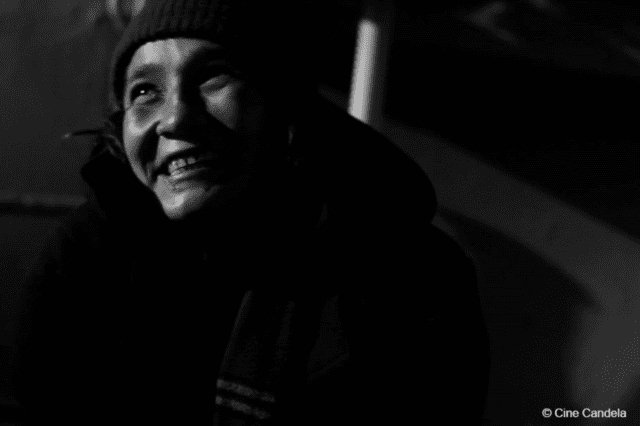
No one emotion dominates this portrayal of homeless people in the US-Mexican border towns of El Paso and Ciudad Juárez. There is no overwhelming sadness, depression or fear. If there’s one sense that pervades Dirty Feathers, it’s curiosity. Director Carlos Alfonso Corral, presenting his feature-length debut, is clearly interested in his characters, having taken his time to gain their trust, sit with them, walk with them and listen to their stories. Their own stories, about themselves. Of course, maybe the homeless man will never actually start his soul food restaurant. Maybe he has been talking about it for years without getting anywhere. There’s no way to know – but that’s not the point. The point is, he’s an interesting person to listen to.
And he’s beautiful. At least, through Corral’s lens. Corral shot his film in gorgeous black and white, finding beauty in an outside shower in a railway yard or the ritual burning of some worn-out shoes. As with the sporadic music, the black and white helps to highlight the inner lives of his characters, dissolving their chaotic surroundings and belongings into shades of grey, and foregrounding their emotions, personalities and conversations. Focussing on who they are, not what they are.
Corral doesn’t judge. It’s like one man says, smiling to the camera with, for some reason, angel wings attached to his back: “There is madness to my method. The question is, is there method to my madness? Now you are going to be the one that defines that, in your own individual perception.” It’s up to us to judge – or decide we don’t need to.
At the same time, Dirty Feathers is a highly structured film. Not just by shooting in black and white and occasionally using emotionally charged music, but also by weaving different characters’ stories into one harmonious whole, hardly ever interrupting the flow of the film, which is guided by the rhythm and tempi of his characters’ lives. There’s indeed a musical aspect to the film’s structure, with some characters regularly returning and others, like the veteran talking about his time in the Navy, who is only included in one scene.
The musicality continues with Corral’s alternating monologues and dialogues, often about the big questions in life. These might very well have been instigated by the filmmakers, but they do not feel any less spontaneous. Just as the words of a young woman, reflecting on life on the streets with remarkable calm and concern for others, do not feel any less heartfelt by having been structured into a recurring voice-over, like a chorus. “All these material things? You ain’t gonna be able to take them up to heaven.”
It’s this combination of intensely intimate portrayal, up close and personal with a handheld camera following smoothly and respectfully, and a highly structured and systematic directorial approach, which recalls the work of Roberto Minervini, for whose films Corral worked in the camera department (from the 2013 Stop The Pounding Heart onwards).
In the press notes of Dirty Feathers, Corral speaks highly of Minervini, stating that his ‘sensibility, compassion, curiosity, and his humanizing approach toward filmmaking have left a lasting impression on me. I have learned how to face and reflect on my own prejudices, guilt, and shame. And by his example, I have learned how to embrace and share my vulnerabilities, pain, and joy with others in order to create meaningful human connection. The ethics of his style of filmmaking creates an environment that is deeply collaborative, cultivates camaraderie and is cathartic for all involved. For Roberto, and now for me, the process of making a film will always be profoundly more important than the result.’
The press notes also explain that Corral, who is Mexican, himself spent his childhood in El Paso. ‘Hence, I am also American – a “Chicano” to be exact.’ In the US, he felt treated as a second-class citizen. ‘I have childhood memories of the police raiding our home, their goal was to destabilize our well-being, inculcate a culture of fear in us, and make us feel that we didn’t belong’, he writes, suggesting this is why ‘I relate with, and care for those living at the margins of US society, stranded in border towns, where everything feels so distant from the rest of the country.’
This personal connection helps explain why Dirty Feathers doesn’t feel like reporting, analysis or observation, but like hanging out. It’s a documentary which is at home with the homeless.
USA/Mexico, 2021, 75 minutes
Director: Carlos Alfonso Corral
Production: Pulpa Film (USA), Cine Candela (Mexico)
Producers: Carlos Alfonso Corral, Roberto Minervini, Denise Ping Lee, Denise Dorado
Sound: Bernat Fortiana
Sound: Mixing Thomas Gauder
Cinematography: Nini Blanco
Editing: Cameron Wheeless
With: Brandon Ashford, Reagan Ashford, Ashley Mistral, Nathan Thomas, Carlos Gutierrez, Felipe Morales, Maria Sabina, Jimbo, Tiny