It all starts weirdly enough, with the urban legend that in 1939 Goebbels manipulated an international conference into changing the frequency of the A above middle C, used for tuning an orchestra, from a pleasant 432 Hertz to a discomforting 440. His aim: to make the population subconsciously more susceptible to violent Nazi propaganda. 440 is the standard we are still using today. Does that mean our A is a Nazi-A?
This suggestion rubs American musician Laurie Amat up the wrong way. Could the music she loves and live for have been manipulated – even worse, still be manipulated, by Goebbels? She decides to investigate.
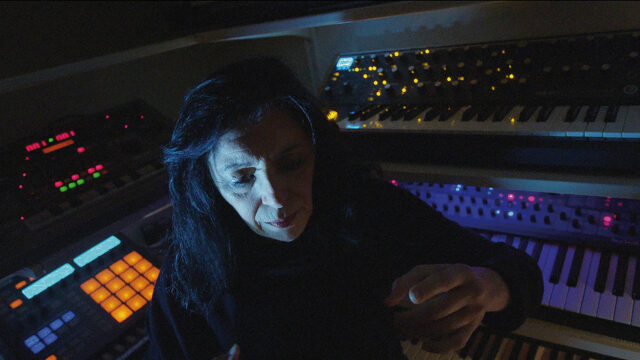
At first, her inquiry feels rather quirky (hence the wacky title). Amat is a distinctive character with an emphatic way of speaking and walks around town with a shotgun microphone and an old-fashioned tape recorder. There are lots of quick close-ups and short soundbites to get us in a playful mood, alert to the sounds around us. Amat loves the clicking sound of a walking dog’s nails. And she adores the sound of champagne, from the sizzling to the bubbles popping. She even enjoys how the word gonorrhoea sounds, savouring each syllable. Go-nor-rhoe-aaaah….
Slowly however, things start to turn more Herzogian. Like Werner Herzog’s documentaries, Oh, it Hertz! introduces idiosyncratic characters with strong personal connections to the subject. There’s the fanatical YouTuber who posts videos on the Nazi theory. He explains the general idea and admits his uncommon views make him something of an outcast in his family who, like most of us, are “brainwashed”. Those who have been brainwashed will call him an “asshole”, those who haven’t call him a “genius” he says – laughing rather like Tom Cruise in that leaked Scientology video.
This seems to straightaway discredit the 440 theory. But Amat and Jensen take a broader approach. Leaving the Nazis aside for a while, they start to investigate the importance and meaning of sounds in general. Amat talks to deaf Scottish percussionist Evelyn Glennie, who describes how she feels vibrations through her hands, belly and chest. She is ear-deaf, we should rather say, because her experience of sound through other organs cannot be considered anything else than hearing. Enabling her to become – although the documentary doesn’t dwell on it – a world-famous and Grammy-winning artist. Just as Amat’s own history of performing with famed avant-gardists The Residents isn’t dwelled upon – although there are references throughout, including repeated use of the song Ginger’s Lament.
I mentioned Werner Herzog. I think ‘quirky Herzog’ characterises this documentary pretty well. A good Herzog documentary combines the weird with the wondrous; the far-out with the philosophical; and the scientific with the sentimental. All these qualifications apply to Oh, it Hertz! as well, with the meandering approach slowly revealing itself as a cleverly constructed argument. From arguing how sounds and music can touch us directly and emotionally, bypassing the rational mind (a fact generally acknowledged), via the effects certain sounds can have on matter (demonstrated by Hans Jenny’s wonderful experiments of the 1960s), to the physical effects on our bodies of certain sounds, positively and negatively. And suddenly, without realizing at first the argument had been made, I had to admit the Nazi theory of manipulating frequencies to affect physical bodies and subconscious minds seemed a little less far-fetched.
The documentary points to other military sound experiments during World War II – just think of the sirens attached to German Stukas. Later, in Vietnam, the Americans introduced the mind-boggling Operation Wandering Soul, in which loudspeakers attached to helicopters simulated the voices of dead Vietnamese soldiers wailing at their comrades below (and also played Arthur Brown’s Fire). A project, as the filmmakers note, that inspired the famous Valkyrie scene in Apocalypse Now (Francis Ford Coppola, 1979).
But if sounds and music can hurt us, can they also cure us? In the film’s most moving segment, musician and sound designer Yoko Sen convincingly argues they can. When she had to spend time in hospital, the many intrusive sounds, from machines beeping to doors slamming, bothered her musician’s ears. She started to wonder about their effects on people’s health. One striking example from her subsequent research was that the combined sounds of the heart monitor and the bed exit alarm form what in medieval times was called the Devil’s Interval – a sound so dissonant that it was actually banned by the Catholic Church. In the documentary, Sen gets to present her findings to a room full of developers at a research facility for medical equipment. But her most incisive question concerns us all: “What is the last sound you want to hear before you die?”
You’ll have to watch the documentary to learn the answer to the mystery of the 440 Hertz. But ultimately, that’s not what Oh, it Hertz! is about. The film is a celebration of listening. With great sound design by Øyvind Rydland, it creates a heightened sonic awareness. Like when Amat drives her car through a carwash and closes her eyes – and the filmmakers join her by turning the picture to black. Suddenly we’re paying attention. Without visual distractions, the carwash turns into a wonderful and even sensual symphony of water and mechanics, slapping and brushing, pulsing and splashing. A feast for the ears. With, as far as I know, absolutely no Nazis involved.
Norway, 2021, 90 minutes
Director Gunnar Hall Jensen
Production UpNorth Film
Producer Christian Aune Falch, Ingrid Galadriel Aune Falch, Torstein Parelius
International sales Syndicado Film Sales
Script Gunnar Hall Jensen, Kristian Stangebye, Elin Sander
Cinematography Måns Berthas
Editing Erlend Harr Eriksson
Sound design Øyvind Rydland
Sound Kristian Stangebye
Music The Residents, Hank Williams, Richard Strauss
With Laurie Amat, Evelyn Glennie, Yoko Sen