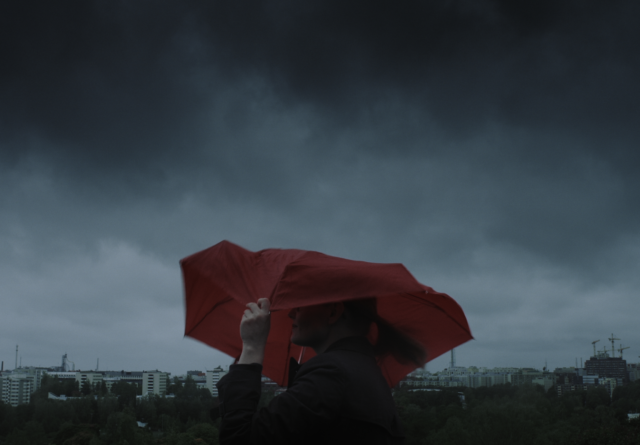
It is science on the level of a dream. Making it rain in the desert. Finnish meteorologist Hannele Korhonen, protagonist of Tuija Halttunen’s documentary How to Kill a Cloud, has made it her life’s work to help bring such dreams closer to reality. Talking about her personal drive to use science to understand the world, to help others understand the world and to improve society, her commitment is palpable. Now, a $1.5 million grant by the United Arab Emirates offers an opportunity to implement her rain enhancement research on a much larger scale – one that, for her field, has not been possible for a long time. She applies and is accepted.
But the possibility of maybe creating rain in the desert also raises moral questions. At the beginning of the documentary, Korhonen shares her doubts if human beings should really want to control the weather. If “there is beauty in chaos”, as she asserts, could trying to control chaos be a mistake?
Director Tujia Halttunen (Heaven and Earth, 1995) makes her position clear from the start. If the title didn’t tip you off, then the opening quote from Goethe’s Faust will: ‘Cursed be the high ambition wherewith the mind itself deludes!’ This way, Halttunen marks Korhonen’s working for the UAE as a Faustian deal. In the end credits, she dedicates the documentary ‘to my beloved daughters (…) – the generation who bears the consequences of our choices’. The story is thus framed as a cautionary tale: our technological hubris threatens future generations.
All this has little to do with the involvement of the Emirates, however. Early on, Korhonen does admit UAE’s sharia law caused her concern, especially the execution of adulterous women. But she accepted anyway, considering outsiders often have stereotypical ideas about a country. Once in the country, she feels treated very well and points to the female leader of their project as an example of more progressive attitudes. No further mention is made of the Emirates’ abysmal human rights record, as the focus of How to Kill a Cloud lies on the moral risks of geo-engineering as applied within in any country.
These risks are mentioned by scientist Korhonenbut eventually dismissed, as she is convinced the UAE geo-engineering project will be of real scientific value. But a God-like voice-over which accompanies the film (sometimes speaking as a kind of external conscience to Korhonen, addressing her directly) does not agree. This voice waxes poetically about the function, meaning and beauty of clouds, suggesting in an almost religious way that they are (or should be) outside of the realm of human engineering. With many images of clouds drifting by, the slow-moving and somewhat repetitive documentary returns time and again to the beauty of nature as a counterpoint to the scientific work being done.
The film is set up in such a way that we expect Korhonen, who has parked her moral doubts in order to expand her scientific work to a scale she never imagined, will eventually face Faustian repercussions. In other words, that the Devil will reveal himself and she will, most probably too late, realise she has sold him her soul. This however – spoiler alert – doesn’t happen. There are some discussions between her science team and the funders, who push for more practical applications to result from the three years of fundamental research – but that’s hardly a surprising development and there is no indication the science itself is in any way compromised. As far as I can tell, based on the film, Korhonen’s position doesn’t fundamentally change during the project – indeed, afterwards she applies for the next instalment of UAE’s rain program.
Instead, Halttunen’ almost dreamlike commentary invites viewers to reflect personally on what clouds mean to them and what dangers such a project might carry. Most of the questions raised by Korhonen and Halttunen are not debated or answered, including ones like ‘if the rain falls here, does that mean it won’t fall somewhere else?’ or whether a country actually owns the clouds above their territory. Halttunen also points to the military use of weather control, when the American Operation Popeye in Vietnam attempted to extend the monsoon season, which resulted in an international treaty against weather warfare – which UAE never signed. But no executives are interviewed about possible military intentions.
However, most questions Halttunen raises are not scientific or militaristic. The tone of the voice-over is predominantly poetic, with moral questions left floating for the contemplation of the individual viewer. More than a scientific or political argument, Halttunen poses a poetic question, one which maybe can’t even fully be put into words, but is reflected in the clouds themselves. As she told Business Doc Europe, Halttunen feels connected to them in a fundamental way: “I strongly feel that I am part of this world in physical levels in many ways. Clouds have a life span like we do. We can see a summary of our choices during our lives in those clouds.” Instead of a Faustian deal, Halttunen offers us a Finnish dream.
Finland, Denmark, 2021, 77 minutes
Director Tuija Halttunen
Production Wacky Tie Films
Producer Pasi Hakkio, Ulrik Gutkin, Niina Virtanen
International sales Rise and Shine World Sales
Script Tuija Halttunen
Cinematography Ville Hakonen
Editing Jussi Sandhu
Sound design Kristian Eidnes Andersen
Music Kristian Eidnes Andersen
With Hannele Korhonen