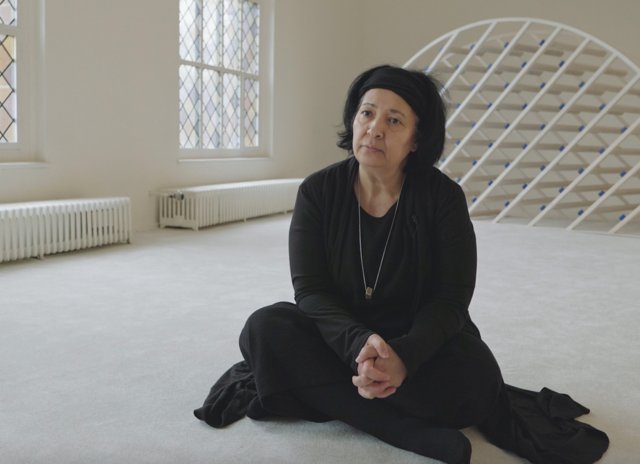
Female imam, feminist and lawyer Seyran is an absolute star whose strength, wisdom and compassion need no kind of adornment. Just watching and hearing her puts you on the edge of your seat, eagerly awaiting her next words.
In Özkal Lorentzen’s film Ateş talks about her childhood spent in poverty and societal captivity. How she left home at eighteen to study law to help women escape their violent husbands and families, just to get shot at the age of 21. How she rose to fame as a feminist, female imam and human rights activist, only to have a fatwa issued against her, which is why she has been living under police protection since 2006.
How she thinks about what this world needs, a progressive Islam, embracing sexual and gender equality, with room for everyone. And what she has been doing to get there, writing her book ‘Islam Needs a Sexual Revolution’, starting a progressive mosque, initiating conversations with persecuted Muslims from all over the world.
Filmmaker Nefise Özkal Lorentzen does let Ateş do a lot of talking, lying on her back watching treetops reaching for the sky; in her mosque; at a table with her mother and sister; visiting sites attacked by terrorists in Madrid and Oslo and other settings. Lorentzen doesn’t choose a chronological approach so the timeline can be a bit confusing at times. The different footage we see is clearly from different years: in some her hair is black and long, short and black or short and grey.
The film sways from topic to topic, with seemingly random attempts at artistry – at one point we see multitudes of Ateş and her nephew walking around in circles in the mosque, her words echoed in other languages. Or a staged scene where Ateş is sitting at a table communicating silently with four empty chairs, while in voice-over we hear the original audio of Muslim prostitutes being interviewed by her.
For me, this artificiality detracts from the totally authentic person the German/Turkish activist is. And the music accompanying some of the more dramatic scenes can also lessen the impact – the inherent drama of the documentary doesn’t need underlining of this kind.
That said, there is enough to enjoy, marvel at or be touched by in Özkal Lorentzen’s film. The documentary opens with Ateş reading from a fist-thick file, containing death threats by conservative Muslims she collected over the years. The word she’s most been called most is ‘whore’, which to her is a clear indication of the overt sexual and gender conservativism of Islam and its need for reform. She jokes about it, but in another scene we see her leaving the house for the mosque where she’s leading a prayer: with four plain cloth officers and a support vehicle accompanying her.
Like all women breaking away from patriarchal chains, she’s paying a high price. But it doesn’t stop her from doing what she does: spreading compassion and awareness in order to create unity and a support base for the progressive Islam she advocates.
She wants Muslims to show a different face from the violent one that always captures attention. That is why she visits the sites where terrorist attacks took place, like the train station of Atocha in Madrid, where 193 people were killed by bombs inside the station (as shown on shocking CCTV-footage). “The only way to fight the political Islam is through Islam,” she says. And she talks to parents of a girl who died in the horrific slaughter of young people at Utoya in Norway. She breaks into real tears, holding onto the mother for comfort.
She even flies to China, hoping to speak to female Uyghur imams about reform. These imams, we’ve learned earlier, may seem progressive, but are conservative at heart. They watch footage of Ateş leading a prayer in a room filled with both men and women, and hugging the man after the ceremony. The female imams are shocked: that is not what the Quran says! Unfortunately, the Chinese government intervenes when Ateş is in China – the conversation she hoped for will not take place.
It would have been insightful to have learned a bit more about her family (she has a few older brothers who are not mentioned, which is interesting as older brothers are particularly influential in Turkish families).
Ultimately, the whole film is testament to Ateş’ unstoppable drive for equality through a progressive Islam. “I am not fighting against anything, I am fighting for things”, she says. She more than deserves a documentary and despite some flaws, this one does her justice and gives you a clear idea of the kind of brave and determined woman that she is. One with a healthy sense of self-mockery – the very last scene (shot from above) shows her in her bathing suit in the water, with her hands spread out like a crucifix. A martyr for freedom, but very much alive.
Director Netfise Özkal Lorentzen
Producer Jorgen Lorentzen
Cinematography Anders Hoft
Editor Morten Haslerud
Composer Simon M. Valentine
Sound design Andreu Jacob
Sales DR Sales, Kim Christiansen