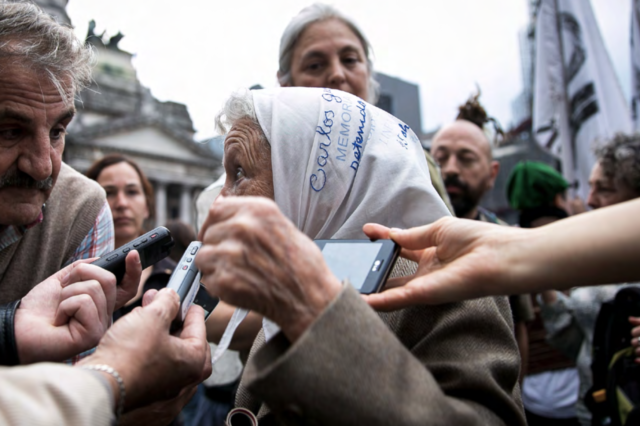
As director Jayson McNamara underlines, It is impossible to overstate Nora Cortiñas’ prominence and importance within contemporary Argentina and across Latin America. She is an internationally recognized figure in the field of human rights who, since the Mothers of Plaza de Mayo’s protests of the late 1970s, has regularly spoken at major global human rights forums including the UN and the OAS. Her most recent focus has been on putting an end to punitive and dangerous abortion laws in Argentina.
The project’s production notes further stress how “Nora’s integrity and conviction, as well as her softer qualities like her compassion and warmth, remind us of the matriarchs in our own families and mirror the increasingly popular approaches of emerging women leaders around the world. She demystifies protest, making activism seem like an accessible and natural expression of democracy.”
The film will present two narrative arcs in parallel, McNamara points out, one which tells the historical story, the other emphasising Nora’s continuing and essential activism. “This is not a woman who’s caught in the past, in the sense that [her story] has become so much more than just her son’s disappearance or participation in the Mothers of Plaza de Mayo who were fighting the dictatorship. She’s become so much more than that. She’s really, I would argue, probably the most respected voice, in a political sense, in Argentina. She’s kind of the godmother of democracy…So we want to try and move quite quickly through the historical arc to really get into more poetic space, which is portraying Nora’s activism as kind of a way for her to vindicate her son and kind of keep his legacy alive.”
McNamara got to know Nora when working on his previous documentary Messenger on a White Horse. The production notes state how the pair share a unique friendship that stems from their initial encounters at LGBTQ+ demonstrations – a cause which Jayson identifies with and which he covered as a reporter at the Buenos Aires Herald.
“I think part of the strength of the film [Norita] is the fact that by the time I turned the cameras on, she and I had actually become friends. She’s a very, very lovely, fun woman,” the director says.
“Nora supported a push here in Argentina to legalize abortion,” McNamara continues of how the film has developed over the past three years. “It was the first major push for reform and it’s since been legalized at the end of last year. So we were able to showcase Nora’s participation in the feminist movement… She’s involved in countless human rights and economic rights struggles. She’s been very active in opposing speculative foreign debt practices. She’s spoken out against the IMF. She’s involved in indigenous land rights, gay rights, workers’ rights. She’s involved in so many things…And it was really interesting to see the crossover between a woman whose political identity is very much tied to her motherhood and this idea of motherhood being a very political space, so to speak, in Argentina.”
The project is currently in post-production. Budgeted at US$550k, producers Rebecca Bennett and Daniel Joyce are looking to raise an outstanding US$250k. (Funders so far are Schoellkopf Family Foundation, Fundación Rosa Luxemburg, HECho en Claypole, Ni Una Menos (Argentina’s “Times Up” group), John Flynn Family Foundation (USA), Mecenazgo Buenos Aires City (Local Arts Fund), Fondo Nacional de las Artes (National Arts Fund), director/producer contribution and an AIDC pitch prize.)
At Sunny Side Bennett and Joyce are looking for streamer or broadcast sales as well as a sales agent and distribution deals. An early 2022 delivery is expected.
“Most of the disappeared were persecuted because of their political activism,” McNamara distils the essence of his film. “So there’s this nice idea of intergenerationality. Nora picks up the baton of her son and as she approaches the end of her life, she’s finding ways to engage a new generation, and ensure that the past doesn’t repeat itself.”