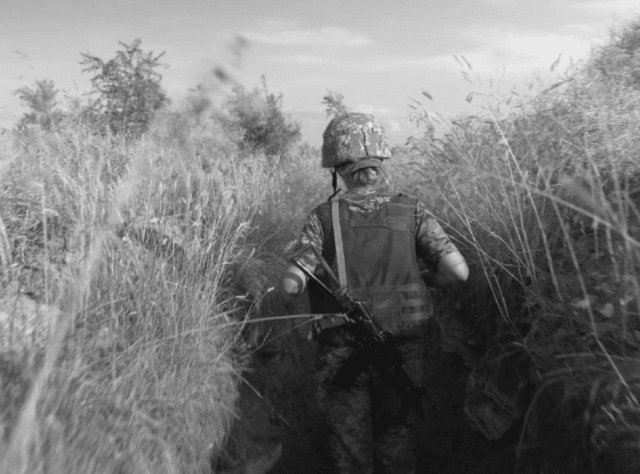
In the opening shot of Loup Bureau’s documentary Trenches we follow a soldier as he (or she) descends into a trench, à la Sam Mendes’ 1917, and walks through its serpentine passages, accompanied by sombre orchestral notation, encountering fellow soldiers as they fix weapons, prepare food, or flash their torchlights.
The film comprises a 3-month chronicle of life during wartime, much of which is spent in this roughly hewn (and continually extending) subterranean environment whose roofing is constructed out of the most elementary of materials which offer scant protection from the weather, let alone from enemy shells.
Bureau is documenting the ongoing war in the Donbas region of Ukraine, referred to in the film as “the last conflict on European soil,” in which conscripts are fighting Ukrainian separatists supported by Russia. As in the fields of Flanders and Northern France during the First World War, battle is engaged from a distance, via shelling, machine gun and sniper, and the enemy is hidden behind hillocks or gun posts, rarely venturing out onto open ground or no-man’s land.
The film follows a handful of soldiers within a unit of 300 men – and one woman, colloquially known as Persephone, the Queen of the Underworld. While far from old, she is nevertheless of an age to be mother to some of the conscripts who, like her sons at home, play video games on their phones as they await battle.
“There’s a lot of women hired in the army, but usually they are not on the front lines,” director Bureau says of his good fortune in encountering Persephone. “I didn’t know her before I came, so of course when you see a brigade with 300 soldiers and one woman, you cannot not show this.”
It may be Bureau’s first documentary, but he is a seasoned war reporter who was in the past incarcerated for 50 days in a Turkish prison on terrorist charges after filming Kurdish militia. Nevertheless in the making of Trenches he was at times terrified, such as when mortars rained down from enemy lines.
“These moments were very scary because these shelters, they are made of wood and basic materials,” he says. “They [the soldiers] do it themselves, the shelters or some of the bunkers. So we know that if a mortar falls at the ‘good’ place at the ‘good’ moment, they can explode the shelters…I don’t like these moments, because it’s a lot of risk and I’m not a particular fan of this.”
Likewise, there are moments when he must film in plain view of the enemy, and take flight accordingly, camera in hand, remarkably retaining the professionalism to record broadcast-worthy material. “That was actually a very dangerous part because when you’re not in the trenches, that’s the moment you are the most vulnerable,” he says. “So of course it was more risky then…there were some moments which were really scary for me, even if I covered a number of conflicts before.”
He adds of his relationship with his subjects: “When you are realizing a movie about the war, you have to gain trust. It takes time, and it’s all about the sensitivity of the approach that you have to someone… What is difficult in the war field is that these people are facing death basically. So it’s very intimate.”
Bureau points out that it isn’t just love of country that is delivering the soldiers to the frontline, but also poverty.
“It’s actually very well-paid to be a soldier right now, it’s about 600 euros per month. And the average salary in Ukraine is 300 euros,” he explains. “At the very beginning of the war, there were a lot of patriot soldiers. There were a lot of people who will hire themselves [out] because they wanted to protect the country and these things, but now that the war has been lasting for seven years, more and more people are coming from all backgrounds and they just want to have a good pay. Of course they are patriotic, but they are not involved in the same way as the others.”
An exception to this is a Falstaffian man mountain referred to as The Beard, who has survived the whole war and exudes a veteran’s authority, despite not being an officer. He does, however, give the orders. He is also in no doubt as to why the conflict is allowed to continue. Oil and money is at the root of matters, he says. “The Russian federation is pulling the strings. EU politicians are powerless assholes. Spineless bitches.”
The film’s aesthetics are informed not so much by other documentaries as by a handful of classic Russian fiction features, such as Ivan’s Childhood by Andrei Tarkovsky. “I try to do something different from what I saw in other documentaries,” says Bureau. “There are a lot of very nice documentaries but somehow they focus [so much] on the physical aspects [of war] that they forget somehow to show what is it for soldiers to live in this environment, to live in a war zone.”
“That’s what it is about in this unit in the trenches,” he continues. “All war filmmakers or war journalists, they know that actually, when you go to the front lines, you spend a lot of time doing nothing. You spend a lot of time waiting for things, and that the moments of violence, the physical war only accounts for 5% of the time…and I wanted to take a look back at this, to try to somehow find the vision, to find a way to explain this.”
Trenches is sold by Films Boutique.