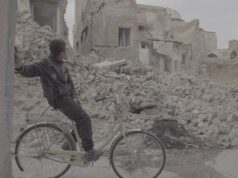
Andrei Kutsila’s powerful, moving and engrossing film When Flowers Are Not Silent looks at the aftermath of protests in Belarus against the country’s long-standing leader Alexander Lukashenka – who in 2020 claimed more than 80% of all votes – after the European Union, local opposition and a large part of the population called foul on the election results.
Seen from the perspective of a series of women caught up in the protests in different ways (the film is dedicated to Kutsila’s sister and “all of the brave women protesters of Belarus”) it refrains from angry polemic and instead focusses on their sadness, bravery and resilience.
The film opened the 25th Ji.hlava International Documentary Film Festival.
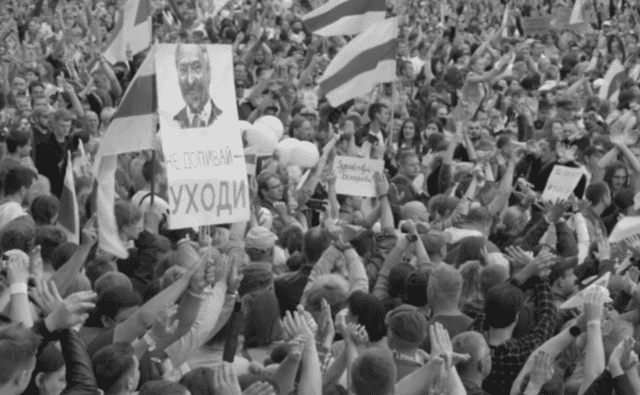
Shot in black-and-white (apart from a clever final colour sequence) the film opens with footage of the mass protests, as men and women (many draped in white sheets and brandishing flowers) took to the streets to protest. Carrying pictures of those assaulted in previous protests they are soon approached by the authorities, with a loud recorded message stating “esteemed citizens you are violating the law – you must go”. Following those 2020 protests, some 33,000 people were detained; several were killed in the protests and some 700 political prisoners are still held.
The women interviewed – all are anonymous – talk about how their lives have been impacted. One woman describes being held in prison, listening to the screams of men being tortured and how the grating sound of metal gates being opened and closed generated fear just because of what it might mean in terms of being taken away.
Another pushes her husband in a wheelchair. His leg was damaged by a grenade during protests and he decides to go across the border to escape further detention, but she is left with two young children, reminiscing about their happier days (she looks plaintively at photographs of their wedding on her home) but increasingly sad about their situation. One woman talks about how she was convinced she and other women were going to be killed while being held, while another admits she can’t focus, sleep or even think about moving on with her life.
News footage of the three women leaders of the protests – Svetlana Tikhanovskaya, Veronika Tsepkalo and Maria Kolesnikova – helps reinforce the bravery of these Belarus women. Footage of the film’s protagonists angrily and sadly waiting outside prisons for news of their loved ones balances material of them still protesting…one woman carrying a placard admits to being more nervous after her ankle was damaged, but she is still there.
These Belorussian women still hope for change even after 27 years of Lukashenka’s dictatorship and the traumatic experiences they have endured. The final scene sees a woman who was an active protester in an early scene watching another protest from the edge, proud of what is happening but now wary. The film slips into colour, though, as she joins the march…nervous, tears on her cheek, but still wanting to protest against the Lukashenka regime.
The film is tightly paced and makes astute and compassionate use of the characters. It never resorts to rage or anger (though that might have been easy) but instead delivers an often heart-rending and insightful story about ordinary people driven to effect profound social and political change.
Poland, 2021, 72mins
Dir/scr/cinematography Andrei Kutsila
Production Belsat
Producer Beata Krasicka
Editors Pawel Klepacz, Andrei Kutsila