

An astonishingly open, moving, funny and challenging insight into the world of a woman paralysed but with her mind intact, Eat Your Catfish is remarkable in portraying an intimate and powerful portrait of a family stretched it its very breaking point. (Envision Competition)
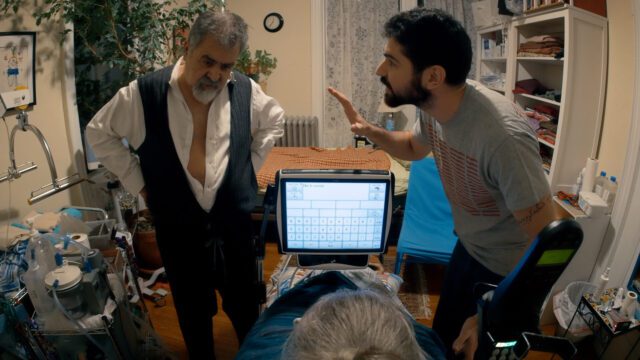
The film is a first-person account of Kathryn, a woman suffering from ALS (Amyotrophic Lateral Sclerosis, also known as Motor Neurone or Lou Gehrig’s disease) and who now lives her life in care, kept alive by mechanical breathing and a team of carers and family members. Kathryn communicates with the outside world with glances, tears and an Eyegaze machine, which allows her to ‘talk’ via on screen messages as her eye-scans are linked to letters on a computer screen.
She is not seeking sympathy – at one point she says how she hates people saying “boy, is she plucky” – and admits to being in constant pain, but is determined to stay alive so she can attend the wedding of her daughter Minou at their house out in the Catskills.
Via a computerised voice we hear her say how, “ALS is a catastrophic and criminal disease if there ever was one. It is like watching yourself get hit by a bus in extremely slow motion and each body part at a time is crushed until you are flattened right up to the nose – only the head is spared until all you have left is your brain attached to a lifeless rag doll body.”
The film draws on 930 hours of footage, all filmed with no crew present from a fixed camera position showing Kathryn’s point of view. It was the idea of her son Noah Amir Arjomand, who is also co-director, who said: “Rather than turning and looking at Kathryn, or asking others to sit down and tell us about her, we aim to bring the viewer as close as possible to actually being Kathryn and experiencing what she experienced.”
The footage reveals her frustrations and sadness, and her reflections on memories as well as on moments of happiness and pride. Her situation has embittered and alienated her husband Said, and often proved too much for many nurses and aides. Her son Noah, who lives with Kathryn and Said in their small New York City apartment cluttered with medical equipment, struggles to balance his academic obligations with those he feels to his mother, with the film often exposing his anger and frustration with his father.
It is an intimate and often desperately sad journey through a life cut short. Occasionally Kathryn is glimpsed in mirrors (or shown as a young hippy woman at the University of Chicago in photographs) but for the rest of the time the viewer just sees the back of her head as she observes things around her.
There are moments of happiness as she observes Minou’s wedding; pride as she sees her daughter’s wedding dress for the first time and in the academic achievements of Noah, and frustration at the nature of her husband’s rambling wedding speech. All around her seem capable of love and compassion as well as anger, frustration and lack of empathy for her condition, but there is a striking sense of balance and ultimate appreciation that this is a challenge for everyone. But we are always aware that this film is shot from Kathryn’s lonely, painful and frustrating perspective.
The title comes from a time she admits to watching the Julia Roberts film August: Osage County when Roberts’ character shouts out “Eat your catfish!” and Kathryn’s deep wish that just once again she could be a person who had the ability to shout out in a moment of heightened drama, just to bring a sense of passion and fight to her life.
US-Spain-Turkey, 2021, 74mins
Dirs Noah Arjomand, Adam Isenberg, Senem Tüzen
Production Zela Films
International sales Deckert Distribution
Producers Noah Arjomand, Adam Isenberg, Senem Tüzen
Cinematography Noah Amir Arjomand
Editors Adam Isenberg, Senem Tüzen
Music Daniel Whitworth





