How documentary is black and white? The world obviously isn’t – even though it sometimes seems that way at dawn or at dusk, or in certain hipster coffee spots. On the other hand, the world when filmed and depicted in black and white is still a direct representation. So, why not?
Most early documentaries were black and white by necessity. But that has changed. Just as we used to call silent movies simply ‘movies’, next to ‘talkies’, and then switched – these days, black and white is the exception, and thus a choice in need of justification.
So, why?
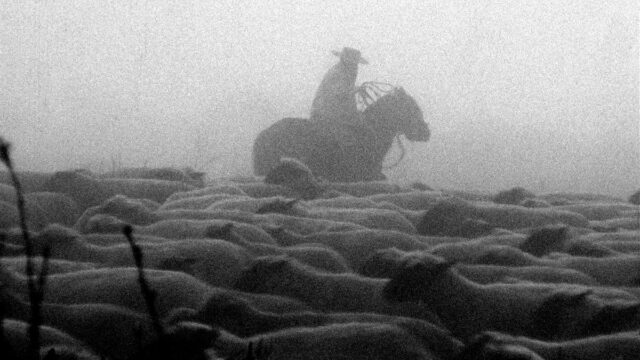
In Diego Acosta’s broadly speaking experimental, almost wordless, film Under the Sky Shelter (Al amparo del cielo), screening in CPH:DOX’s Dox:Award section, the decision to shoot in black and white at first seems primarily an artistic one. His shots of shepherds leading an enormous flock through the mountains are often gorgeous compositions of light and shadow. At this basic level, Under the Sky Shelter already provides a lot – enough – to enjoy.
Black and white also abstracts. It takes a step back from reality and from the present moment. Thus, the shepherd becomes a Shepherd, the mountain a Mountain. There is a timelessness to black and white that is often commented upon by critics, and this is a clear example. And it is helped by the relatively few acknowledgements of the modern era (the fact that the presence of a McDonald’s cap is jarring says enough about the prevailing mood).
When Chilean director Acosta and camera person Sebastián Sánchez Barrientos film the shepherd on his horse, half hidden by the mist, his endless flock passing in front of him, he looks like every shepherd ever depicted.
There is a tension in black-and-white film, however, between appearing timeless and historic. There are echoes here of, to take the classic example, Flaherty’s Nanook of the North (1922). Under the Sky Shelter often has a similar ethnographic feel, as we observe the shepherds at work. Is this film also, like Nanook of the North, partly a reconstruction? That’s hard to say. It’s possible that during shooting or editing the film, certain shots of mobile phones, for example, were left out. Although we do see one of the shepherds tuning a radio – a bit of an old-fashioned looking one, but still. But then there is the moment where a shepherd hands a drink to another, with a cut in the middle, where the camera was clearly repositioned.
However, this last rather obvious acknowledgement of the filming and editing process might well have been on purpose. Because now we come to the experimental aspect of the film, which reveals itself most clearly in the acknowledgement of the filmic material. Under the Sky Shelter was shot on film, and the filmmakers make every effort to emphasise this. There are specks and dust on the film, there are frames missing, parts damaged – the film sometimes even looks crumpled, like paper, as if the celluloid had been twisted. There are also scenes that have been slowed down, sped up or even reversed. Time and again, the materiality of the film stock calls attention to itself. While at the same time adhering quite sternly to the observational mode. Another interesting tension.
To come back to that radio: I don’t think the sound we’re hearing while the shepherd is tuning was recorded directly. But at other times the sound does seem to emanate from the image. Here again, the materiality of the film calls attention to itself. Sometimes, the background noise changes on the cut – implying direct recordings – at other times, it continues on during very different shots. A soft murmuring of the shepherds in the background feels very documentary; but the sounds of a rock falling down a hill seem decidedly Foley.
The combined effect, for image and sound, is a mix of direct, ethnographic observation and dreamlike, manipulated reflection. With, between the clear extremes of these approaches, large swathes where they blur into each other – it goes without saying, those are the most interesting parts of the film.
Because there is very little obvious narrative, my mind tended to wander. The sounds of water, wind and crickets, combined with moody electronic soundscapes, also created a certain dreaminess. In other words: don’t watch this film at the end of a long festival day, if you don’t want to fall asleep. Which you shouldn’t, because then you would miss some haunting images. Two of my favourites were a shot of sheep at night, dozens of eyes reflecting the camera lights, and the equally ghostly backward sequence of a large, relatively narrow waterfall, with the water leaping upwards in elegant arcs.
Are these the shepherd’s dreams? That is how they are described in the press notes, so that’s presumably what the director intended (the notes also explain that those horses I saw were in fact mules – that’s a city slicker for you). But as I watched Under the Sky Shelter, lulled into a dreamlike state myself by Diego Aguilar Gutiérrez’s sound design, they felt like my own.
Chile, 2021, 70 minutes
Director Diego Acosta
Production Nuevos Trópicos, Santiago Independiente
Producer Florencia Dupont, Sebastián Sánchez Barrientos, Pepe Acosta
International sales Santiago Independiente
Script Diego Acosta
Cinematography Sebastián Sánchez Barrientos
Editing Diego Acosta
Sound design Diego Aguilar Gutiérrez
Sound Nicolás Saldivia, Diego Aguilar Gutiérrez
Music Sebastián Cifuentes
With José “Cucho” Ulloa, José Aurelio “Joselo” Ulloa, Jorge Torres