

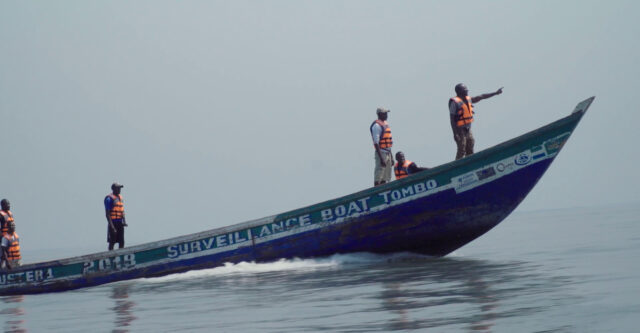
In New Boats, illegal fishing by companies from Far Eastern countries is forcing fishermen in Sierra Leone to emigrate, but some of them are putting up a fierce resistance. “The documentary film is an investigative piece that tells a relevant story of a community struggle trying to save not only their livelihoods but the critical food source that the country depends on,” says director Lansana Mansaray.
Sierra Leone director Mansaray (better known as Barmmy Boy) is perfectly qualified to tell this story of latter day oppression and eco-colonialism. “Growing up in Sierra Leone and throughout the 10-year Civil War, fishing played a very important role in keeping us alive,” he told the Geneva professional audience. “Partly because the EU placed a yellow card ban from fish from Sierra Leone [this means] we cannot sell fish for the international market.”
This meant that “doors for exploitation” opened up, which had dire effects on the fish sector in Sierra Leone.
Impact producer Adenike Hamilton outlined her future strategy for the doc: “We believe that this film can be a force for good, not just in Sierra Leone, but connecting the stories of these fisherman with a global community facing some of the same challenges.”
“We want this film to be able to build a movement, inspiring communities to take ownership of the conversations and the issues that this film raises. Issues of climate change, illegal fishing, forced migration, and the fight to protect livelihoods. We also want to empower the Fishermen’s Union in Sierra Leone with the tools and the skills to document illegal activities in our waters, setting up a mobile cinema unit in the union’s office for further screenings, community outreach, education and campaign purposes,” she added.
“We hope that with this film we can also enable communities to understand the causes of fish scarcity and the threats to food security in Sierra Leone and help these same communities understand some of the threats that climate poses on their livelihoods, bringing the conversation of climate change to local languages and understanding community adaptation and resilience mechanisms that they can employ,” she added.
Barmmy Boy further explained how the project can deliver great impact, with 24 community screenings not only in coastal communities, but in also in the villages in the hinterlands of Sierra Leone, and help to build conservation links with groups in Tombo (fishing centre) to help them to manage what they have, but also protect what they have, he underlined.
“Also we are organizing the first ever environmental climate summit in Sierra Leone where the film will be screened and [where] we bring on board politicians as we approach the elections in Sierra Leone,” the director adds. “We want to create a [forum] where politicians, students, everyone can start the critical discussion around these issues…And we also need support because we filmed over 300 hours worth of material. We want to use some of this material to edit into shorter clips, to share on social media, to study conservation and to continue the conversation.”
New Boats is produced by STEPS (South Africa) producer Tiny Mungwe. “This film takes an incisive look at the challenges faced by communities, not just in Sierra Leone, but around the world when it comes to having sovereignty over their resources and having the possibility to be custodians of the environment that they find themselves in,” she commented.
“The team for New Boats in Sierra Leone has started already a very incisive impact campaign with screenings around the country. They are also looking to use the film to be a driver for dialogue and conversation and national discussion on the issues of climate change, illegal fishing, as well as a sustainable future for the environment. This film can be a powerful tool for the team in Sierra Leone, but also for many other stakeholders in the community, for education, for lobbying and for outreach.”





