

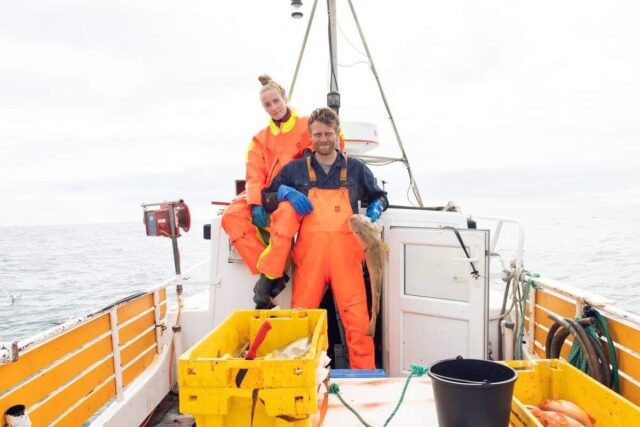
In Rut Sigurðardóttir’s feature documentary, Kristján Torfi, husband of filmmaker, decides to address their debt situation by taking to the Atlantic to fish for cod in a small fishing boat using a line and a hook.
The boat is called Skuld, a name which means debt or which can be slang for money. As significantly, in Icelandic mythology Skuld was one of the glorious Valkyrie, along with Urðr (‘fate’) and Verðandi (‘happening’).
Rut’s husband Kristján is patient, gentle and diligent. He also likes to sing, which is why his songs feature on the film’s soundtrack. What’s more, he is happy to be filmed in the process of preparing the boat for sail before taking to the high seas. He takes problems in his stride and quotes the fisherman’s law that “when shit happens, more shit will happen.” Before he can start he must fix the boat’s alternator, the radiator cap, the turbine and the turning belt.
He must also put up with the reckless land-based 4-wheel driving of fellow fisherman and friend Maggi who almost scuppers the boat as he manoeuvres it towards the harbour waters. And yes, Kristján also gets frustrated with Rut when he feels, at times, that she is not pulling her weight on the boat.
The fishing season lasts three or four months and fishermen like Kristján can take 12 trips per month, with a maximum quota of 774kg per trip. During this season his fish yield amounts to 26 tons.
For all Icelanders, the cod occupies a place of near mythical importance, Sigurðardóttir points out. “It’s an ancient industry in Iceland. It’s the oldest industry in Iceland. It’s the reason why Icelanders went out on a rowing boat with a line and a hook. It is the reason why we were able to live on this isolated rock in the Atlantic Ocean.”
“What does the cod mean to Iceland? It means everything. It’s the basis for everything,” she underlines. “It’s the reason why we’re a rich nation.”
But independent fishing is endangered by the domination of huge trawlers and dwindling quotas assigned to the fishermen, Sigurðardóttir points out. “The small fishing boat industry has a very small piece of the cake, so it’s very hard to make a living. The future is uncertain…It could be and should be a sustainable industry, because it’s the most economical, friendly way of catching fish. We use a line and a hook. We make no damage to the ocean bottom. And we spend very little oil. We only like spend oil when we go out to the fishing grounds, then we turn the engine off.”
What’s more, it is a way of life that few people of Sigurðardóttir’s generation seem to recognise as still functioning. “There are so many people that are losing connection to the ocean,” she says. “Even though most of them have at least a grandfather that used to do this kind of work. When I was telling my friends about what we were doing, they had no idea. So this is the reason why I wanted to make this film, just to show people what we are doing that and that it is relevant that we exist, that it is important.”
When she is not shooting her husband in the film, Sigurðardóttir introduces us to some of the island’s other fisherfolk, such as Einar the miracle-working engineer; the funny and comic double act of Pétar and Óskar; Dóra who observes how her job is one that entails “practising mindfulness”; the trickster Bjöggi who seems to direct rival fishermen to waters empty of cod, and the aging Dolli whose new life on the seas means he no longer has to “crawl from Herod to Pilate” for work.
Speaking to BDE in November 2022 Sigurðardóttir explained how “I always believed that I wanted to tell other people’s stories, to bring other people’s narratives and views out to the public. But very soon I realised that, of course, I’m always telling my own personal story, exploring my personal identity and role in this crazy world. [It’s] so obvious when you think about it… my covert narcissism disguised as altruism!”
That said, she now concedes that it was difficult watching herself on screen when it came to editing the film. “The most difficult part was, was to put ourselves in front of the cameras,” she says in retrospect. “Both of us are very, very private people. We’re not very keen on putting ourselves out there.”
“I was filming our communication and how we talk to each other and approach each other. Sometimes you don’t think that much about the camera because it just the two of us,” she says. “It was funny, I was watching it, and I was like, wow, you sometimes you could be a bit more like gentle or polite or [less] controlling like. It was really interesting and therapeutic almost.”
Rut Sigurðardóttir’s Skuld: For the Love of Cod is selected for Icedocs, Iceland Documentary Film Festival (Akranesi) which runs 19-23 July.





