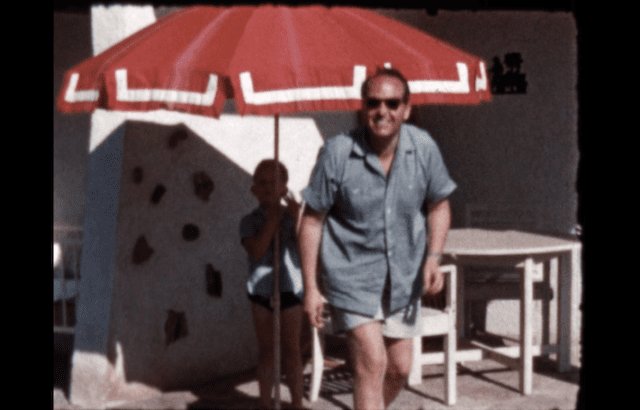
On the face of it, the images we see in the post-war home movies of Rose, the grandmother of German director Annika Mayer, reflect nothing other than domestic bliss and affluence, set against a backdrop of the country’s economic recovery.
After the war the 19-year-old Rose married the returning soldier Rolf, 12 years her senior. It was a marriage she was shoehorned into by a father who held Rolf’s status in high esteem. She wanted to complete her studies but parental intervention determined that marriage was to be her future, and immediate, trajectory. It was a time of deference, and Rose duly complied, despite her recollection of how she was “totally disgusted” following Rolf’s first “lunge” that left her mouth covered in drool.
That said, Rolf seemed to represent stability and wealth, at least initially, which we see much evidence of in Mayer’s film. He works as an executive in the family firm. We watch the family (augmented by two boys, Ernst and Frank) as they ski in the mountains and holiday by the sea. The boys are dressed in expensive traditional leather trousers. And everybody smiles to camera.
But all the time Rose, now in her 90s, is also watching the footage and offering a commentary on aspects of her life that we don’t see in her personal archive, the slow drip of domestic abuse and suppression, sometimes punctuated by public displays of violence which prompt the swift intervention of bystanders. She was even threatened with a gun, although she felt more obliged to lock it away after the event, rather than go to the police, such were the times.
Rose stuck around for 23 years, despite the violence, the misery, the prostitutes and Rolf’s evolving relationship with his secretary Ilka, but she had the company of her boys, and sometimes their protection. But enough was enough, and eventually, in the late 1970s, she called time on the marriage.
The story of this marriage was one that director Annika Mayer, also a producer and editor and who studied cultural anthropology, knew well, and decided to tell in Home Sweet Home, her feature doc debut, world-premiering in DOK Leipzig German Documentary Competition.
“I’m basically always interested in sociopolitical stories, but also very much in personal stories and how they relate to bigger questions,” she says. “Basically I wanted to do a feature film, I still want to do a feature film, about the structural problems behind domestic violence or partner violence. And I never wanted to do a film about my family because I always thought everybody does a film about his or her family, and it’s awkward. But then I started to do these interviews with my grandma and I was so surprised that she was willing to talk about it in front of the camera, and I thought, okay, well fair enough…I think I’m always interested in personal stories that can say more about society.”
So did Rose need a lot of persuasion to open up on film? “She was more willing than I thought she would be,” Mayer responds. “I think she had some fears, but in general I think she was very open to talk about it because, as she said, it’s a very dark chapter of [her] life, but it’s over and it’s something she was willing to talk about.”
What makes the film so fascinating is how Rose’s commentary is in stark contrast to the happy family life we see on screen (not that her former husband would have allowed footage depicting him in a bad light to survive, one assumes). But Rose still recognizes some of Rolf’s expressions and facial tics which, in the past, were indicators of an imminent outburst. “We had this moment when she said, ‘I just saw it again in the material, how he looked away and I could recognize it immediately.’”
“That was always the idea [of the film], to look at this kind of perfect Western German post-war family and their perfect performance in public,” Mayer adds. As Rose indicates in the film, it was an era in which a turtle neck would be worn to cover the bruises on her neck.
Nor did the director herself recognize her own seemingly benign grandfather on screen. She was ten when he died, but nevertheless only ever had “dark memories” of him. She was afraid of him, even though she concedes there was no overt reason to be, and that there was always a “tense atmosphere” in his house. “And I knew about the violence, but I didn’t know about the extent of the violence,” she admits having listened to her grandmother’s testimony.
In the film, we see how the boys, and especially Mayer’s dad Ernst, the eldest son, heroically try to protect their mother from their father’s violence. The gun episode ended with Frank tackling his father from behind. The gun was dropped and Rose threw it out of the window, later to be found and hid in her safe.
Why is the boys’ testimony (her father and uncle’s) not used in the film? “I always wanted only her [Rose’s] perspective…I think for me that was the point of the film,” Mayer answers. “But of course I asked my dad if it was okay because it’s also his story, and I think for him it would be much more difficult because it’s his dad. You cannot just say, okay, I’m over with it – because he stays your dad. I knew that he would also have more difficulties in participating, so that was never an idea.”
“But they’ve seen the film and they liked it…But for me it was important to show how my grandma was stuck [in her predicament], and in the end how she made it out of [there].”
Mayer further reflects on the colourful world we see in the elegiac footage, and sees an inherent contradiction. “If you think back about the society in the fifties and sixties in Germany, everybody claimed everything was okay and basically nothing was okay,” she says. “There was a lot of hope because of the Marshall plan and everything, and they were affluent so they could afford stuff, and it was post-war so there was a lot of hope for a better future. But on the other side, there were men coming back from the war, super traumatized, and nobody spoke about it.”
“They were all Nazis, and no-one of course was ever a Nazi,” she adds ironically. “And as far as I read in history books, there was no conscience about being on the bad side. So I think there was this weird situation where everybody just wanted to forget about the past and claimed everything was positive.”
Home Sweet Home is produced by Annika Mayer and Jakob Krese for Berlin-based Majmun Films.