“Eduardo Palmer is, on the one hand, an important and respected producer in many Latin American countries. But on the other hand, he is completely unknown to most people. I want that to change,” Spanish filmmaker Pere Salom tells Business Doc Europe ahead DocsBarcelona Industry, where he is pitching his feature project The Witness, which tells Palmer’s story.
“This is an extraordinary case. There are few men left alive who have [documented] Fidel Castro, Raúl Castro, Che Guevara, among others… and then conspired in the so-called counter-revolution,” Salom continues. “But Cuba is only one of the chapters of his life.”
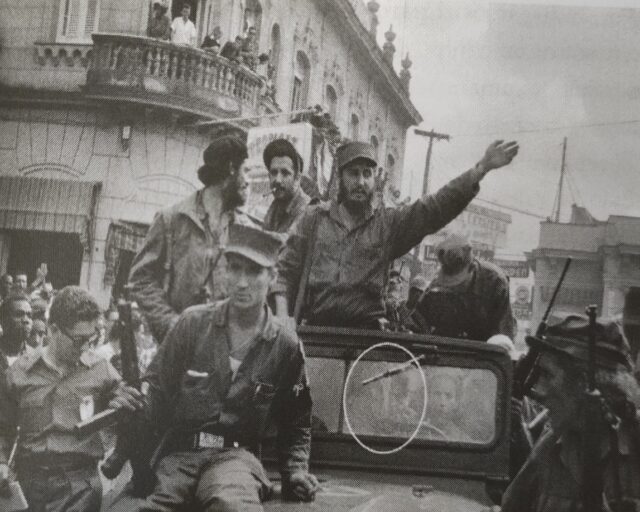
Cuban by birth, Palmer was the only cameraman to accompany brothers Fidel and Raul Castro, as well as Che Guevara, on their triumphal arrival in Havana in 1959. Palmer also covered the civil war in the Dominican Republic, as well as conflicts in Nicaragua, El Salvador and Panama. Disillusioned with the regime in Cuba, he produced (in 1963) the critical Cuba, satélite 13, the title of which referred to Cuba’s over-reliance on the Soviet Union. He has latterly lived his life in exile in the US, where he has produced the North America’s largest Latino newscast.
“[Palmer] met and interacted with a good part of the Latino socio-political establishment. Presidents, writers, artists…,” says director Salom. “Through his films, either as producer or director, we can find key moments in the development of Latin America in the second half of the 20th century.”
“We are going to tell the story under the axis that drove all his movements: the absolute certainty of defending what is right. We will do so in the context that Latin America was, in the second half of the 20th century, a space of great political instability,” Salom continues. “It should be noted that many of the political events of the 1950s and 1960s were decisive for subsequent social development. The debate and confrontation of two [political] models was real and palpable. Palmer was on the front line on numerous occasions, he saw corpses and heard bombs, but he believed it was relevant to the work he was doing. He never had any qualms about getting close to ‘the action.’”
Salom adds: “We will be in Cuba, the Dominican Republic, Nicaragua, Honduras, Panama, the United States, Venezuela…We intend to alternate the biography of the character with the political reality experienced in each of the countries. While we recount his experiences, we see what was happening in all those countries. In the end, we want people to understand what happened in the second half of the 20th century on that continent.”
If all goes to plan, Salom hopes to finish shooting in 2024 and have a first version ready by mid-2025. “At Barcelona, my main objective is to get support in any field – except development, as the project is well established,” he says. In terms of outlets for the project, the director is targeting “the big screen,” festival sand platforms.
Salom tells BDE that the project has been enthusiastically received, not least from Palmer himself who has allowed Salom access to his complete back catalogue of films. “We are very hopeful about the interest it is arousing,” Salom stresses of the project. “The enormous difference is that Eduardo Palmer was there. The source is direct. There are hardly any sources left on the planet [so directly connected with] the Dominican civil war, the revolution in Cuba, the conflict in Panama – or New York in the 60s.”