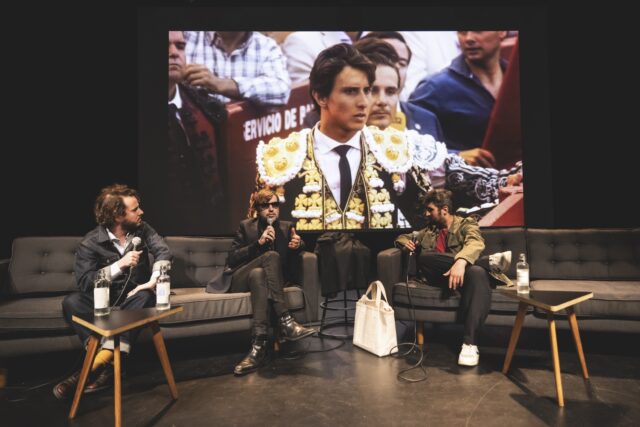
Catalan director Albert Serra is a combination of many things, not least of which is combative. Or indeed controversial, or uncompromising, or dismissive. But smart is up there too, and funny. And even, at times, wise.
Together with his editor Artur Tort (a man equally deserving of a positive adjective or two), Serra discussed his upcoming bullfighting doc Afternoon of Solitude.
As he expressed, the doc form is not exactly one that Serra is overly fond of, nor its practitioners, some of whom he refers to as “bourgeois,” and whose work resembles little other than “a mental therapy.”
“Most of the time the documentaries are for the people that are doing it,” he said early in his address to the DocsBarcelona audience. “I don’t know what is the point because it’s not interesting for anybody else except them.”
Nevertheless, he has turned to documentary to make his latest film. Why so? “Everybody knows that making a fiction [is] more interesting and better than making a documentary,” he replied. “The only possible answer to this is to say, I do a documentary because it’s impossible to make a fiction about it.”
He elaborated. “You are dealing with a subject [bullfighting] that first of all, there is no possible actor to do it with quality. And then you can use obviously a real torero that can do a fiction, but it’s difficult for them… Maybe it’s possible, but it’s unlikely.”
Editor Tort underlined that the story is also located exclusively in and around the bullring, documenting the processes that go on there and only there. “Formally speaking you can do a lot of types of documentaries, [but] here we are not dealing a lot with his personal life or with his background or family. It’s much more being in the moment where things are at stake really for him, for the bull, and the previous moments and the afterwards, but really all around this crucial moment of facing death and living this sort of almost unimaginable life experience. So in this sense it’s really tight, it’s really focused.”
But only one torero would do, Serra underlined, and that was the Peruvian Andrés Roca Rey. “We [shot] a lot of toreros and none of them was any interesting…The only one that had real interest [for us] to be shooting in a documentary…to put a camera and to use cinematographic language to do a documentary – it was him…The subject is not enough. It has to give something with some grace to the images, has to be some kind of visual interest…
Toreros in general] are dealing with a very dangerous activity. All the others are doing the same [but] they are not interesting – zero,” he stresses of the particulate appeal of Roca.
Editor Tort elaborated on the sense of aesthetic that Rey embodies: “It’s clear that at the certain point we saw [it]. And then of course it’s in the editing process, when you see the rushes, that you really can really verify, you can really be certain that you have something that has this cinematic interest beyond the subject. This is something more, that is pure cinematic interest, because this guy has a powerful image when looked through the lens of a camera…It is his presence.”
“Then of course what he does, it’s really, really impressive,” Tort added. “A lot of times we have been discussing how would we do this film without him, I mean with another bullfighter. Because there wouldn’t be no movie. It’s almost like a sort of miracle in a way.”
The subsequent footage they shot was, according to Serra, “the best possible thing [one] could find…on earth related to the subject.”
But they had to learn how to achieve this, Tort added. “We are trained because of the fiction work we do. We are trained in shooting in quite chaotic situations,” he said, but the bullfight arena was another level of chaos where “you have no possibility of control.”
“But in a way it’s not so far [from fiction], conceptually speaking, in terms of the way we approach the shooting itself, in the sense that we are trained in judging and finding the appropriate moment. It’s a sort of quest that happens in all of our fiction work. So in a way, we were already skilled to do that. In fact, on the first bullfight that we did, we asked someone that had a lot of background in television work of bullfighting, a guy that worked in television and did a lot of live bullfights…None of the material he showed was usable…We couldn’t find a common ground or language. I couldn’t explain anything. So in fact, the only way was us doing it, learning it through all the bullfights…and finding a way.”
“I don’t think anybody in history has ever had access to this,” Serra added of the work in the bullring. “Nobody with this quality of approach of the cinematography.”
“It’s not fiction so you cannot then change it a lot,” he added. “So you have to really insist and insist on the angles of approach. Of course fiction always [has] its angles of approach, but there is a possibility of creating a deliberate chaos that at least will shake things and will make things unpredictable. But here you cannot change anything. You are a documentary.”
Tort added: “There is this deeper meaning of the images that you simply cannot understand at the moment. You have to see them later because the camera captures things that the eye doesn’t…And so it’s what makes cinema worthwhile as a language.”
Likewise from an auditory perspective, the pair also underlined how they assumed they would be editing out much of the background chat surrounding the torero, but in the edit suite this noise was deemed essential for inclusion, as the chat was designed to fortify and prepare the hero for the fight, which was not obvious to the filmmakers when they were shooting.
The crew on Afternoons of Solitude began the film never having seen a bullfight. They were of course curious but approached the task with a sense of detachment from the subject, Serra stressed. “They didn’t have any opinion. So this innocence, pure innocence. They are very kind and smart people and they are curious of everything, including this kind of violent thing. I always say, ‘okay, we are going there and we are going to shoot. We are not the ones who are doing this [bullfighting]. Forget it. I mean we are just witnesses,” Serra said of the “innocence” he was looking for.
He added of this approach: “It’s quite uncommon with documentary people because from the moment they choose the subject, they already have some kind of attachment to the subject and they always – I will say of 99% of documentaries – they know what they want to say or they don’t really have the innocence and the curiosity to explore something really, really blindly. They have some kind of affection, some kind of attachment with the subject….I think this is very dangerous and not very interesting for the final result.”
The business of being in the editing suite was highly educative for both, they pointed out. “What is the essence of the image?” asked Serra. “It’s a plastic object. And we realize that, especially obviously in recent years with these new extraordinary tools of digital post-production that are very [good], and maybe even better in the future, these change a lot of perception [within] a lot of images. You can really change the sense, even the meaning, the direct meaning [but] without manipulating, without making any kind of strange manipulation on the image, just changing colours, just changing a little bit of texture here and there by checking it [in] real time…We have this idea, let’s check it, let’s try it, and if it works, then a new [door] suddenly opens.”
“We [are] together the best editors in the world,” Serra further claimed. “I think it’s literally impossible that there is anybody better. They can be the same level but not better. It’s impossible because nobody [else] at this stage of evolution of the new tools [can have] arrived to this point.”
Serra further argued cinematographers working in fiction could learn more about their craft by spending time in the editing room to see how their images are subsequently transformed. They could also learn a lot from their documentary counterparts who are, much of the time, also the directors and editors of their own films, and are hence very familiar with their material.
“These fucking cinematographers, they receive a fortune for making the film. So they want to go from one film to another as fast as possible and receive as much [money, as possible]. And it’s fun to shoot a film. Of course it’s more fun than editing a film, but you don’t understand anything.”
A funny and instructive exchange followed in which the pair explained how a particular phrase emerged which served as a guide and warning during the edit process, that of ‘troisgros.’
Both Serra and Tort told how they are avowed fans of the legendary Frederick Wiseman, who made the epic Menus-Plaisirs – Les Troisgros documentary in 2023. But this film evoked in them a particular sense of what to avoid in their film, and when they were nearing such a point, they would say ‘troisgros,’ and the danger would pass.
“I am an admirer of the work of Wiseman in general and this film too. I like the film, but it’s not for us,” said Serra. “I like his methodology, I like him as a person, but I didn’t like the result of the film. I mean I liked the result of the film [Serra said he was very interested in food] but I thought that there was something really useful [in] us of not doing [similar].”
“Because when you have this feeling that it looks ‘troisgros’, there is something so scary. So I don’t know. That is something very dangerous aesthetically for us,” he added.
As did Serra, Tort struggled to define the essence of ‘troisgros’, also being an admirer of Wiseman, and also conversely liking the foodie doc and not wishing to give any offence. “It feels too ‘documentary’ in a way which is descriptive and it has no inner atmosphere…But what makes his film interesting is the accumulation. So then you have a lot of ‘troisgros’ shots, and in the end it doesn’t matter because you are inside this and the atmosphere is created by this accumulation. But as a single shot, no way.”
Serra offered up his own explanation of the meaning of “troisgros,” at least as he saw it. “It’s about intuition and it’s difficult to define. I agree with what he [Tort] said, but there is something more pernicious in it,” he opined. “Of course you mean a lack of tension in some shots…I feel it lacks some kind of young energetic violence [or] a little bit of self-criticism somehow.”
“Maybe because they are not on the edge of being fictional. Maybe because there is nobody body pushing anything,” he suggested.
“There is an energy of creating a fictional wall that means…trying to look for the things that have more volume, that are…not predictable. Looking for the unpredictable in what is a paradox, but pushing for the unpredictable, but in a very tense way,” he explained.
“Of course, it’s easy to say that when you see Trois Gros, a film about [a] restaurant compared with the film about [bull]fighting,” he conceded.
Towards the end of the case study, the pair offered their thoughts on continuity and how only total immersion into the film and subject (in their case, nine months in the edit suite) could offer anything structurally meaningful, although Tort conceded that the process of maintaining continuity could be at times “mystifying.”
They also underlined that theirs is now a deep well of knowledge in terms of what they had to learn over the course of making Afternoons of Solitude. And while they are happy to discuss what they know in public at a superficial level, professional in-depth sharing will come at a cost. “This is knowledge that if somebody wants to know they have to pay for,” Serra ended.