She works behind the counter at a food market in Connecticut, but nobody knows that single mother Lhakpa Sherpa from Nepal has reached the summit of Mount Everest ten times. Nor that she has been the victim of domestic abuse. In the Netflix feature documentary Mountain Queen: The Summits of Lhakpa Sherpa, Emmy-winning and Oscar-nominated director Lucy Walker tells the eponymous heroine’s story of perseverance, not only as a climber but as an immigrant and survivor.
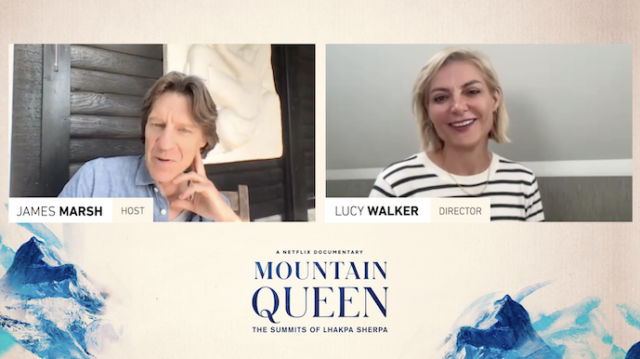
Walker discusses her film with Academy Award-winning James Marsh (Man on Wire).
Early in the conversation Marsh observes how it was fascinating to see the film examine the relationship that locals have with the mountain in whose shadow they live, and how that relationship is informed by proximity.
“It’s a much more interesting ethnographical take when you see her [Lhakpa] talk about the mountain and revere the mountain in a certain kind of way, and personify it,” he says. “It wasn’t just a derring-do adventure story, it was about someone who had a deep and quite profound relationship with the mountain itself as an entity. And that’s not usual. Normally these adventure films (if I can call it an adventure film, because it’s much, much more than that) don’t have that kind of interesting, deeper level of understanding. This is how the Sherpa culture regards this mountain and respects it in a certain kind of way.”
Walker then explains how, during the course of their interviews, Lhakpa opened up, little by little, in telling her story of domestic violence.
“It was very upsetting and she would really have a trauma response,” Walker says. “Sometimes she’d start shaking. She found it very difficult. She couldn’t sleep afterwards if we touched on difficult things. So we kind of did it slowly together and it was a real…climb unto itself.”
“For all the strength it takes to climb Everest, actually to share openly things that, in her culture in particular and I think for all of us in general, carry such shame, these are secrets that people take to their grave and will design their whole life around not mentioning, let alone sharing in this documentary,” Walker adds.
“But I knew we wanted to include that because that is what she’s overcoming in climbing. And what was actually fuelling her was this feeling that this was what was happening to her, [that] what had happened to her in her life was wrong, and that women deserve more and that women were capable of more if they were given an opportunity. And by God, she just tries and tries and tries and tries and tries to get those opportunities. And she manages.”
To see the whole conversation between Lucy Walker and James Marsh, click below.