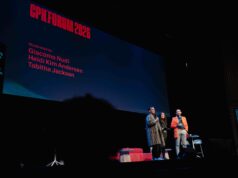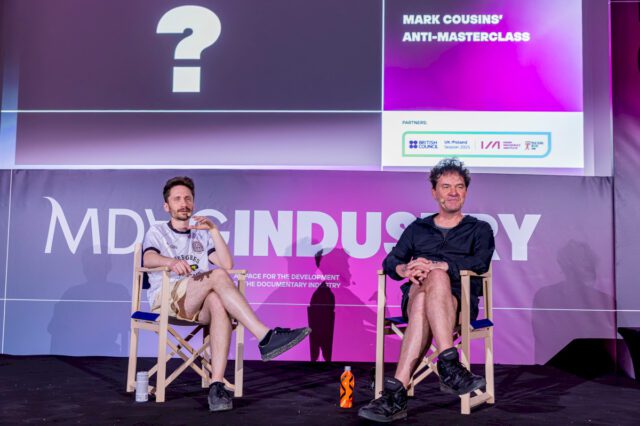
It is a truth universally acknowledged that film festival masterclasses are delivered in hushed, reverential tones to an ostensibly mute and seated audience. Not when Northern Irish filmmaker/academic/doc maverick Mark Cousins comes to town. This week he was in Warsaw to engage head-to-head with MDAG Artistic Director Karol Piekarczyk and, in the process, deliver what he called his “Anti-masterclass.”
The last time I saw the word ‘anti’ flagged up within a public address to Industry, it was for Argentinian director Mariano Llinás who, at IFFR a decade or so ago, delivered his Anti-lab lecture. In it he railed against the lab system of script development that he believed was killing cinema. “It is making pictures that are already dead [by the time] they are shot,” he bemoaned at that time.
I was therefore a little concerned before Cousins took to the stage. Was this going to be something similar – a subversive, grim demolition of the popular, at times illuminating, masterclass format?
As it happens, my fears were without foundation. Subversive? Certainly. Grim? Anything but. What we got instead was a paean to the power of the image, to the importance of eyelines, to the romance of a sweeping diagonal. We even got to overlap our cellphone spotlights, Dambuster-like, on the ceiling of the darkened auditorium. And we danced. Some of us timidly, others raucously. We also got to be co-developers/co-creators of a brand new Mark Cousins film. Well, almost.
The whole event took on a kind of a three-act structure (what would Llinás have thought of that?). Resembling a pair of marathon runners, the bare-legged Irishman riffed for 30 minutes or so on pictures and stills chosen by the equally bare-legged Piekarczyk. It was a fascinating exercise in looking and seeing.
Thirteen or so still images were shown – some were from films, some were photos – of which Cousins had no prior knowledge, and which he set forth to analyse.
“We are in a space of vulnerability, and depending on the world to show us something,” he observed. “So I have literally no idea what’s coming up on screen, and I’m just going to try and respond to it according to this man’s [Piekarczyk’s] imagination.”
We saw the frontispiece image from the Ernest Cole exhibition at MDAG, that of a woman, mid-embrace on a New York tube train, turning to look at the camera. “Her look is fantastic,” observed Cousins. “I think that’s she’s saying, ‘I know you, I see you. I am doing something here.’ It feels to me as if in a way she’s the author of this moment.”
Later he assessed an image from Sara Dosa’s Fire of Love, in which volcanologists Katia and Maurice Krafft are standing in front of the fiery red lava, wearing silver space suits, the whole thing captured in very long shot. “The cinematographer is nowhere near that lava, otherwise their camera will be overheating massively. But it looks like an image from 2001 A Space Odyssey, frankly, doesn’t it? It looks totally fictional, but it’s not…It’s a beautiful film. It’s about love. Stories are often triangles, as we know. There are three, it’s never binary, it’s often tertiary. These two people and the volcano, they were the three in love with each other.”
One of the later images was a still from Cousins’ own film I Am Belfast, which showed a mural of a bar (McGurk’s Bar) on a wall, in the exact location where the original pub was destroyed by a bomb in 1971, killing 15 people including the owner’s wife and child.
He discussed two passers-by in the image. “I saw these two guys walking towards each other,” he said. “I’m very interested in machismo and masculinity, where I come from in Belfast. So these two guys were walking towards each other and I froze it and I froze it and I’ve froze it until they get to almost there [just facing each other]. And then the main character in the film says, will they kiss? And then they just walk past each other.”
Very soon, we the audience were plunged into darkness, and were encouraged to watch Cousins’ spotlight on the ceiling before joining it with our own. It was an exercise designed to engage our eyes. “Sergei Eisenstein, the great filmmaker, he said the job of the filmmaker is to move the audience’s eyes,” said Cousins. “We’ve been talking about eye lines, quite a few of those first three or four pictures were all about eye lines, I felt. So I must say as a cinematographer, I feel my job is to move your eyes and to try to direct your attention in some way.”
And then we were invited to dance [Depeche Mode – Personal Jesus]. Why? Two reasons. “To remind ourselves that as filmmakers, we are not only brains and jars, we are not only using this part of our body [pointing to his head]. We have to think more about the whole aspect of [our] lives – including joy.”
Cousins also wanted to effect a major change in our perception. “Do you remember that moment where Dorothy opens the door from black and white into colour?” he asked. “I think we need, as documentary filmmakers, to understand that and how you create a world shift, how you go from mind to body, how you go from thinking to dancing…I think that all of us should at least, in theory, be interested in that idea of a transformative thing where we’re not in Kansas anymore, where the film shifts.”
He cited the example of Capturing the Friedmans (Andrew Jarecki, 2003) “It starts as a film about a family of clowns who perform at children’s parties. And then it becomes about how they realize that several of the family members have been child abusers. That kind of radical shift is very, very interesting.”
The final part of the ‘anti-masterclass’ concerned a photo that Cousins had taken a few days before in Gdansk. It was of a closed door within a wall, beside which was a building that wore a plaque. Behind the wall was a tree and another building upon which shadows of other buildings were cast.
Cousins told how, as he was standing in the road by the door, an elderly woman walked out [Cousins guessed an age of 76), wearing an orange hat and pushing a pram. He then set out to examine the cinematic or storytelling potential of what he had observed, and asked us to contribute our ideas.
The woman in the orange hat was a source of enormous fascination for him. “What’s interesting is her life. What did she live through? She lived through Gdansk in the 1970s. In the shipyards. And she lived [through] Solidarity. Of course she’s born after World War II, but boy did she see the Soviet Empire.”
“I think, especially, an older person’s life is super interesting. I think an older woman’s life is super interesting. An older Polish woman’s life is super, super interesting because of the layers that she’s lived through.”
One person in the audience wanted to know if every story of an old grandma is really worth the effort? “We all have grandmas, we all have these stories in the families and around on the streets. How do you decide that this is a story worth telling?” they asked.
“Lots of my family members I find extremely boring. But you wouldn’t, I think, and it’s a matter of the telling,” Cousins responded. “I think most human lives are interesting [but]… if you ask somebody to talk about themselves, often they don’t do a very good job. So the question is the voice, the story. In other words, with a film we’re asking who’s telling the story, from where, when and why.”
There are longitudinal films, Cousins pointed out, when we follow one person over years, but there are latitudinal films which are all about a moment in somebody’s life. Why not a make film only about 76-year olds, the proposed age of the woman pushing the pram. And what about the colour of her hat? Why not elaborate on that as the subject? “Her hat was so orange; her hat was the same colour as the brick wall behind me. What if you go out now after this and just look for the colour orange? It’ll be amazing. Warsaw will reconfigure itself in your eyes.”
Of course if the woman is going to be the subject of his film, she should have as much agency in the process as the filmmaker. “Maybe it’s actually her who’s going to make the first step of inviting you in, or actually being curious about you,” an audience member suggested to Cousins. “So it just gives space for mutual curiosity.”
What therefore of the relationship between the filmmaker and their subject? Cousins answered by quoting Roman author Pliny’s tale of the woman who wanted to trace the shadow of her brother on the wall before he went off to war. So she lights a candle, has him stand by the wall and traces his shadow.
“But what Pliny doesn’t mention is that her shadow will be in the image too. You can’t trace somebody else’s shadow without yours being in there as well. And we can learn, as filmmakers, that we can’t completely pretend we’re not in the story, that we don’t have agency…So I completely agree. When we’re engaging with someone, we have to acknowledge our own subjectivity as well as theirs.”
Cousins held this thought as he ended his masterclass with a nod to some of the great Poles of history. He wears a tattoo of Marie Curie on his arm, he said. “I’m a physics boy,” he added, before turning to the final image projected on the screen, that of the great astronomer Copernicus.
“I think he was the first documentary filmmaker who ever existed. Nearly 500 years ago, he asked the most important creative question. What if we are not the centre of the universe? What if a master is not a master? What if a masterclass is not a masterclass? What if the woman with the orange hat is much more interesting than I am? Which is almost certainly the case. Thank you,” he signed off.