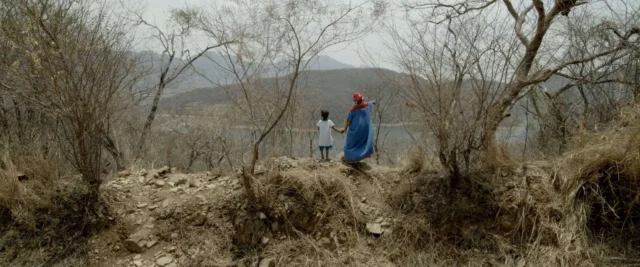
“This film is stitched to my heart and soul. There is blood in it – family – and roots that go back decades, tangled with the lives of the communities who welcomed us not as filmmakers, but as kin,” director Alejandro Valbuena (Curare Films, Canada/Colombia) tells BDE ahead of his rough-cut presentation at DocsBarcelona Industry.
The film takes us to the La Guajira desert in South America, and follows three Indigenous Wayuu guardians as they resist wind companies’ corporate greed masked, the synopsis posits, as green progress. Tita, keeper of ancestral land, sees the trap woven into the wind companies’ promises. Misael fights for the Bruno River, now a ghost, guided by “dreams that speak in water and warning.” Jazmine, fierce with grief, battles for the Wayuu women, for stolen futures, for the right to exist.
Cinematically, Valbuena tells their story using techniques which bring us profound insights into the life, landscapes and struggles of the people. “This is a film where the territory itself speaks—where the dreams of the elders echo through every frame, carried by a more cinematic and stylized use of image and sound. My intention was never just to document, but to transport: to invite the audience into the spiritual world of my compadres, of mamá Aminta, where dreams are not illusions but ancestral maps. At its heart, this film is also a gesture of reverence—a vision of dignity for a people who carry their history with pride, even as the winds of the world try to erase their trace,” Valbuena explains.
More accustomed to fiction, Valbuena found unexpected new reserves within himself, deep connections, and a renewed understanding of the enduring impact a documentary can make after the final cut. “I never thought I had the patience for a feature doc—but it turns out patience had been living quietly inside me all along, side by side with empathy. What stays isn’t the story—it’s the relationships we built. They don’t fade when the credits roll.
They live on, breathing with you, walking beside you, reminding you that a film is just a slice of the world you bring to the audience. But that the world and the work continues long and after the film is done.”
Valbuena’s newfound patience, and his rapport with the participants reaped rewards. “From the beginning, this was never meant to be a film about them, but with them. We held workshops under the sun and covered in dust, taught the children how to hold a camera, how to listen to the wind with a boom mic, how to remember their stories through dance, music, and theatre.” (The elders were a constant guide and support.)
The Wind’s Thirst is now nearing completion, and Valbuena, alongside fellow producer Arantza Maldonado (is looking to secure additional funding, as well as seeking partners to help craft the Impact campaign. A world premiere is next on the agenda, and in terms of an ideal takeaway from DocsBarcelona, the team have three very clear objectives; to build a relationship with the festival, secure a sales agent and find the right partners for an Impact campaign.
Whoever takes up the team’s call for collaboration will help provide insight into a beautiful, spiritual way of life that, according to Valbuena, must be witnessed, understood and protected. A mode of living and connection with the environment that, perhaps, has something to teach us all. “I believe the project speaks with unwavering clarity about a cultural genocide—one driven as much by mining as by so-called green energies.”
“When profit is the compass, it matters little whether the industry wears a friendly face. Our characters are disarmingly honest, deeply compelling, and, at times, unexpectedly funny,” he continues.
“One of the most poetic veins of the film lies in its exploration of dreams—not as metaphor, but as real forces shaping decisions within Wayuu culture. This spiritual dimension weaves a gentle thread of magical realism through our film, which is as visually stunning as it is emotionally resonant,” Valbuena concludes.