

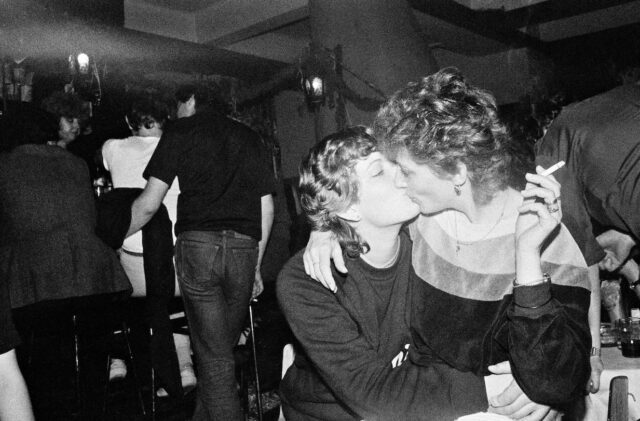
Told in five distinct acts that span the Prague Spring of 1968 and the fall of the Berlin Wall in 1989, Klára Tasovská’s I’m Not Everything I Want to Be chronicles the journey towards both artistic freedom and sexual liberation of renowned Czech photographer Libuše Jarcovjáková.
Back in the 1960s Prague, against a backdrop of Soviet oppression, Libuše was desperate to be a photographer. But she was not initially accepted into the renowned FAMU film school as she was from a “politically unreliable family.” However, if she were to show the “right attitude” she can re-apply, she was told.
So Libuše decided to adopt a more proletarian persona, taking a job in a print factory. Her co-workers were both curious and suspicious of her until she proved that she could hold her alcohol as well as they could, at which point all barriers were removed. She began to take intimate photographs within the factory, made close friendships, such as with the bewitching Jiriña (who “confuses men’s minds”), and she set out to seduce young men such as the “mysterious Richie.”
But when the ruling party got to see Libuše’s photographs, she was accused of defaming the workers and was forced to leave the factory. In a bar she slept with the barman and got pregnant, and only just managed to receive approval from the Abortion Committee to terminate the pregnancy, after which she felt both “devastated” and “worthless.”
When she was eventually accepted into the FAMU school at the age of 24 she felt uncomfortable within the “elite environment,” and subsequently escaped into the Prague nightlife where she met Franta, who was fun, and who offered the possibility of great sex. She became pregnant again and this time had a back-street abortion. She married Franta, but the marriage was doomed, as he refused to leave his mother, with whom he lived. The couple remained married, however, if only on paper.
Throughout, Libuše chronicled all these intimate moments her life in still photography, which are presented in the film, alongside readings from the diaries she kept over all these years.
“She was surprised that she took photos of everything,” Klára Tasovská tells BDE of Libuše’s reaction after her photographs were catalogued and digitised for the director’s I’m Not Everything I Want to Be, which is the Czech Republic’s candidate for an Oscar in the International Feature Film category. “And also she has a lot of self-portraits. That was also surprising for her.”
Thereafter Libuše set off an unwitting odyssey of self-discovery, to Japan where she befriended Katsuyuki, the husband of a Czech friend and who took an interest in her work.
When she returned to Prague she discovered the underground and clandestine T Club gay bar, where she met Eva “who is beautiful in her brokenness…it turns me on.” But after a murder close to the club, Libuše was asked to submit her negatives to the police, at which point she realised that her photographs were compromising the lives of her club members. She therefore refused to take any more pictures at the club.
The photographs from this period, when eventually exhibited In Arles (France) in 2019, invited comparison with the highly intimate work of Nan Golding, who was working and living in New York around the same time Libuše was active in Prague.
Libuše demanded, and was eventually granted, a divorce from Franta in order to arrange a marriage of convenience to leave Prague for Berlin. The decision represented both a “step into the void, but a step forward.” That said, on first encountering the Wall, she doesn’t know if she is “inside or outside the cage.”
When Libuše visited Tokyo again in 1988 she received a commission to photograph Rei Kawakubo’s latest Comme des Garçons collection. These pictures may have been highly regarded, but for her they were “purely commercial” works that didn’t reflect her personality. From the other side of the world, Berlin seemed once more a “positive” proposition.
Libuše returned in 1989 to take a job as a hotel maid, but “despite cleaning stairs, I’m still a photographer. Maybe even more so. The camera is a navigational tool. It helps me return back to myself,” she narrates.
Before the start of the new decade, the Wall comes down, and when she returned to the newly liberated Prague, she met and fell in love with the married Marta…
A delicate coda sequence suggests that Libuše’s subsequent life may have been a happy one.
Director Klára Tasovská knew of Libuše and her work before the 2019 Arles exhibition. “The Czech Republic is a very small place, so artists know each other well… but I never heard about her life story.”
She was approached on the occasion of Libuše’s 70th birthday to make a programme for Czech TV. “I met her and I was so fascinated by her and told them that we definitely had to prepare some huge project, an important work about her,” Tasovská tells BDE.
Libuše had offered some notes and comments from her diaries for the Arles exhibition, but for the film she gave Tasovská everything, which comprised tens of thousands of photos and diary pages. At which point the labour of love commenced.
“At the beginning it was a free timeline and it was stressful,” the director explains. “And then I saw that her story could be in five chapters, because she lived in Prague, in Berlin, in Tokyo, and then in Berlin again. And then she returned to Prague.”
Tasovská decided to collaborate with Czech editor Alexander Kashcheev, who edited the Oscar-nominated and Student Oscar winner Daughter (2019). “He also fell in love with the project and we worked together for two years, sitting eight hours a day and also weekends.”
The first cut of the film was two and a half hours, but it seemed “unstructured” and overlong, given how the visuals consisted of still after still. So it was cut back to 90 minutes. What’s more, the team were having to catalogue the photographs as they went. “At the beginning we didn’t know how it happened, this journey, because Libuše is a little bit messy, a little bit unorganized,” says Tasovská. Nevertheless the process of organising the material was both satisfying and “creative,” she adds.
“We had something on her discs in digital form, but not all the photos,” she says. “We worked with offline photos and then we had to rescan every photo, [all] 3000 photos and change it in the timeline. It was work for one month, but we did it.”
I’m Not Everything I Want to Be premiered at the Berlinale International Film Festival and has since travelled to more that 110 festivals and showcases all over the world, while securing distribution within several territories including Germany and Switzerland (Salzgeber), Portugal (No Comboio) and, as recently announced, the US (Grasshopper).
As the subject Libuše is a visual artist herself, how did she react to this visual interpretation of her life? “I think she loves it,” Tasovská replies. “Although sometimes it’s hard for her…some things like abortions and other things.”
“But she said that it’s very interesting to see her life – or some parts of life how she lived them. She’s very happy that we could make this film together. And also [that] she is the main narrator and there is her voice…She’s very happy for that,” Tasovská signs off.





