

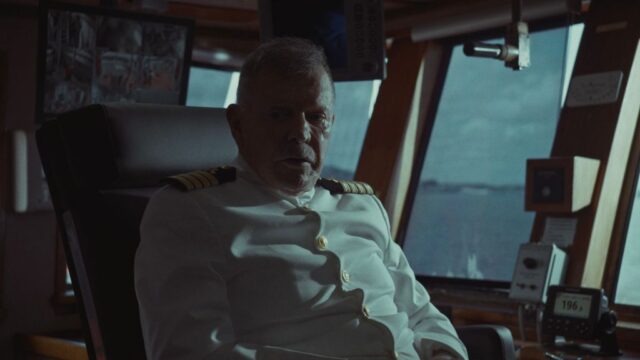
“What initially began as a portrait of loss and transformation is now evolving into something luminous, where life, resilience, and affection create space for hope,” says producer Estephania Bonnett (Playlab Films, Barcelona) of her latest project, Captain. Currently in production, the work is being pitched this week during FIPADOC Pro Industry days.
Directed by Laura Otálora, Captain is a farewell between a father suffering from Alzheimer’s, and his daughter (the director Otálora herself). The film is shot in seven scenes in reverse chronological order, from present day Barcelona, to the family’s early life in Colombia.
Far from being a story of sadness, producer Estephania Bonnett tells BDE, this is a tale of hope, “a poetic, loving, and complex gaze at how the loss of memory can, paradoxically, become an opportunity to heal broken bonds, to reframe the present, and to recover through affection what has been lost.”
The protagonist, Efrén, joined the Grancolombian Merchant Fleet as a young man, spending more time at sea than on dry land. His visits to family were fleeting, and from his daughter’s perspective, these were exotic events, full of tales from the sea, dreams of travelling the world, and spending time together reading Jules Verne.
Fast-forward to present day and, as we read in the film notes, ‘Efren has been forced to dock permanently in an Alzheimer’s residence… [the film is] an attempt to outrun time and embark on one last adventure together. Through the making of a film in which they revisit Efren’s memories using play, sensory stimulation and re-enactment, they reframe the disease, heal old wounds, reveal long-held family secrets and, little by little and to everyone’s surprise, transform his present, bringing life back to his once-absent gaze.’
Over seven years in the making, Captain will be finished this year. It hasn’t all been plain sailing though, explains Bonnett. The film was originally conceived as a voyage following daughter and father while he was still well, to revisit memories and life at sea, to re-connect before it was too late. Then Covid hit, and Efrán was diagnosed with Alzheimer’s.
“It was a very hard time, of course, as it’s also a very personal film,” Bonnett tells BDE. The director and producer were forced to pivot, but with the unexpected twist in the road, came transformation, both in terms of the different relationship between father and daughter and new discoveries about the disease, and also in terms of the film’s finance and production.
While the original idea started and ended in Barcelona, with funding being sourced from within Spain, the onset of the Efrán’s Alzheimer’s meant that Colombia would play a much bigger part in the narrative.
“So we found a very, very good co-producer [Nicolás Herreño Leal, Tomato Content, Colombia] …and with Catalan Film Fund grants and private Colombian and Spanish investment, we are now 80% funded.”
Laura Otálora used a Hi8 camera to film much of the footage, which reflects the family archives and the camera that recorded her early days. This is a cinematic approach which, the director posits, evokes a “dreamlike world, far from the tangible and lucid reality.”
Another unexpected transformation was that Efrán started to get better, becoming more lucid in the course of the filming. According to Bonnett, the Alzheimer’s specialists that they consulted [including collaborators Alzheimer Europe Foundation] advised them that this was likely because of the memories evoked during the filming, through the series of scenarios, role-plays and games devised by Otálora and the team, though it was unlikely that the progress of the disease was actually halted.
That’s where the film’s impact comes in, along with a message of hope. Bonnett explains. “So we have another way to approach the illness, not by feeling pity, but another way. And we found that the way that we want to address [Alzheimer’s] was by playing, by having lots of fun. And right now, Laura is also doing a farewell because he still has Alzheimer’s and he eventually is going to go, but she is feeling it from another place.”
Bonnett will make her Fipadoc pitch 29 January to the professional audience at Biarritz. Two versions are planned: 90-minute and 52-minute. What is the team’s ideal outcome?
‘We’d like to finalise our funding, and to get a sales agent on board as early as possible,” says Bonnett. “All the films I do, I pick the stories because they are a way of opening conversations… if we have on board people that are already doing that, like sales agents, marketing, that would be amazing because of course it would be multiplying synergies and multiplying ideas.”
Bonnett is looking for like-minded collaborators who really want to get the message out there. “I don’t want it to be just limited to festivals. I want to find spaces to start the conversation about [the] illness and also hope, [and] how you can address it from another point of view,” she signs off.





