

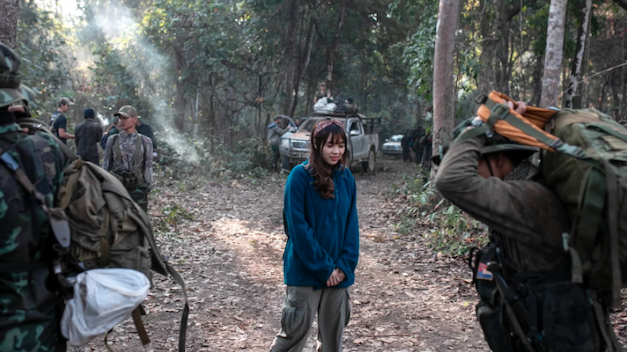
“This Is Not a Civil War tells the story of the silent revolution unfolding in Myanmar through the eyes of its youth,” French producer Tanguy Babin of PaladiOra Films tells BDE of his feature doc This Is Not A Civil War, which is set for completion August 2026.
In the film, Hnin (26), a Burmese activist living in exile in Thailand after the 2021 coup and subsequent role in anti-junta protests, secretly returns to Myanmar to witness how the revolution is unfolding. Moving between the jungle and the cities, she encounters a new generation determined to rebuild the country without taking up arms—through education, healthcare, and independent or underground media. In the midst of bombings, airstrikes, and devastation, simple acts like teaching, treating the wounded, or reporting the truth become forms of resistance.
“Since the military coup in 2021, an entire generation has engaged in the struggle for democracy, often at great personal risk,” Babin tells BDE. “The film seeks to portray this reality from the inside, at a human scale, by following individual trajectories that embody the hopes, contradictions, and determination of a generation in resistance. A generation that fights without weapons, but by healing, educating, and informing, in order to resist the junta and contribute to rebuilding a democratic society.”
He adds: “The film aims to move beyond a strictly geopolitical reading of the conflict and instead reveals human stories that are intimate and universal. Through the future impact campaign, our goal is to circulate these testimonies in screening and discussion spaces, each time in partnership with a different NGO, in order to help maintain international attention on the situation in Myanmar. These events will also invite audiences to reflect on their own political and social realities, to recognize the often invisible fragilities within their societies, and to encourage concrete forms of engagement through calls to action.”
Burmese director Hnin Thet Hmu Khin brings a unique proximity to the story, producer Babin underlines. “As an activist who experienced exile after the coup, she embodies the perspective of a generation whose life was abruptly overturned by the return of military rule. In the film, she becomes both the narrator and the guide, leading us through her clandestine return to Myanmar and introducing us to the people she meets along the way. Her personal journey allows the film to access stories and environments that would otherwise remain invisible,” he tells BDE.
“Oliver Petrie complements this perspective with a strong documentary vision and long-standing personal ties to the country,” Babin adds. “He has known Myanmar for more than twenty years and has closely followed its political evolution. His experience as a photographer and filmmaker allows him to capture the reality of the conflict with an immersive approach, filming at the level of the protagonists and sharing their daily lives.”
“The collaboration between Hnin and Oliver creates a powerful dialogue between an insider’s perspective and a filmmaker’s narrative approach, resulting in a film that is both deeply personal and accessible to an international audience,” he adds.
Babin further describes the impact campaign he will be launching for the film. “By following the community of Demoso, the film shows how resistance can lie in everyday gestures and collective acts. We want to celebrate these quiet forms of resistance while helping younger generations recognize threats to democracy in a world of growing authoritarianism and international influence. We aim to open discussions about what ‘taking action’ means.”
“Even from far away, people can act,” he continues. “By standing with local organizations, sharing reliable information or signing petitions, they can take part in a broader, collective effort to push for political and economic pressure that protects democratic voices.”





