

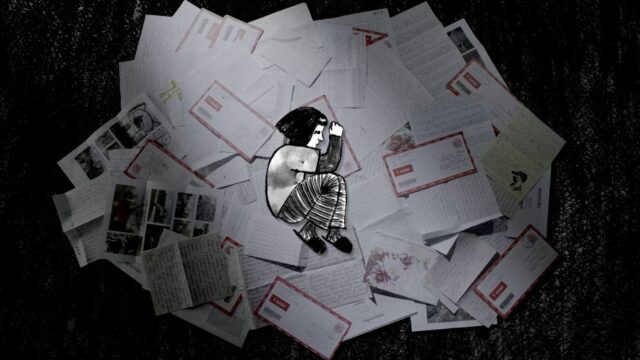
Belarusian filmmaker Andrei Kutsila is currently in post-production on Letters (WT), a 90-minute documentary that portrays contemporary Belarus through the correspondences of people affected by political repression, imprisonment, exile and state violence. Produced by Mirosław Dembiński for Poland’s DocEdu Foundation, the film is a Poland-Germany-Lithuania co-production with inselfilm produktion and Moonmakers.
The project was presented at Millennium Docs Against Gravity’s Progress Pitching Session on 8 May, where the team were looking for distributors, broadcasters, festivals, VoD platforms and post-production funds.
The film is rooted in the aftermath of the mass peaceful protests that erupted in Belarus in 2020, and which were subsequently crushed by the authorities. Since then, public dissent has been driven underground, with many activists, journalists and ordinary citizens imprisoned, forced into exile or compelled to live in hiding. Letters approaches this landscape not through a conventional political chronicle, but through intimate written testimonies: prison letters, personal messages, diaries, drawings and archival fragments.
The project’s synopsis describes Letters as “the story of contemporary Belarus told through stories of individuals who have endured imprisonment, repression, and exile — voices silenced by an autocratic regime.” Each story reveals a different experience of repression, from survival inside prison to avoidance of arrest, separation from family, grief and life under surveillance.
The film follows several protagonists whose experiences form a polyphonic portrait of Belarusian society after the suppression of the 2020 movement — a society marked by fear and silence, but also by forms of solidarity, memory and resistance that continue through writing.
One chapter, for example, explores art and imprisonment through Kasia, a young woman jailed for taking part in protests. Having dreamed of becoming a designer, she continues to draw behind bars. Her correspondences and images offer a glimpse of prison life, censorship, anxiety, humour and the persistence of imagination under conditions designed to erase individuality.
The film also follows Andrei, a former member of the Belarusian law-enforcement system who refused to cooperate with the regime after the post-election violence of 2020. His escape from Belarus and subsequent life in Poland open a reflection on complicity, awakening and the possibility of leaving a system built on obedience and force.
Another strand centres on Vitold Ashurak, a political prisoner who died in custody under unclear circumstances. Through his correspondence with his friend and mother, the film builds a portrait of a man whose letters combine tenderness, historical memory and political conviction. His story turns private correspondence into testimony against erasure.
The film combines observational footage, amateur videos, phone images, drawings, police and surveillance recordings, archival materials and letters read as voiceover. Its texture reflects the conditions under which the story is being told. In many cases, openly filming in Belarus is impossible, and therefore the film’s fragmented, intimate form becomes part of its political meaning.
The project description also highlights the role of Kasia’s drawings, which animate the inner life of a person cut off from the outside world, as well as footage from home videos and personal archives. Rather than present Belarusian repression through statistics alone, Letters seeks to translate political violence into lived experience: what fear does to the body, what absence does to families, and how connection survives when ordinary public speech has become dangerous.
Kutsila is one of the most prominent Belarusian documentary filmmakers of his generation. His previous film When Flowers Are Not Silent, about the Belarusian protests and their aftermath, won Best Feature Documentary at the Warsaw Film Festival in 2021. His earlier work Summa won the IDFA Award for Best Medium-Length Documentary in 2018, while in 2019 it received the Silver Hobby-Horse for Best Documentary in the National Competition at the Krakow Film Festival. Since leaving Belarus in 2021, he has lived and worked in Poland.
The project is produced by the aforementioned Dembiński, a veteran Polish docmaker and producer with more than 30 years of experience and over 80 films to his credit. Dembiński’s work has received more than 120 awards at international festivals, and through the DocEdu Foundation he has supported young filmmakers from Ukraine, Belarus and Georgia via programmes including Young Europe.
Inselfilm is represented by Gregor Streiber and Friedemann Hottenbacher, whilst Moonmakers is headed by Lithuanian director-producer Giedrė Žickytė. The team also includes editor Piotr Ogiński, composers Vygintas Kisevičius and Paulius Kilbauskas, and sound designer Saulius Urbanavičius.
Letters has a total budget of €424,712, with €385,923 secured. Confirmed financiers include the Polish Film Institute, the Lodz Film Commission, Polish Television, Deutsche Welle, inselfilm, Moonmakers, the DocEdu Foundation, the National Film Centre of Latvia, ZDF/ARTE and the Connected Foundation.
The film is slated for completion in November 2026. Its ambition is to offer a collective portrait of a silenced country through the most fragile and persistent of forms: letters written across prison walls, borders, exile and grief.





