A heartwarming insight into the life of Haitian refugees in Mexico City, who’ve built a strong community out of small tents, in anticipation of the promised land.
A tent camp has sprung up in a square in Mexico City, home mainly to Haitian refugees awaiting visas. They live there under the watchful eye of Giordano Bruno, a scientist and freethinker who was persecuted and murdered in the seventeenth century for his ideas, which ran counter to Catholic dogma. The camera immerses you in everyday life in the tent camp, where a close-knit community has formed over the months during which the film was shot.
In the finest tradition of direct cinema, the camera closely records and observes what is happening in the makeshift village. News of appointments at the visa office – and whether this or that person has been granted a visa – always plays an important role, but life goes on as normal in the meantime.
Women cook in makeshift outdoor kitchens, chatting amongst themselves about love, voodoo, the country they left behind and their future. The men hang about, mending a tent, calling out comments to the women, joking and arguing.
Every day, the older children leave the camp, heading into the neighbourhood with empty jerry cans and plastic bottles to fetch water. Hair is groomed, feet are filed, and cuticles are trimmed. There are always people waiting outside the makeshift shower – a square tent with a row of water bottles outside it.
The outside world is more or less shut out, so that all focus is on ‘normal’ life, in which the floor is swept neatly every day, the blankets in the tents are smoothed out and the washing is hung up. Every now and then, news comes through that someone has managed to cross a border, or that someone has been sent back to their country of origin.
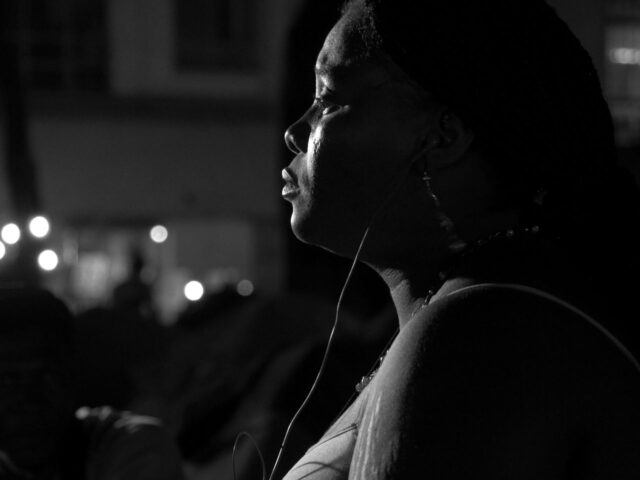
The wonderful thing is that nowhere is there any judgement passed on life in this bizarre microcosm, although one does wonder what kind of life these people fled from. What comes across in the striking black-and-white images is their dignity, strength and ability to turn a situation that at first glance seems hopeless into something liveable. The refugees do not see themselves as victims, nor do they behave as such; instead, they do everything in their power to remain in control of their own lives.
There are beautiful moments of stillness and focus – such as when a girl applies her make-up in a shard of a mirror, or when a woman, singing, chops up a cabbage for yet another large pan of food – in which the director’s observant and respectful eye is clearly evident. And there is plenty of room for humour, which is essential for keeping life going in the tightly packed tents, where nobody has any money.
As a viewer, you are drawn into this noisy, warm, resilient community, whilst learning about the (changing) relationships between men and women in Haiti, faith and superstition, and migration policy, and you are left with a glimmer of hope for better times.
Mexico 2026, 97 minutes
Direction and cinematography Juan Manuel Sepúlveda
Production Juan Manuel Sepúlveda,Mariana Mendivil
Editing Pablo Gil Rituerto
Sound Design Thomas Becka, Antonio Porem
Sales Frague Cine