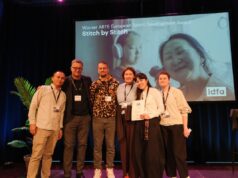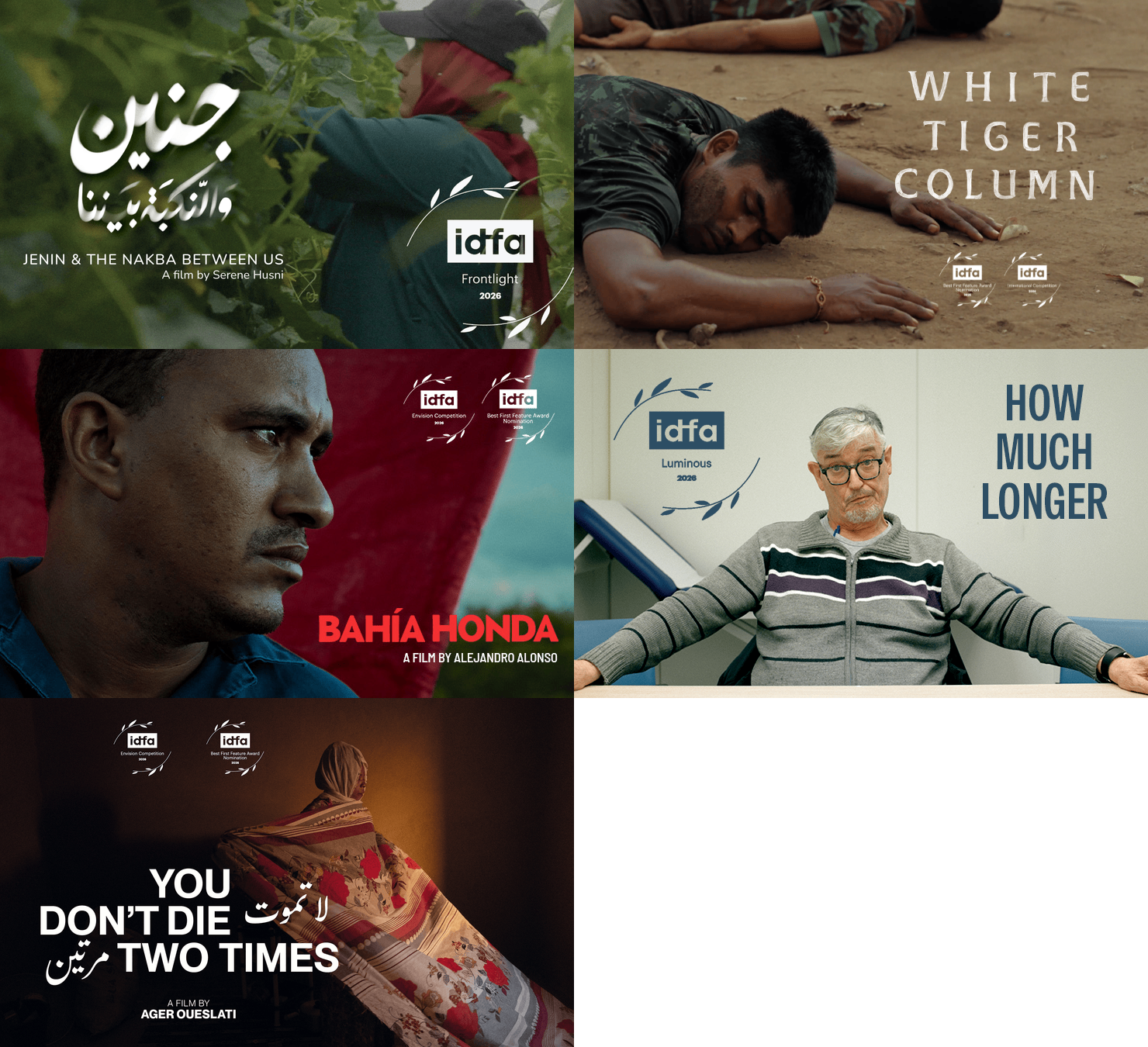
The IDFA selection in 2026 includes no less than 14 creative feature docs, three of which played in International Feature Competition (Bardi by Tala Hadid; Hazara Town by Khadim Dai; Morro Grande by Isabel Joffily, Rita Toledo), and two in Envision Competition (Alejandro Alonso Estrella’s Bahía Honda and Ager Oueslati’s You Don’t Die Two Times). A further boon has been the presence this week in Amsterdam of Tatiana Huezo, a recipient of IBF funding, as Guest of Honour.
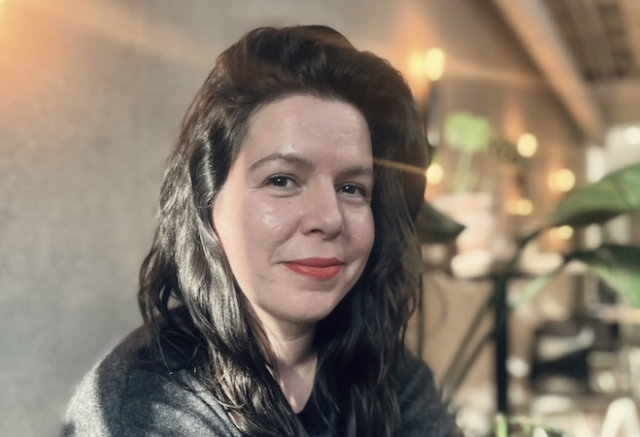
“Of course, she’s an accomplished filmmaker in her own right, but it’s wonderful to see that the Fund was there to see her develop her creative independence. And seeing her at IDFA as Guest of Honour is a testament to the possibility of building a long and fruitful career. That alone really stands out for me,” says Selin Murat Head of IDFA Bertha Fund.
There are more than 50 grantees coming to Amsterdam these days, she adds. “Some have films in progress, others have projects at the Forum or IDFAcademy, and some are working on their next films, building on their careers.” Furthermore, several of the Fund harvest at IDFA this year were presented as world premieres. “Being able to see these filmmakers watching their films on the big screen for the first time is always such a special moment.”
The IDFA Bertha Fund (IBF) champions independent documentary filmmaking in parts of the world where filmmakers face significant obstacles in securing finance, accessing distribution networks and maintaining creative autonomy, such as parts of Africa, Asia, Eastern Europe, Latin America, the Caribbean and Oceania. It focuses particularly on regions where established public and private funding mechanisms are limited or absent, and where censorship may impose further constraints on artistic expression.
A core criterion of support is a strong commitment both to and from filmmakers whose work demonstrates originality, artistic ambition and a willingness to challenge conventional approaches to documentary storytelling.
“For me, the value of the Fund lies first and foremost in its ability to provide relatively unrestricted funding,” Murat further underlines. “It’s funding that comes with very few strings attached and is genuinely intended for creative development and creative producing, to be used in whatever way the film teams need.”
“Our minority co-production schemes, which we run with Creative Europe MEDIA (IBF Europe) and the Netherlands Film Fund (NFF + IBF), also encourage fair and equitable co-production structures. They allow filmmakers and grantees to work through international collaborations in a way that we believe is more transparent and fair,” she adds.
“Beyond the funding itself, [even] though I have to say that money is ultimately what filmmakers need most, I value that we foster a sense of community. And an independent documentary film community really does exist. It’s global, but also very well connected.”
I put it to Murat that in an ideal world, there would be little need for IBF funding, that the regions she and her team target would be self-sustaining. Is that dream any closer to coming true these days, compared to when the Fund was first launched?
“That is the dream, isn’t it?” she responds, adding that her mandate is actually expanding rather than shrinking. “At this point, it’s almost global. Very few territories are excluded from the Fund: some of our colleagues in France, Germany, parts of Western Europe, the Nordics, Canada for example still benefit from robust public financing systems. But when I speak with them, it’s clear that being an independent documentary filmmaker isn’t easy for them either. Sustaining a career as an independent filmmaker is incredibly difficult, and I think it always has been, but it’s particularly challenging now.”
“To give you an example, we’ve seen an almost twofold increase in applications across all our schemes between 2020-2025, while the number of projects we can support remained the same. That means the success rate keeps getting smaller,” she continues.
“The projects we’ve been able to support increasingly come from territories where freedom of expression and filmmakers’ safety are becoming serious concerns,” Murat adds. “Up to 80% of the films we’ve funded in the past two years have come from filmmakers who are putting themselves at risk to tell the stories they want to tell.”
“So, yes, it remains a dream. In the two years that I’ve been formally involved with the Fund, and throughout the almost 20 years I’ve been in the documentary film industry, I haven’t seen that dream coming any closer to reality. Unfortunately, the situation seems to be moving in the opposite direction.”
Unlike most sections of the festival, closing night doesn’t represent a culmination of Murat’s year’s work. Rather, the festival is part of the Fund’s year-round continuum.
“The festival ends, and hopefully our colleagues who’ve been working towards it get some time to rest. But we’re already preparing to announce our next funding calls, with deadlines early next year,” the Fund boss says. “We’re also already lining up the industry professionals from around the world who will be reading applications and joining the selection committees for the upcoming rounds. So our work is just ramping up again, and this winter will be busy, which is great.”
“I love seeing an IDFA Bertha Fund-supported film at IDFA, but it’s also incredibly exciting to meet our colleagues, collaborators and grantees in their own territories and homes,” she adds.
“Throughout the year, there are markets, festivals and new places we’re invited to visit and where we can start new collaborations. We love those opportunities. It’s really nice to see people in Amsterdam, but I also appreciate going out to meet colleagues in their own spaces. And that’s perhaps one of the most wonderful things about our film community: it’s global yet closely connected,” Murat signs off.