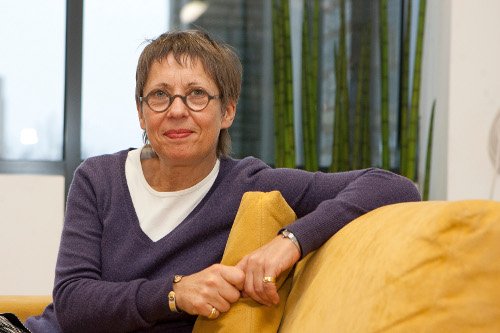
EFA director Marion Döring and outgoing IFFR chief Bero Beyer update Business Doc Europe on the IDFA/IFFR/EFA film initiative designed to support international filmmakers who face political persecution for their work.
Ahead of the European Film Awards (December 7 2019), EFA’s Marion Döring explained the progress she and her colleagues have made in developing the Coalition for Filmmakers at Risk, an initiative of IDFA, IFFR and the European Film Academy. She said that a foundation will be in place as of March 2020 ahead of a “real start” to activities in 2021, by which time she is confident that an operational budget will be secured and staff in place.
“We have a preliminary budget and now we are in touch with institutions that can help us with the basic funding. In March next year [we] will be a Dutch foundation, a Dutch Stichting” she said.
“But the real start will be in 2021,” she added, “Now we will work with what we have, the two festivals and EFA on board, but in the future we will need an independent budget, and we will need to have people to work for this… Once we have started working there will be more and more cases coming to us, so we need to be efficient and ready.”
Last week at IDFA, IFFR’s Bero Beyer and IDFA Creative Director Orwa Nyrabia met with potential partners about the initiative.
“We had good meetings, everybody realises there is a clear need and we have received nothing but positive feedback on the concept,” commented Beyer. “Everybody in the whole film industry realises that this is something we should pay attention to… We will always make sure there is a co-ordinated effort to jump up and scream if we have to, or to be very delicate and quiet, as we work for the safety of filmmakers who are part of our filmmaking community.”
Added Döring: “It’s not that we will work just with our three institutions, we will also operate with strategic partners such as festivals or associations inside the film community and of course we will also work with stars and with filmmakers, and ask them to give their voice and their support. It all depends on the different cases.”
“Sometimes it is good to make noise and sometimes it is better to work silently and to involve, for example, embassies or cultural institutions,” she agrees with Beyer.
Döring also confirmed that EFA, IDFA and IFFR held recent meetings with international human rights agencies such as Front Line Defenders, Icorn and the Martin Roth Initiative. “We want to gain more knowledge and we want to be better prepared for the cases that will come up in the future.”
“There is a frenzy now with IDFA having just ended, with the European Film Awards this weekend and IFFR coming up, but if all goes well with the connections that we have made over the last few weeks, I am confident we will be able to set up a clean, sharp, focussed organisation that is easily fundable,” stressed Beyer.
During this weekend’s European Film Awards, EFA deputy chairman Mike Downey will address both the gathering in Berlin and the worldwide internet audience to underline the need for the Coalition initiative.
“If we can professionalise and co-ordinate our possibilities, we will have a greater chance of being effective and providing real hope to those members of the international film community who are in need,” he told BDE. “The International Coalition for Filmmakers intends to be an organisation to advocate for, and to act in solidarity with, filmmakers at risk, respond to cases of persecution or threats to the personal safety and/or liberty of the filmmakers as a result of their work, and to defend their right to continue their work by mobilizing the international filmmaking community.”
Beyer stressed how future campaigns to offer support to filmmakers in jeopardy must be as organised and as well co-ordinated as possible to deliver the desired results. He cites the case of Ukrainian filmmaker Oleg Sentsov who was released in September 2019 after more than five years of incarceration in Russia, and five years of appeal from the international film community.
“[The Sentsov case] proves that if we are loud enough at the right moment then something can happen, but it is also proof that the more co-ordinated we are then the stronger the impact can be, and that is exactly the idea of the coalition.”