In O que não se vê (What you don’t see) Portuguese director Paulo Abreu returns to a project he put to one side after the death of his friend and collaborator, turning it into something altogether different during lockdown.
The initial plan was to make a film based on a book written over a century ago, Raul Brandão’s ‘As ilhas desconhecidas’ (‘The Unknown Islands’), composed in a broadstroke Impressionist style that director Paulo Abreu wanted to replicate on celluloid. “Brandão is a writer who writes like a painter,” the filmmaker underlines.
The proposed film entailed shooting on the Azores islands of Faial and Pico. Director Abreu and DOP Lee Fuzeta travelled to Faial in 2016 for reconnaissance, and were joined on the later trip to Pico in 2016 by producer/actor João da Ponte (who had suffered an earlier attack of claustrophobia which meant he refused to board the flight for the first trip).
But the project was destined never to get off the ground, as it were, due to unreliable weather and incessant fog on the key island of Pico. Nevertheless the footage that was shot forms the basis of a fascinating and funny study of camaraderie and loss in which images play as metaphor for the lot of the artist.
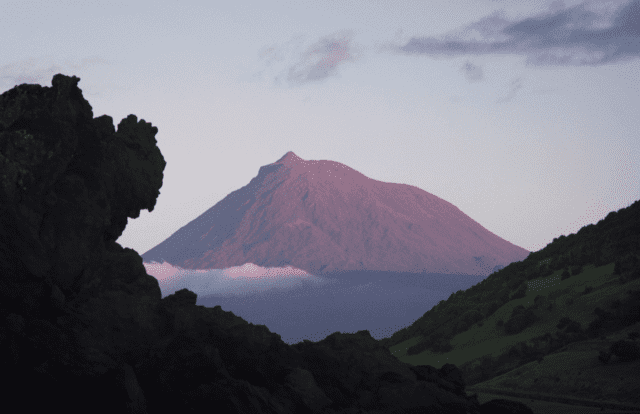
In the film we are reminded of John Ford’s observation that three things will always sustain our interest on screen; a mountain, a dancing couple and a running horse. The first of these – a giant mountain on the island of Pico – dominates the first half of the film. We see it from all angles and in all guises. As presented, it could be the backdrop for a Scottish highland idyll, or a dream Balinese honeymoon backdrop. Or when it blazes red at dusk, it could be a feature on the surface of Mars, even the location for UFOs. Sometimes it is bathed in cloud, which presages the frustrations the protagonists feel in the second half of the film.
“All the people living on the islands [surrounding Pico] are very anxious if the island will appear that day or not, like the mountain is a god for them,” says director Abreu.
But when the filmmakers return the next year to reccy the island of Pico itself, things could not be more different, nor more stark, as the landscape is rendered unobservable, and the roads almost impassable, by a continuous thick fog. While the first part of the film enables myriad ways of seeing because of the sense of distance maintained by the filmmakers, getting up close and personal with the subject in the second half diminishes their ability to observe, to perceive and to understand.
But there is hope. The gregarious João is in the front of the car, talking, chatting and referencing Robbie Burns, the national poet of his beloved Scotland. João and Abreu had previously worked together on a mockumentary about a fake director who makes films about UFOs (hence the references to objects in the sky in O que não se vê.) The producer/actor therefore becomes our focus. Which makes this even more a film about cinema, its processes and the path to a work’s realisation (or otherwise). The budget, the fimmakers eventually conclude, could never stretch to cover a protracted stay on an island on which meteorological conditions are so mercurial.
Three days after the crew returned to Lisbon, João died of a heart attack. At which point director Abreu immediately dropped the project. “For years I never looked at the footage,” he confides.
But when he did, in 2020, he discovered another film. Time, both in the sense of the passing years and in what lockdown offered up, enabled him to tell a renewed story of a friendship within a film about a film. The Brandão theme was dropped (despite Abreu retaining a deep appreciation for the writer’s work) and the gap was plugged by an invented and amusing conversation between Abreu and a fictitious, cynical producer, laid over scratchy Super-8 footage of the mountain. “That destroy[ed] the idea of my initial project.”
“I began to edit and suddenly it was like by accident that a marvellous film was made,” Abreu adds. “The film is an homage to him [João]. I think he would be very happy. I think he would love it.”