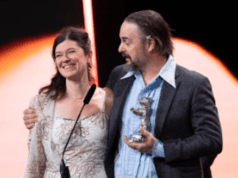
Mr Nobody Against Putin by Pasha Talankin and David Borenstein was handed the Bafta for Best Documentary during the award ceremony February 22 at London’s Festival Hall.
The film, which is also nominated for Academy Award, follows a Russian teacher (Talankin) who documents the Putin administration’s movements in control public perception of the ongoing war in Ukraine.
It is produced by Helle Faber of Made in Copenhagen, and Alžběta Karásková & Radovan Síbrt of Prague-based PINK.
The four other nominated films within the Documentary category were:
- 2000 Meters To Andriivka by Mstyslav Chernov
- Apocalypse In The Tropics by Petra Costa
- Cover-Up by Laura Poitras, Mark Obenhaus
- The Perfect Neighbor by Geeta Gandbhir
The Perfect Neighbor is also nominated for the 2026 Feature Documentary Oscar.
As Business Doc Europe wrote before the world-premiere of Mr Nobody Against Putin at Sundance 2025, on the one hand the film is giving audiences insight into the sheer extent of the propaganda Russians have been fed about their country’s full-scale invasion of Ukraine. On the other, though, it’s a warm and often funny account of a school teacher devoted to his pupils.
Pavel “Pasha” Talankin (the documentary’s co-director) is the videographer at a primary school in Karabash, an industrial Russian town known for its high pollution levels and low life expectancy. He’s a free thinking and gentle character.
“He has such a warm heart for this school and the people around him. He is a kind of class clown figure who has always been the joker holding a camera in the halls of the school,” co-director Borenstein observes.
The collaboration between Pasha and Borenstein (an American filmmaker based in Denmark) began in unlikely circumstances. Feeling as if the walls were closing in on him, Pasha initially thought about resigning from his job at the school in protest against the way the curriculum had been hijacked by pro-war zealots. Instead, he made contact online with someone from Europe who wanted him to make a film about how the war is affecting his school.
Pasha takes back his resignation and instead starts chronicling the goings-on in the classrooms and corridors. At times, for instance when some Wagner Group mercenaries drop by to give a lecture and show off their weapons, school life takes on a surreal air.
“The very special tone of the piece comes from the most radical part of the project which is the decision for Pasha and I to co-direct,” Borenstein states. He put his trust in Pasha to shoot what needed to be shot. Pasha, meanwhile, who was half convinced the whole documentary idea was a scam, agreed to send his footage to a stranger thousands of miles away whom he had never met.
“This is something of a political thriller and a very vital record of wartime Russia, but then to have Pasha’s voice at the centre creates that heart-warming, schoolyard drama vibe as well.”