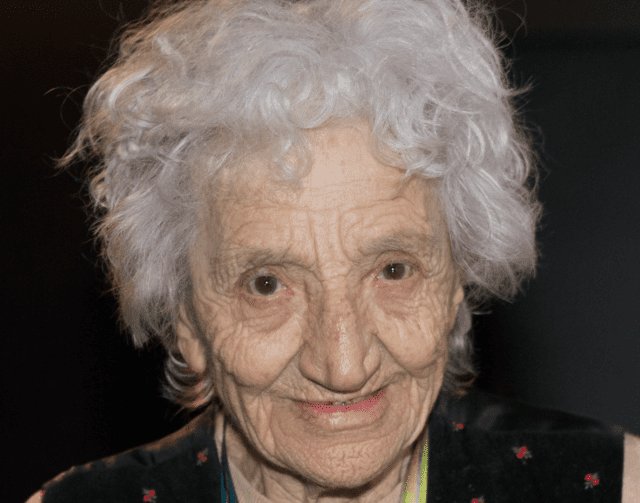
“I came quite late to the work of Cecilia Mangini,” Mike Downey, producer and European Film Academy Chairman, commented this week. “But when I discovered her work it blew me away.” The first female to direct documentaries in post-war Italy, she remained an active practitioner till her death at 93 this week.
“Director, photographer, screenwriter, she chronicled the history of fascism and censorship in her native country, the suffering of women, the south of Italy and the Roman suburbs.
“Anarchist, libertarian, and rebel – her films reveal her as a fearless fighter and champion of the voiceless, the dispossessed and the disadvantaged. European cinema mourns the passing of one of the greats.”
Cécilia Mangini (1927, Italy) was an Italian writer and photographer and filmmaker who began her career in film as a critic for publications such as Cinema Nuovo, Cinema ’60 and L’Eco del Cinema, before turning to filmmaking in collaboration with her husband, Lino Del Fra, as well as the legendary auteur Pier Paolo Pasolini.
Over the course of six decades, Mangini made works that were defined both by a deep humanity and an unyielding concern for the human condition, covering the gamut of social and political issues from abortion to class struggle to pay inequality.
With Pasolini she made Ignoti alla città (Unknown to the City, 1958), about the idle and disaffected youth of post-war Rome. He wrote two further documentaries for her, La Canta delle marane (The Blues of the Marshes), which was inspired by his novel ‘Ragazzi di Vita’ (‘The Street Kids’); and Stendalì which is a reflection on the traditions within the South of Italy as locals reconstruct an ancient funeral rite.
“I owe Pasolini a lot, both for the scripts and also because he was considered so dangerous – so frequenting him I was exposed to risks that were very useful to me,” Mangini said of the collaboration.
At heart, she was a pioneer, a fighter and an evangelist, a passionate advocate for the equal status of women, for justice and for workers’ rights. Hers was an anarchic but gentle heart, kind and without prejudice. And all of this is evidenced in films such as All’armi, siam fascisti (To Arms, We’re Fascists), her highly controversial 1962 documentary that chronicles the rise of Italian fascism (and the consent given by some of the country’s captains of industry), and Essere donne (Being Girls, 1965), a coruscating critique of pay inequalities for women.
Venice Film Festival president Roberto Cicutto paid touching tribute to Mangini this week: “I met a generous artist, enthusiastic like a kid, yet rigorous and demanding like a great professional. She was joyous and thankful to life. Without sounding self-congratulatory, she was aware she gave a lot to culture and the arts.”
Her final film Two Forgotten Boxes (Due scatole dimenticate), co-directed with Paolo Pisanelli, comprises a heart-warming (sometimes heart-breaking) reflection on the period she spent in Vietnam with her husband in 1965 as they researched a documentary about a people at war. Sometimes her memories are unclear but the beautifully catalogued photographs in the two forgotten boxes help lift the fog, at which point she becomes sharp as a pin.
There is one moment in the film which crystallizes her intrinsic humanity, her concern for the dispossessed and her understanding of the transformative quality of the medium she chose in order to express her art and politics. As we see her sitting among the curious, clever and very creative Vietnamese children, taking their pictures, she observes very quietly how, “giving every child a camera would be a truly Socialist action.’’