Short-listed for a European Film Award, and in the Oscar race across three categories (Best Documentary Feature; Best International Feature Film [Montenegro] and Best Cinematography), Biljana Tutorov and Petar Glomazić’s Sundance-winning feature documentary To Hold A Mountain is a paean both to nature and to love…and to resistance.
Sinjajevina is the Montenegrin mountain of the film’s title, an elemental force that the locals call Mother, and the place to which the ageing Gara and 13-year old Nada return each summer. Together, they live in the remotest of outposts, tending to their cattle, making cheese and, at times, walking for miles up hill and down dale to locate errant livestock. It is a film that is warm and elegiac, and a study in the pastoral practice of transhumance.
But the fragile harmony we see is threatened when the Montenegrin government announces plans for a NATO-backed military training ground in the heart of this UNESCO-protected landscape. The thrum of helicopters begins to interrupt the silence, and fear and uncertainty seep into the community.
What’s more, Nada and Gara share a tragic history, the details of which we are slowly fed throughout the film, that renders their bond unbreakable.
Over the course of seven summers (and 230 shooting days), the older Gara, on her white horse and resembling an avenging angel, leads the resistance to the militarisation of the mountain, while Nada grows towards womanhood. Between the silence of the past and the uncertainties of what is to come, the pair must also navigate a path through their grief and ensure that the cycle of familial harm is broken.
Co-director Biljana Tutorov recalls the first time she saw the mountain. “It was really like entering an Old Masters painting with this amazing light and this very distinct colour palette, these dirty pinks and deep greens, golden and purple,” she says. “We thought, ‘wow, this is really like a stage for a story.’”
Years later, when the filmmakers heard about the NATO take-over of the mountain they returned. But there still wasn’t a film, until Gara appeared on her white horse to address the community about the imminent military operations. “For me, that was the moment when the film really started,” says Tutorov.
Co-director Glomazić, and life partner of Tutorov, remembers it slightly differently. “This story began much earlier in my early childhood, because I’m coming from this northern part of Montenegro, and through my family roots I’m deeply connected to this way of living and this very old tradition of herding,” he tells BDE. “I spent all my summers in my childhood and teenage time with my aunts, the sisters of my mother, being a shepherd with the herds, going through this beautiful, vast, empty land.”
“So yes, I really wanted to tell the story about them. And then, when we were together for the first time at Sinjajevina Mountain, it was easy to agree that this is the stage, this is the place to tell the beautiful, slow, poetic story about the people and this beautiful land.”
Tutorov further explains the sense of immediate, mutual trust that was established between the filmmakers and their subjects. When they understood the extent to which Gara and Nada were prepared to share their story, the filmmakers developed an unshakeable sense of purpose, of ethical responsibility towards them. “It was not spoken, but between us, it was clear that that is the main condition for this film, that we will never do anything that will hurt or betray them.”
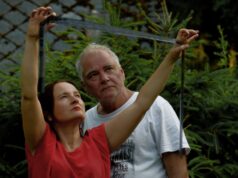
DOP Eva Kraljević, who trained at NFTS in the UK and who has a Montenegrin father, also trained in psychotherapy. “She has a very special human quality,” says Tutorov. “The three of us were really a very good team. And we lived together in a small shepherd’s cottage not far from Gara and Nada, and we really became family.”
In the film, there is one particularly long and poignant scene, shot in the morning, where Gara is reading the grains in her coffee cup. “She was contemplating her destiny,” says Tutorov. “And that very moment, Nada woke up for the first time aware of her own destiny.” What ensues is a deeply moving and tearful sequence during which Gara explains the exact circumstances of the Nada’s early childhood. “We left the room, but Eva was smart to leave the camera on, so that’s why we have only one angle, but we thought we shouldn’t be here.”
The experience was instructive. Afterwards, the filmmakers were wary of having encroached on Gara and Nada’s privacy, realising that very personal family details were revealed, and so looked to build their language around the taboo. They therefore told Gara that they wouldn’t use the sequence. “But she then said, ‘you haveto use it. We really want you to use it.’ And from that moment on, it was very clear that that’s just how it was. This intimacy was never something we needed to convince them of, or which we needed to earn.”
Tutorov further describes the almost mythical context in which their film was playing out. “We actually really saw it as a Greek drama, so we started thinking how to organize the stage. Suddenly the mountain took the role of the chorus, it became the witness of their story, but also of all the other stories. And little by little, it was coming together, with us always thinking of how to remain ethical and faithful to our original pact with our participants.”
She also points out the “two consequences of patriarchy and their possible interconnection,” within the story, that of the military activities on the mountain, and the violence against women that has, in part, shaped the lives of the protagonists.
The film has already screened at more than 50 festivals around the world, with another 40 already confirmed. “We’ve heard so many deep and profound readings of the film from many different people from different languages, from different cultures. But also we learned that there are many, many, hidden secrets in all families all around the world, and there are many themes that it’s not easy to talk about. This film and the destiny and fate of our protagonists is something very close to every single person in the world, and we can understand the challenges they are facing.”
The film’s submission to the Oscars as the representative of Montenegro is “quite a twist,”, the filmmakers note. “It’s a new government that is really trying to change the paradigm after 30 years of one man and one political party ruling the country, but still it’s kind of a statement that Montenegro officials are planning to screen the film in Strasbourg as Montenegro is taking over the presidency of the Council of Europe.”
“When the president saw the film, he decided to give Gara a high state distinction, The Order of the Montenegrin Flag,” Tutorov reveals. “He said, ‘I would like to thank you guys for teaching us democracy.’”