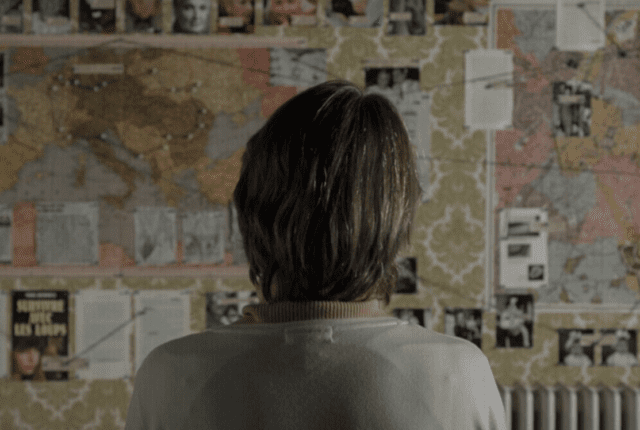
A fascinating story of falsehoods, self-delusion and literary deception, Misha and the Wolves is an enthralling and often incredible documentary full of twists and turns that prompt a series of questions that at heart are difficult to answer.
At its core is the revelation that a dramatic story of a woman whose Holocaust memoir, which took the world by storm, turned out to be pure deception, but which also hid a darker and uncomfortable truth.
The film is cleverly structured to tell this strange story (and contains a ‘twist’ of its own that the filmmakers are keen not to have revealed, although the central aspect has been reported widely in the past). Misha and the Wolves attempts to get to the core not just of how things happened, but also give some thought as to why. Interviews, re-enactments and archival footage blend nicely to try and detail the truth behind Misha Defonseca and her astonishing story.
In the early 1990s, Defonseca had moved with her husband Maurice to a small friendly town in Massachusetts. Seen as mildly eccentric – she had many cats apparently – but friendly, she began to tell friends in the Jewish community of her experiences as a young girl during World War II. She had been given a new name, she said, was ‘hidden’ with a Catholic family in Belgium and eventually decided to walk east across Europe to try and find her deported Jewish parents. Her story saw her evading Nazi soldiers, eating insects and eventually even befriending a pack of wolves.
Local publisher Jane Daniel heard of her amazing account and persuaded Misha to write the story as a memoir. Their relationship was often strained, but buzz around the book grew and grew. Translation rights were sold around the world; Disney wanted the film rights and when Oprah’s Book Club got involved there was a guarantee that it would be an international bestseller.
At that point Misha started to get uncooperative and reluctant to take part in the Oprah Book Club show, with things eventually resulting in her taking Jane Daniel to court, accusing her of stealing the copyright and withholding royalties. The jury at the Middlesex Superior Court in Massachusetts found for the Holocaust survivor on all counts and the judge ordered Daniel to pay damages of $22.5 million.
Devastated, Jane Daniel decided to write a blog about her experience and went back to her attorney’s research. There she found a bank slip, written in Misha’s hand, which gave her mother’s maiden name as well as her own date and place of birth, all of which she had claimed to not know, stating that her true identity was lost in the war. An American genealogist read the blog and offered to help, and started to see discrepancies in Misha’s account of her ‘hidden’ childhood, and called on Belgian genealogist Evelyne Haendel (whose own parents had been deported from Brussels to concentration camps) to commence her own research.
Haendel eventually discovered that Misha was in fact born Monique DeWael on May 12, 1937, had been baptised a Catholic and that her story was most likely fabricated. After this was revealed in Daniel’s blog, journalist Marc Metdepenningen took investigations further, and tracked down Monique/Misha’s elderly aunt Emma DeWael, who says the young Monique had always created imaginary worlds. Even more disturbing was the truth about Monique’s father Robert DeWael, who had joined the Belgian resistance, but ended up being arrested eventually to inform on fellow resistance members in order to protect his family.
Told in relatively linear fashion, Sam Hobkinson’s film apportions blame in gentle fashion. Mischa admits eventually that “this story is mine…it is not the actual reality” and had the court decision rescinded, while there are also subtle implications that Jane Daniel was driven by commercial concerns. As Holocaust historian Deborah Dwork says: “Jane sent the manuscript to me and I called her to explain why the narrative did not work. I said I wouldn’t publish it, but she decided to go ahead.”
But perhaps most revealing are comments by Evelyne Haendel, whose background was similar to the fictional Misha’s. She said she felt “some pity…some repulsion…and some understanding. She (Mischa) is the victim and the villain in this story”. The film astutely delves into where the lines blur between victim and perpetrator and just who to trust and why. It is an enthralling, fascinating and ultimately sad journey.
UK/Belgium, 2021, 90mins
Dir/scr: Sam Hobkinson
Production: Arts Alliance Productions, Met Film, Bright Yellow Films, Las Belgas, Take Five
International sales: MetFilm Sales
Producers: Poppy Dixon, Al Morrow, Matthew Wells, Gregory Zalcman, Jurgen Buedts
Cinematography: Will Pugh
Editor: Peter Norrey
Music: Nick Foster