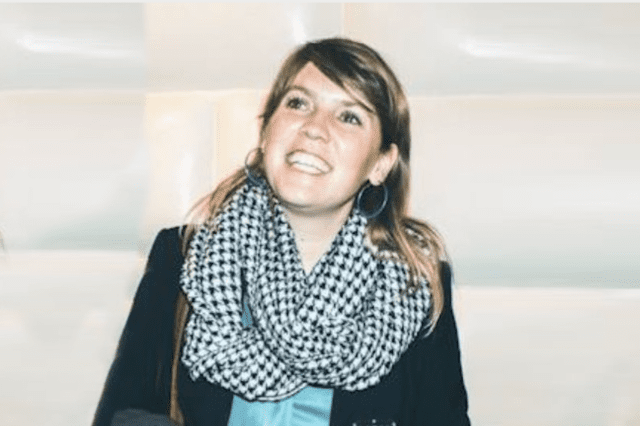
Dutch producer Corine Meijers, formerly of Submarine Channel and now MD of Utrecht-based Studio Biarritz, is a participant at Rotterdam Lab 2021 where she will be both honing her production skills and promoting her impressive slate of documentary, immersive and interactive projects.
For Rotterdam Lab 2021 participant Corine Meijers, seven years at Submarine Channel was a superb (and pretty cool) place to cut her production teeth. “I got to see the whole production and financing pipeline, and because Submarine Channel is also distributing its own projects I was also involved in their distribution. I am still learning a lot, but I got to understand the A-Z of making and releasing a project.”
But while Meijers continues to freelance for Submarine Channel – she is developing Steye Hallema’s VR experience The Imaginary Friend as well as the interactive documentary series Artificio, by Jorge Cabellero and Anna Giralt Gris – the time seemed just right in 2019 to launch her own production outfit, Studio Biarritz.
“It’s a dream I had for a long time, even when I was working at the various film festivals and co-production markets,” she says. “I was looking for the right moment for me, when I felt I had enough expertise and enough knowledge of the market, and also when I had enough experience of producing audiovisual projects. And that time arrived.”
Ok, with the benefit of hindsight, late 2019 may have seemed like an unfortunate time to launch a new company, what with there being a global pandemic just around the corner. But that didn’t stop Meijers raising finance in 2020 for her documentary project De Bastaard, directed by Turkish-Dutch photographer Ahmet Polat in which he follows Moroccan-Flemish author and actor Rashif El Kaoui on a journey to find redemption. The ambitious project, on which broadcaster NTR is a partner, is part of larger cross-media project which also includes a theatre play in collaboration with Het Zuidelijk Toneel, Stichting Nieuwe Helden and Studio Polat.
Nor did it stop her raising co-production finance on the Juanita Onzaga doc/VR hybrid Floating With Spirits, produced by Belgian production outfit Cassette for timescapes, which follows two young indigenous sisters preparing for the Day of the Dead in the mystic mountains of Mexico with their shaman granny.
“For me to make different types of project is inspiring, and they are never a copy paste of each other,” says Meijers. “Every time it is a different process, a different technology, a different team.”
The producer is also developing a ground-breaking doc/VR named Improv Music Collective DNA? AND?, which comprises a cast of special needs children and a revolving ensemble of adult musicians. DNA? AND?’s infectious exchange between carefree improvisation and stark repetition elicits some of the most original music ever produced, impulsive, unfiltered and free, Meijers points out. “We are going to do a co-creation with them and give them the opportunity to create a VR piece, based on their dreams and ambitions and how they perceive music. It will be my first project that I am going to build from scratch.”
During her years at Submarine Meijers observed the “interactive story-telling industry” expand, and with it the number international collaborations. This is very much to Meijers’ taste. “I don’t want to be in the Netherlands only working on Dutch projects, so I am really looking for this international focus too in my projects.”
Of her Rotterdam Lab experience, Meijers breathes a sigh of relief that she is the beneficiary of all the hard work and organisation of her former colleagues at IFFR, and not the one doing the facilitating. “I was on the other side of the fence for a long time. Now I get the chance to be on the producers’ side and really experience the festival and the market and the tutoring of content creatives and the business experts.”
That said, she also describes the particular work ethic/modus operandi that she developed while working at the likes of IFFR and the Holland Film Meeting, one based around creativity, adaptability… and sticking to deadlines. “At festivals you always have very tight deadlines, and you have to meet them. This is important. You always have to pull it off. Things are not going to work by giving up. You just do it. If you can’t solve a problem by going left, then you go to the right.”
“For me and my projects it has been beneficial to apply that basic schooling,” she ends.