By its very nature, a documentary that runs north of three hours is bound to offer a very real sense of immersion on the part of the viewer into the lives of its subjects. Maria Speth’s is not an approach based on soundbites, snapshots or surface scratching. Rather, her Mr Bachmann and His Class is made and presented with a determination to offer depth to its characters, allowing them space to grow and develop fully for the audience.
Running some 217 minutes means that the film (screening in Competition in Berlin) is likely destined for further festival exposure but possibly fewer small screen outings (theatrical releases will probably be thin on the ground), but that should take nothing away from the film’s warmth, compassion and sensitivity as it boldly tackles a complex subject in a refreshingly matter-of-fact manner. The process of immersive filmmaking is not a new one, but it takes a steady hand to make it work in a way that it holds the viewer.
The film is set against the backdrop of the German city of Stadtallendorf, a relatively small community in the county of Marburg-Biedenkopf, Hesse, which apparently has a complex history of both excluding and integrating foreigners. It sits centrally in the country, for from other national borders, but 70% of its population are from an immigrant background as families arrived to build new lives.
Very much on the frontline at Georg Buchner School is genial and warm-hearted teacher Dieter Bachmann, who, despite being on the brink of retirement, wants to inspire his pupils and get them to engage with a variety of subjects. Aged between 12 and 14, and coming from twelve different nations, some have still to master the German language. The film – which is simple in structure – follows Bachmann and his pupils as they get to know each other and reinforces (if it needs reinforcing) the importance and power of good educators.
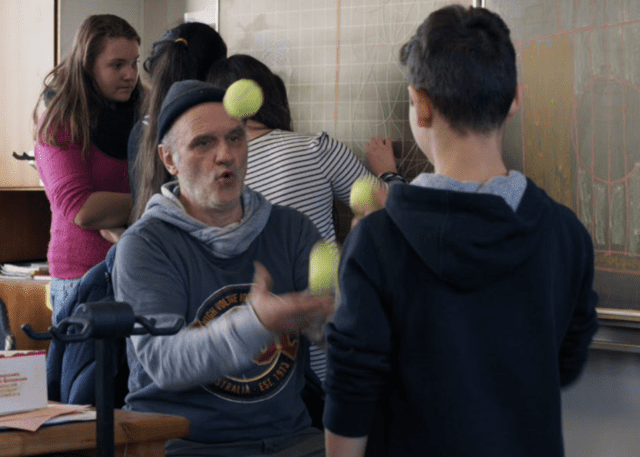
Bachmann is a laid-back individual. Dressed casually and always sporting a distinctive woolly hat, he rarely raises his voice as he gains the trust of the mismatched group of students, often relying on music and culture to help tackle different subjects. Whether by singing Dolly Parton’s ‘Jolene’ to the students (to the obvious bemusement of all, bordering on disgust to some) or challenging them to help each other to learn, he is a much-needed constant in their lives and often an enabler to help them voice their worries about their different situations.
Director Maria Speth and her cinematographer Reinhold Vorschneider are ever-present in the classroom, only occasionally venturing outside the school building into the town to help present a backdrop of the none too salubrious local environment. The fact that the youngsters seem so at ease with the camera speaks volumes about the trust that is built up, and while Speth naturally has a ‘story’ to tell, it does not come with an agenda. Both languid and unfussy, the filmmaking allows personalities to unfold, challenges to be faced and youngsters to grow and develop.
Naturally enough, there are moments of frustration, anger and confusion – especially when parents come into the equation – but in the end Herr Bachmann is there to reinforce that the class is a ‘family’, and as he comes to hand out report cards at the end of term and wish them good luck as they head into seventh grade he reinforces very simply that they are “all terrific kids.”
As he says: “The report cards are nothing but snapshots…you’re all completely different people and these grades don’t reflect who you are…what’s more important is that you’re all terrific kids and youngsters – you’re all really honest. Remain true to yourselves.” Each hug him as they leave the room, and in a charming moment, Hasan, one of the students, gives him a farewell gift…a new woolly hat in Bulgarian national colours.
The final scene sees the youngsters put their chairs up on the school desks for a final time in the classroom, and Speth shoots Herr Bachmann from behind, sitting facing the desks and wiping a tear from his eye. Astutely, she never exploits the moment, but the film shows how valuable a compassionate educator can be, and pays tribute to just how important education actually is.
Germany, 2021, 217mins
Dir: Maria Speth
Production: Madonnen Film
International sales: Films Boutique
Producer: Maria Speth
Screenplay: Maria Speth, Reinhold Vorschneider
Cinematography: Reinhold Vorschneider
Editor: Maria Speth
With: Dieter Bachmann, Aynur Bal, Önder Cavdar