Chemnitz is a city shaped by a world that disappeared within a generation, reads the logline for Julius Gintaras Blum’s feature doc project Eastkids, nearing completion and selected for Leipzig’s DOK Preview Germany October 26 pitch event.
Once known as Karl-Marx-Stadt, it was an industrial centre of socialist East Germany. But with German reunification, came the disappearance of jobs and economic security, and the identity of an entire working-class society began to disappear. Today, a new generation is growing up in the shadow of this history. “What still connects generations shaped by such different worlds?” the filmmakers ask.
“Eastkids explores the long-term consequences of reunification through the lives of people who experienced it directly and a younger generation who inherited its consequences without experiencing it themselves,” producer Leon Harms (Filmakademie Baden-Württemberg) tells Business Doc Europe. Chemnitz may recently have gained a reputation for right-wing extremism and deep social tensions, but Harms is looking to redress the balance, promising “an intimate, nuanced portrait of the city, its people, contradictions and everyday realities as well as a perspective on eastern Germany as a whole.”
The film, co-produced by ZDF, builds on the short documentary Chemkids (2022), which explored similar themes in Chemnitz and which screened at international festivals including Clermont-Ferrand ISFF.
“Having been born and raised in Saxony, Julius Gintaras Blum has a personal connection to the questions at the heart of Eastkids: how the history of East Germany continues to shape the present and what it reveals about life in Germany today,” Harms underlines the suitability of his director to be broaching this subject. “After making Chemkids and conducting several years of research, Julius moved to Chemnitz in 2024 to make Eastkids. He has since built lasting relationships with his protagonists, making himself and the project accessible through an open casting call that invited people to participate directly.”
“His interest lies in how historical experiences are transmitted across generations, including
experiences that the younger generation never lived through themselves,” Harms adds. “Julius approaches Chemnitz with affection and curiosity, while remaining interested in its contradictions rather than offering a simplified or idealised portrait.”
Director Blum further explains his rationale in bringing this story to screen. “Eastkids brings together themes that I have been deeply engaged with for many years: the relationship between young people and the places in which they grow up, and the ways in which history continues to shape individual lives,” he says.
“I grew up in eastern Germany, close to Chemnitz. My mother spent the first thirty years of her life in Soviet-occupied Lithuania, while my father comes from West Germany, so East and West were a natural part of my family life. It was only later, when I moved to West Germany to study film, that I realised that coming from ‘the East’ still meant something.”
“Chemnitz was a blind spot for me for a long time, even though I grew up nearby,” he adds. “It became central to my life when I fell in love with someone from the city more than eight years ago. Over time, I got to know its people, microcosms and contradictions. I came to see Chemnitz as a particularly strong expression of an ‘Eastern legacy’: a city whose identity was deeply rooted in its role as an industrial metropolis of socialist East Germany, before reunification profoundly disrupted that foundation.”
Harms describes a film that promises considerable cinematic allure. “Eastkids deliberately
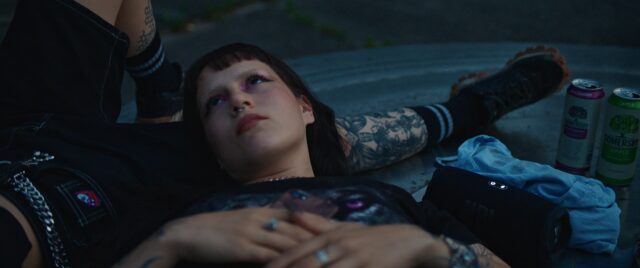
draws on Western coming-of-age cinema, using CinemaScope, glossy images and
bold, colourful palettes,” he says. Places like Chemnitz are often seen through the lens of
news coverage of major events and demonstrations, leaving less room for the city’s
own visual character and atmosphere to come into focus. Eastkids consciously
breaks with this visual language, portraying the city with colour, energy and a pop-
cultural sensibility.”
“Carefully composed, cinematic images alternate almost equally with raw, camcorder footage that feels as though it were filmed by a best friend. This interplay brings together visual precision and the immediacy of being close to their lives,” he adds.
The visuals will be enhanced by a lyrical voice-over and four original songs, each linked to one of the seasons, composed by Selma Juhran, a young musician who grew up in Chemnitz and herself one of the protagonists. “She addresses the city directly, making music an integral part of the storytelling rather than simply a soundtrack,” says Harms.
The producer further emphasises the inherent sense of urgency he feels for a project, that marks a key point in time. “The younger generation is now entering adulthood, while their parents and grandparents are looking back on working lives and social structures profoundly changed by 1989/90, he says. “At the coal-fired power plant, the final shift marks the end of an industrial era, while other protagonists face the beginnings of school, adulthood or new phases of life.”
“The film asks what is inherited across generations, even when the historical experiences that shaped parents and grandparents are no longer part of their children’s direct memories,” Harms signs off.