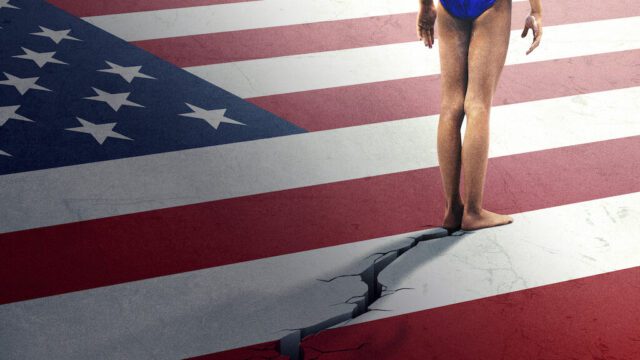
UK audiences are likely to feel a familiar sinking feeling while watching Athlete A, the harrowing Netflix documentary about disgraced US Gymnastics team doctor Larry Nassar. In late February 2021, seventeen former gymnasts in the UK brought legal action against British Gymnastics for the sustained physical and psychological abuse they endured.
Athlete A is directed by Bonni Cohen and Jon Shenk. It tells the grim story of how US gymnastics recruited Béla and Márta Károlyi, the hard-driving Romanian coaches behind the gold medal-winning career of Nadia Comăneci. The Károlyis brought a new ruthlessness to US gymnastics. On the surface, their approach was very successful indeed, yielding Olympic medals and glowing press. What the media didn’t realise was the brutality of the coaches’ methods. Nor was anyone aware that the seemingly mild-mannered Larry Nassar, a far less intimidating figure than the Károlyis, was committing multiple acts of sexual assault against the female gymnasts.
“We had followed the Larry Nassar story much as you had or as anyone else who was following the journalism around it. But, in the middle of it, we were approached by Jennifer Sey, who was the US 1986 National Champion. She had written a book in 2008 called ‘Chalked Up’ which talked a lot about the physical and psychological abuses rampant throughout US gymnastics in her experience and her teammates’ experience,” Bonni Cohen explains of how she and her filmmaking partner Shenk began work on their film.
Sey (a producer on the film) suggested that they explore the links between the Nassar scandal and the bullying and intimidation which had been going on for years in US gymnastics.
“We actually really lit on that idea – looking into the institutional problems with the Larry Nassar case at the centre of that,” says Cohen.
“One of the shocking things we discovered when we were making the film was that abuse of young girls and women in the sport of gymnastics goes all the way back to the 1960s and 70s, when gymnastics really became a little girl’s sport,” Shenk says.
Ironically, the Cold War played a part. Coaches behind the Iron Curtain (like the Károlyis) were achieving spectacular results. The Soviets, as Shenk puts it, had been using “athletes as proxy soldiers in a war against the west.” The Americans were determined to match them, even if it meant blurring ethical lines and ruining young lives.
Then there was the commercial aspect. Gymnastics was fast becoming big business and the better Team USA performed at the Olympics, the more money-making opportunities would arise. There was an unholy combination of malign influences on the sport – and Nassar was at the centre.
One key question was whether the Károlyis knew what Nassar was doing. It’s impossible that they didn’t and yet, Cohen says, they’ve “still been able to run free. They’ve certainly not been held accountable. Nothing has happened to them legally. And that is also true for the other adults and leadership at USA Gymnastics, the USA Olympics Committee and frankly the International Olympics Committee.”
Athlete A, though, may change that state of affairs, Since the film premiered on Netflix last summer, it has been seen all over the world. The Károlyis have therefore been exposed – and so have their counterparts on other countries. Several criminal investigations are now underway and some form of justice may eventually be served. “Survivors really are speaking out and taking matters into their own hands and demanding justice and demanding change,” Shenk notes.
If the film offers a savage indictment of USA Gymnastics, it also provides an inspiring example of investigative journalism. The documentary makers themselves together with the dogged reporters at the Indianapolis Star have helped expose the wrongdoing. Cohen and Shenk highlight the way these reporters broke the case “just by following their noses as really gutsy local journalists,” says Cohen. “In our making of the film, we really relied on their investigation and on their deep journalistic integrity to really wrap their heads around the story.”
If the Olympics take place in Tokyo this summer, the eyes of the world will be on USA Gymnastics. It is debatable, though, whether the athletes are yet actually receiving better treatment.
“From what we hear from servers and gymnasts, they are telling us that USA Gymnastics has not done enough to acknowledge their role in the rise of Larry Nassar..[it] really has not stepped up and provided the level of protection that is necessary.”
Rogue coaches remain at large, even though there are myriad complaints against them.
One of the saddest codas to a very grim story was provided recently when Simone Biles, a legendary figure in American gymnastics, said that if she had a daughter, she would not let her compete for USA Gymnastics.
The filmmakers contacted USA President Steve Penny, a marketing genius but one with obvious culpability in the unfolding scandal. Penny refused to participate. “He was under investigation at the time so that may have been the reason,” Cohen suggests. “He watched all of this go on…he was made aware of it [the Larry Nassar abuse] and it took him over a year to do anything about it.”
What about idealistic young girls who want to go into gymnastics at the grassroots level? Is that dream now soured for them too? In response to the question, the filmmakers point to some of the characters in their documentary, particularly Maggie Nichols, who, against the odds, have somehow managed to keep their love of their sport – and to continue to excel at it.