What was it about the 1970’s and urban planning? Every city has its nightmare stories of how communities were razed to make room for a Utopia, only for the surrounding area to fall into neglect, eventually to resemble more a ghost town.
Brussels was no different, in its case the area around North Station where the Little Manhattan modernist ‘dream’ was installed. The centre piece of the project was the World Trade Centre twin towers which, by and large, went unoccupied (and unloved). So in recent years change and redevelopment was called for and agreed on. The problem is, how can participants in the rejuvenation project guarantee that history will not merely repeat itself? And will all parties, not just local government apparatchiks and big business concerns, get a say in how the area will be developed?
This is the subject of Lietje Bauwens and Wouter De Raeve’s WTC: A Love Story, a film that uses documentary, fiction and role play to explore which stories take centre stage (or whose voices are heard loudest) as the process of political representation is accelerated.
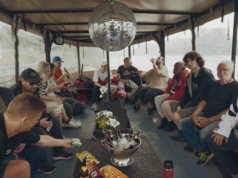
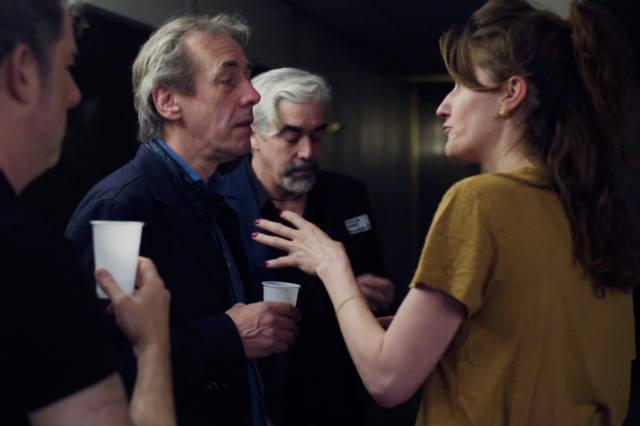
The filmmakers’ methods are fascinating, and in themselves create myriad levels of psychological complexity, but in essence the ‘real’ players in the urban drama (the Bouwmeester, the politician, the WTC owner, the architect, the consultant etc) are played by actors (or avatars). Each actor receives a 30-minute brief by their real-life counterpart into the dilemma as he or she sees it, and then the combined troupe gather to roleplay their subsequent deliberations either around a committee table, the water cooler or, at times, one on one.
In the last third of the film, a new constituency is introduced (and one hitherto ignored by the power brokers), those who represent the needs of the powerless and, in some cases, the oppressed. Their voice is sounded by community and social workers, sociologists and representatives of refugee organisations.
Lietje Bauwens and Wouter De Raeve are not filmmakers, Bauwens stresses. She studied philosophy and he has a background in architecture, but they are “artists with an activist motivation,” she underlines, and have sought to represent “the politics of space making” in previous works, using differing methodologies.
“We always had our office in the WTC building and we saw everything changing around us,” Bauwens comments, “and we thought ‘how can we intervene in the debate and claim a voice and change how it is happening?’ Then we decided to make a film not just about the situation but with the people involved, to see how they could become part of the film, co-authors in a way.”
The results are riveting, seeing how actors’ behaviour and reactions are informed not only by the briefs they receive but also by their own inclinations and personalities. The tension is further cranked up as three of the ‘real’ players watch and react to the drama that the filmmakers have shot. Bauwens remarks on how ‘real’ politician Ans Persoons [a woman] responds to how her actress is spoken to the actor playing WTC owner Werner Joris [a man]. “He is patronising and not taking her very seriously, so in the fiction the actress stands up for herself,” says Bauwens. “When Ans sees the actress do that she says, ‘I wish I could do that myself more often in real life.’”
But there is another dynamic at play that the film exposes, one of public accountability. “People in power really don’t want to put themselves into insecure positions, and that is why they repeat the status quo ,” says Bauwens. “Basically we want to take them out of their comfort zone by putting them into our context, an artistic context, where we force them to be alienated, or alienate themselves.”
In the film we don’t get to see how the actors/avatars get to play their community workers, social workers et al (who are already fantastically articulate and committed). We will have to wait for the story’s continuation within a follow-up series called WTC A Never-ending Love Story. Bauwens promises that in the series she and co-director De Raeve will be upping the ante and drawing in some heftier politicians (and their representative actors). “It will be more focused on the social organisations but we will also again include politicians, such as the mayor of Brussels. We found in this film that if we include the people of power in the project, they have to relate to other people’s realities in a constructive way, respond to them and acknowledge the critique.”
“What is important for us is this methodology,” she adds. “Using a film and a series to put a spotlight on a political situation that is otherwise happening behind closed doors.”
This article was first published in See NL (Eye International and Netherlands Film Fund)