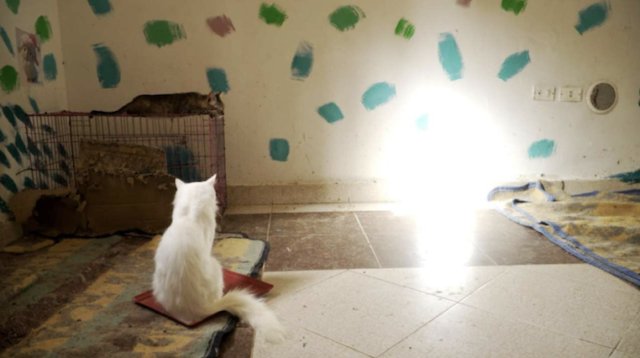
Cats and dogs feature very prominently in Life Is There, the lyrical and evocative new documentary directed by Ishtar Yasin Gutiérrez that receives its world premiere in Ji.hlava’s Opus Bonum competition.
In Cairo, where the film is set, the animals are considered sacred. They are a connection to an ancient past and yet, all too often today, they are treated with cruelty and indifference.
Cats and dogs feature very prominently in Life Is There, the lyrical and evocative new documentary directed by Ishtar Yasin Gutiérrez that receives its world premiere in Ji.hlava’s Opus Bonum competition. In Cairo, where the film is set, the animals are considered sacred. They are a connection to an ancient past and yet, all too often today, they are treated with cruelty and indifference.
“I don’t want human beings in the centre of the story. I think that the animals are living with us. I am talking in this film about vulnerability and those who live in the margins. They [the cats and dogs] depend on us. In the film, I talk about orphans. These animals are also like orphans, in really dangerous situations. I feel a real identification with them…also, I wanted to say that these animals are sacred for me.”
The Moscow-born, much travelled Gutiérrez first came to Cairo as a teenager. She had been hoping to go to Iraq to visit her family but these were the years of Saddam Hussein’s dictatorship, and her father instead sent her off to Egypt to stay with a friend, an Egyptologist.
“In place of Iraq, I found a home in Cairo,” she remembers. Now, more than 30 years later, she returned to the city. It wasn’t her intention to shoot a documentary but as she walked through the downtown areas, she began to feel inspired by what she saw around her. “I wanted to make a film at random. I wanted reality to give me surprises,” she stresses.
Gutiérrez was filming spontaneously, without a script or even a concept. “I just wanted to work with cinematic language, with images and sound, and afterwards I discovered the film on the editing table,” she adds.
On the Cairo streets, she encountered the stray dogs and the woman who runs the sanctuary for over 100 cats. She met a muralist who had painted the walls of the city during the spring 2011 Egyptian revolution and who invited her to his workshop. She encountered an elderly music teacher who loved to play an imaginary accordion. Her travels around the city eventually took her to the Meera Kindergarten where orphaned Palestinian children from Gaza are looked after.
“I wanted to be there, to hug them, to listen to them and see them – and so I took a bag full of toys. I was there with them and it was a great experience,” she recalls.
When she herself was a kid, her father gave her a book, In Time of War Children Testify, a collection of drawings by displaced Palestinian children in refugee camps in the late 1970s.
“This had an impact on me,” the director recalls. She too has experience of exile both from Iraq, because of Saddam, and from Chile, because of Pinochet. (When her family fled Chile after the coup against president Allende, she had to leave her pet dog behind, “a very hard loss for me.”)
The film also includes footage of a beautiful pigeon which lives above the hostel where she stays when she is in Cairo. “I identify myself with the pigeon – and also we all know what kind of a symbol a white pigeon can be. This pigeon has such freedom, purity and tenderness.”
In all, while making the documentary, she made three trips back to Cairo, in 2023, 2024 and 2025. he describes her project as a plea for tolerance. “The most important thing is never to lose your humanity, never! Humanity means empathy; it means generosity, solidarity. It means the capacity to give love and feel the pain of others as if it is your own pain.”
Part of the film is shot on 16mm and part on digital. The director relished the contrast between the two formats, arguing that each gives “a different dimension of the rhythm of the city.” She also includes a tiny bit of very old archive material showing a massive homecoming reception for Saad Zaghloul, leader of Egypt’s 1919 revolution, in Cairo in 1923.
On Life Is There, Gutiérrez was working like a one-woman orchestra, playing every instrument. She produced and directed the film; shot it herself, and did the sound and the editing for good measure. “In all my work, I always want to explore different possibilities of cinema. I’ve worked with scripts in other films but I wanted here to be more like a painter or a writer and to work directly with the images and the sounds – and not to begin with writing which is another language. In this film, I was totally alone but it was a pleasure because I wanted to be totally free of norms and rules.”
It helped that she was able to work on such a small budget, and that she could start filming whenever she wanted, without having to justify herself first. “I think the philosophy should come after the images, not before,” she says.
The project does have backers, though, among them Lief Studio in the UK and Hassala Film in Egypt. Her own production company, Astarte Films is based between Mexico, Costa Rica and Chile. Gutiérrez has directed 15 films including three dramatic features and her work has screened at many international festivals. “I’ve tried with every film to create a home with open windows so the viewer can enter,” she states. “For me, cinema is like an experience that we have to feel first…and then we can understand.”