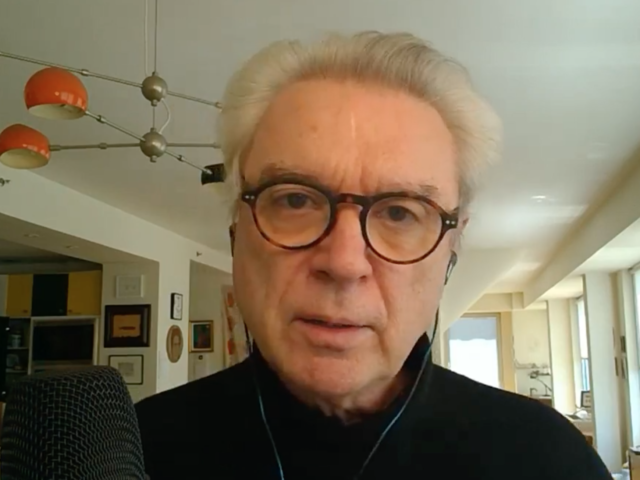
David Byrne, the sublime Scottish/American maverick, popstar, icon, filmmaker, wearer of big suits and former Talking Heads frontman, zoomed in to CPH:DOX to discuss, with Danish journalist Erik Jensen, his concert film American Utopia, working with Spike Lee and dancing during lockdown.
“It’s been, of course, as it is for everyone, very strange, sometimes very sad and frustrating, sometimes I wake up in the morning and feel like ‘what am I doing today and why?’” reflected Byrne at the start of his 45-minute virtual chat.
“But other times, you know, you just get up and get busy with it. I recently did a show in a large space here, a kind of life performance, it was called the Social Distance Dance Club, and that’s what it was. I did it with some collaborators and basically it was my voice leading 100 people, all socially distanced on six-foot circles in some dance for an hour. It was not a dance class but it was, for all of us, the first time we had gotten together in a room with that many people and actually danced together. It was really cathartic and a kind of amazing experience.”
Moderator Jensen reminded Byrne of a Talking Heads concert that he had attended decades before in Roskilde (Denmark) when the audience were on their feet dancing in no time at all, not unlike the audiences in Jonathan Demme’s iconic Talking Head concert pic Stop Making Sense (1984). Byrne observed that such early participation was never going to be the case with a Broadway audience during the shooting of American Utopia.
“I realised that, unlike the audience at Roskilde, the audience isn’t going to start dancing after the second song. A Broadway audience are going to want a little bit more of an introduction before they are ready to jump out of the seats,” he said. “So I looked at that as an opportunity to bring out a little bit more what I perceived as the narrative arc in the show, the kind of growth and journey of this character that would be me from a kind of inwardly directed young man…to the end of the show where he and his friends and small community become more socially engaged with the wider world, so as I see it, that’s the journey, the film and the show.”
“The way it is staged is in some ways more like a dance performance, a dance theatre performance [than] a rock concert. But it still has the energy and the rhythm of a music concert,” Byrne continued.
“The idea of this show was to achieve a completely empty stage to get rid of all the usual equipment, cables, risers, instruments, music stands, all those kinds of things, so the focus was then left on us as performers, as human beings and how we relate to one another and how we relate to the audience instead of the technology,” he added.
Jensen asked Byrne how Spike Lee entered the frame as director. “I had known Spike for many years – not that well, but we had crossed paths many times over the decades,” Byrne replied. “In some ways we came up at the same time in parallel, and occasionally we would work together on something. I contributed to some documentaries he had done, but not much. When the opportunity came, when the idea was presented to maybe film the show I thought ‘I’m going to ask Spike’. He’s going to understand what the show is about. He has filmed live shows before, live performance before, which is very different from filming fictional scenes where everything is controlled, so I happened to have his number (he laughs) and I just texted him.”
Lee agreed, after watching two same-day Saturday performances. “We had some discussions [about the approach to the film] but more or less I followed orders. I left it up to him and Ellen [Kuras],his director of photography. At one point I asked Spike if he thought there are any songs that we should cut or anything we should change and he says ‘no, I think you’ve worked on this for a long time, the show really works as it is, it’s my job to cut that, to get it on film.’”
Byrne added that “my only requirement was that you don’t see the cameras on stage, that we preserve the kind of minimal look of what is on stage.”
So what is Byrne working on right now, Jensen asked, and is there any chance that the Heads would ever get it together again?
“That seems a bit risky,” he responded to the latter question. “ I can’t think of [many] of those reunion projects where you really feel it was justified.”
“I’m hoping that the project that I described earlier, the Social Distance Dance Club, I’m hoping that we can start to run [that] in other cities,” he added. “It was created as something that can happen now, in a way that is safe but allows people to be together, so I’m hoping that we can do that. And I’m working on some music, there is a song for a film and something for a TV show, this and that, odd things. Of course, very little that’s really big right now. It’s kind of hard. I’m certainly not planning any tours at the moment.”
And given that New York is such a live, pulsating, “evil” city, asked Jensen, was Byrne tempted to vacate when Covid rendered it lifeless and empty over the past year? Or at some time in the future?
“Some friends moved away, some friends have houses in the country and they moved there, other people boughthouses in the country,” Byrne responded. “A lot of people felt that the things that made New York special, the social interactions and professional interactions, had all been taken away from them in the last year, and so they wondered ‘why am I here if I don’t have those things’, but I think they are slowly coming back, those things are slowly coming back.”