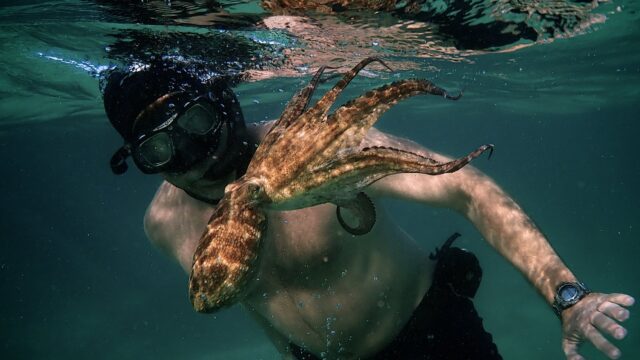
My Octopus Teacher, the Netflix story of one man’s psychological transformation through the relationship he develops with an octopus within the kelp forests off the coast of South Africa has won the Best Feature Doc Oscar at the 93rdAcademy Awards.
Colette, written and directed by Anthony Giacchino, won the Oscar for Best Short. The film tells the story of 90-year-old former French resistance member Colette Marin-Catherine, who visits the concentration camp where her brother was murdered during the war with a young history student, Lucie Fouble.
“It is definitely something that took us by surprise…we didn’t see it coming at all” My Octopus Teacher co-director James Reed told Business Doc Europe earlier this month of the Oscar nomination. “Back when we were making it, and I came on quite late in the process, the film had no platform. It didn’t have a broadcaster. Netflix wasn’t on board. We were confident in it and thought we had a special story and were doing a good job trying to tell it, but we had no idea of the trajectory it was going to go on.”
Before the July 15 world-premiere of the film at Thessaloniki, co-director Pippa Ehrlich told BDE of her reaction when asked to come on board My Octopus Teacher. “He sent me a treatment and I was absolutely blown away,” she remembers, after the film’s subject Craig Foster, himself a filmmaker and co-founder of the Sea Change/Great African Seaforest project, contacted her.
He told her an extraordinary story that he wanted to make into a film, one that he had already partly shot, chronicling, over the course of a year, his evolving relationship with an octopus he encountered within the submarine terrain. “I was crying at my desk as I was reading it, so I immediately jumped aboard,” she said.
In Colette, one image that looms very large is a photograph of resistance heroine’s brother Jean-Pierre Catherine. Colette keeps it on her wall and brings it with her when she journeys to the concentration camp. There is a beautiful and eerie shot at the end of the film in which her companion Lucie is shown holding it in a whitewashed room with Colette sitting beside her. This, the filmmaker explained to BDE, “is the space where Jean-Pierre died.”
The photograph itself has a painful history. When Jean-Pierre was under arrest in France, before he was moved to Germany, his family were still able to visit him. His father took the photograph even though it was strictly forbidden to bring cameras to the prison and he would have been shot instantly if he had been discovered with one.
“Did he [the father] think maybe he would never see his son again? That’s possible. If they were risking being shot by sneaking a camera in there and taking a picture, I think that’s a pretty good bet,” Giacchino speculated as to why he dared take such a picture.