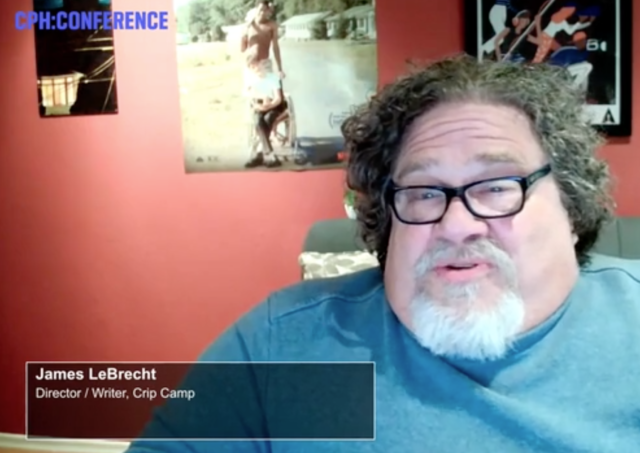
Crip Camp co-director James LeBrecht
Speaking at the CPH:DOX 2021 Reset! Conference, Nicole Newnham and James LeBrecht, the filmmakers behind Netflix’s Oscar nominated documentary Crip Camp (exec produced by Barack and Michelle Obama) hailed this year’s Oscar ceremony as “an incredible breakthrough” in its approach to disability.
Newnham and LeBrecht were speaking 28 April during a session titled ‘The Power To Speak: A Filmmaker’s Perspective.’
The Crip Camp entourage at the Oscars included disability rights activist Judith Heumann and impact producer Andraea LaVant together with her service dog.
“Imagine on the red carpet three people on wheelchairs and a service dog!” LeBrecht enthused. “Our presence there at the Academy Awards was very much noticed. In fact, this was the most accessible Academy Awards ceremony ever. There was a ramp to the stage. We entreated the Academy to really make this a very equitable experience where everybody in a wheelchair was travelling exactly the same path as anybody else who didn’t have a mobility device.”
The Crip Camp director added that the group felt “incredibly welcomed.”
Newnham said that Crip Camp was helping “blow apart many of the stereotypes in the way we typically see people with disabilities on screen.” She also revealed that one of the inspirations for the documentary was The Times Of Harvey Milk, Ron Epstein’s ground-breaking 1984 documentary about the political career of Harvey Milk, one of the first openly gay figures to hold elected office in California.
“It’s a documentary I’ve long admired partially because it feels so much that you are getting to witness a community telling its story from the inside out and to each other.”
The filmmakers told the CPH:DOX audience of some of the challenges they faced in making their documentary. At times, they were “literally knocking down physical barriers that were in our way because of lack of access in our industry.”
“We realised very early on that there were places Nicole could go where I could not because I use a wheelchair,” LeBrecht said.
Such places included the Sundance edit lab. “This place was not very wheelchair accessible,” the director noted. “One of the bigger issues that I’ve been trying to fight for years was that the filmmakers’ lodge was up three flights of stairs in Park City, Utah, for the Sundance Film Festival.”
The filmmakers lobbied hard – and by the time Crip Camp premiered at Sundance in 2020, an elevator had been put into the building. “It was quite the moment!”
“Our working with Netflix was an incredible experience in that we basically entreated them, or asked them, to be activists along with us,” Lebrecht added.
“We used the word ‘crip’ as a way to reclaim the word ‘cripple.’ This is an indication that our film is not just a sweet little portrait of a summer camp – that there’s a cultural connection, a civil rights connection…in the long run, our film is accessible to more people with disabilities than any other film they [Netflix] have done before,” he continued.
“More languages for audio-description, more languages for the deaf and hard of hearing – and we got a request that they make a script so people who are deaf/blind can go to the website and download it and be able to load it into their braille readers so they can experience the film.”
Lebrecht praised Netflix for “never” hesitating and “always supporting” the filmmakers’ mission.