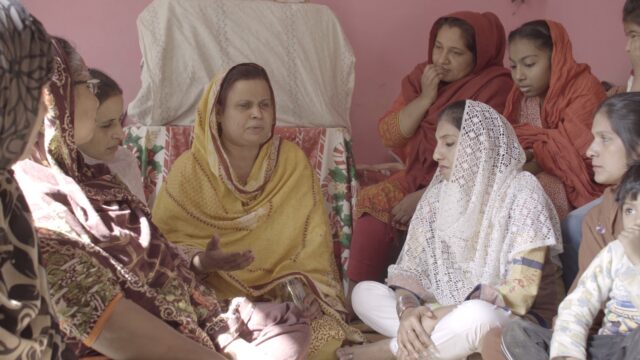
It is 75 years since Pakistani freedom fighter Fatima Sughra clambered on to the top of a high building to pull down the British flag. Her example still inspires the women featured in Anam Abbas’ feature debut This Stained Dawn, screening as a world premiere in Sheffield this week. These are the Karachi feminists who organise the Aurat street marches to protest against the deeply engrained sexism within Pakistan’s government, media and religious right.
Pakistani-Canadian filmmaker Abbas has been involved in the Aurat march movement from the very beginning. “The first Aurat march happened in 2018 and the very first public meeting actually ended up happening at my apartment,” she says of her intimate connection with the movement. She was living in Karachi at the time, making web series for which she was already collaborating with several feminist writers and artists. “Being a filmmaker, my contribution to the organising space was to photograph and make videos.”
After the 2019 march, the debate within Pakistan around the protesters intensified. “There was a lot of paranoia and misinformation about who these women are and where the money comes from,” Abbas observes of the tendency among some on the Pakistani right to regard the marchers as tools of western propaganda.
The director also realised that the visual history of Pakistani feminism had not been properly archived or celebrated. She was keen to “situate this particular movement within a history of feminist resistance” in Pakistan.
In the documentary, there is startling footage from a press conference at which the Aurat marchers are berated by male Pakistani journalists ostensibly there to cover their event in an impartial fashion.
“The media is very misogynist for sure. That extends to television entertainment like soaps as well as news journalism,” the director reflects. The marchers do have some allies within the press but it is also commonplace for Urdu language newspapers to call the protesters “Urdu whores.”
Organisers are often faced with a dilemma as to how much access to give the media. Sometimes, bloggers who’ve pretended to be supporters of the movement have come to its events and then proceeded to vilify the female marchers.
“It is a very difficult space because you do want the word to be spread and for there to be press about these events so that conversation can be sparked…but you don’t know who to trust and who is there for actual journalism and who is there with a pre-conceived idea,” Abbas describes the movement’s complicated relationship with the media.
One point she is also keen to underline is that the marches are exhilarating. For all the logistical stresses and opposition the marchers must deal with, the actual experience is very positive.
“The 2018 march for me was the most joyous day of my life,” the director says. “It was also unexpectedly large as a first initiative. I think almost 10,000 people showed up. That march specifically, [there] was a sense of euphoria. Over the years, as threats increased, obviously the tone has shifted, especially for organisers. You suddenly have the responsibility for these mostly young women who show up, to make sure nothing happens…but I remember we started calling it feminist Eid because it did have that sense of togetherness, family, celebration and joy.”
One difference now is that the joy the marchers now is one of “defiance.” In spite of all the opposition, they take pleasure in the fact they are “still here.”
Abbas isn’t impressed by the feminist credentials of the western-educated current Pakistani President, Imran Khan, former captain of the Pakistani cricket team.
“He [the President] is not supportive at all, at least in public,” the director reflects. When Imran Khan was asked about the march, his response was: “this is not our culture.” He allied himself with those who accuse the marchers of trying to destroy the traditional Pakistani family.
It’s three years since the first Aurat march. Its impact is already becoming apparent. As Abbas notes, “suddenly the word ‘patriarchy’ is being discussed on prime-time television. That is a huge shift.” Meanwhile, attitudes toward gender are rapidly changing among younger Pakistanis.
This Stained Dawn was made through the director’s company Other Memory Media. The name, she explains, is “a reference to Bene Gesserit of [Frank] Herbert’s ‘Dune’ mythology – women who could access their matrilineal genetic memory through spice trance, i.e Other Memory.”
The director is one of the co-founders of the Documentary Association of Pakistan which has been operating since 2017. “We became a group and started this initiative because there weren’t any spaces for documentary to be seen [in Pakistan],” she notes. With very limited theatrical and broadcast opportunities, the Association members are taking it on themselves to get their films seen through initiatives like travelling film festivals. They also organise screenings at universities.
“I find virtual screenings to be very insecure because you can’t look at people in the eye,” Abbas says of the risks involved in online distribution. The idea therefore is to wait until This Stained Dawn can be screened physically before launching it in Pakistan.