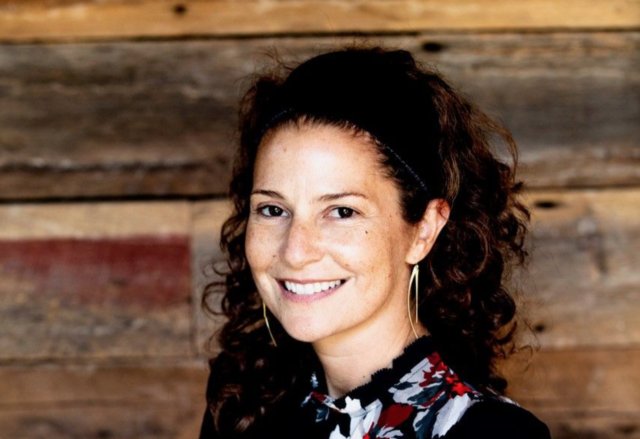
Redford Center’s Jill Tidman (photo: Alan Silfen)
“Our mission is to use the power of storytelling to galvanise environmental justice and regeneration,” Jill Tidman, Executive-Director of the San Francisco-based Redford Center, tells BDE during Sunny Side, of the non-profit organisation set up in 2005 by Robert Redford and his son James Redford, which has become a powerful force in the documentary world.
The Center is one of the sponsors of Sunny Side of the Doc’s Wildlife & Conservation Pitch this week.
“The invitation was really hard to pass up,” Tidman says of the chance to participate in Sunny Side. The Center may be headquartered in the US but is increasingly looking to support international artists and storytellers involved in environmental impact work.
Yes, that could mean supporting filmmakers from Europe too. “First and foremost, I would tell a young aspiring filmmaker who cares about this issue and is interested in using film as a tool for impact on this issue to just go for it!”
The Redford Center hasn’t previously had an international strategy as such, but has still been able to support international projects through many of its strands, among them its grant-making programme and fiscal sponsorship programmes. There is also a film-oriented youth storytelling initiative aimed at middle school students in which five different countries participated this year.
Tidman speaks of the Center as “an evolution of the Redford family’s engagement with environmental issues for decades.”
In 2019, Tidman and her team took the decision to “scale up.” They were determined to use the power of film, video and new media to stimulate further environmental action and change. “We were fortunate to be in the position when Covid hit to have the vision pretty clear,” the Exec-Director says of how the organisation adjusted and continued to grow during the pandemic.
Tidman is the lead producer on the Redford Center’s original content. Sometimes, the stories will be touching on grim subject matter but it’s a point of faith for Tidman that they have a positive perspective. The aim always to look for solutions, not to wallow in despair about environmental destruction.
“Where we sit in the field of storytelling, we talk about filling the hope gap. The films we produce and support always have a pathway forward for the audience so there isn’t this hopelessness at the end of the day,” Tidman says. “One of the big opportunities for us as an organisation is really to put that kind of storytelling on the map for the industry…”
There was very sad news last year when the Center’s inspirational co-founder James Redford died aged only 58. “It was an enormous blow to the organisation and to all of us who had deep friendship with Jamie, which was very easy to do because of who he was. We are still uncovering some of the gaps [left by his passing]…but he left us with so much vision and integrity,” Tidman says of the documentary maker. “He was my mentor as well as my partner. Everything that we do as an organisation really comes down from him, and also from his father.”
Tidman points out that James Redford’s son, Dylan, 29, is also a filmmaker and as the new co-chair of the board has thrown himself into the Center’s activities.
“Everything that is going on is as planned,” Tidman says of the efforts to fulfil the vision James originally had for the organisation.
The Redford Center has close “collegial” relations with like-minded organisations including Jeff Skoll’s Participant Media and Working Films (which uses documentaries to advance social justice and environmental protection). It has collaborated with Doc Society on its story labs and has worked with many other organisations and individuals.
The Center makes certain films entirely in house. For example, Jamie Redford’s Happening: A Clean Energy Revolution(2017) was 100% financed, produced and developed through the organisation – and was picked up by HBO.
When the Center backs films through its grants programme, it will offer not just funding but networking and promotional support, help with festivals and story notes. “Once we get engaged with a project, while we aren’t technically producing, we are supporting them, cheering them on and really hoping that they succeed with their goals and get the audience they’re looking for and the impact they’re hoping for.”
Tidman acknowledges that the word “environment” carries a lot of “baggage.” The Center is looking to support storytellers who are under-represented. It promotes racial justice and gender equality as well as environmental action. There is also an attempt not to be too earnest and self-righteous. Jamie Redford always called for storytelling to be accessible and entertaining.
“At the end of the day, we have to be excited by the story on its own,” Tidman says.
Although the main focus is on documentary, The Redford Center doesn’t discount supporting narrative projects. It is currently partnering with the Natural Resources Defence Council (NRDC) and The Black List to offer three climate change storytelling fellowships. “This is for screenplays or teleplays that have climate narrative woven into them.” The Center is also about to give a grant to the narrative feature Anthill, based on the novel by biologist Edward O. Wilson.
Tidman has been working at the Redford Center for over a decade. Over that time, she has gathered plenty of inspirational stories about what its films and initiatives have achieved, both on a small scale and a large one.
“One of the student filmmakers who submitted a film this year, when he was making his film, he shared his film with his friend. In that exchange, his friend asked if they could form a group to pick up trash because that was what his film was about,” she cites one tiny example of “peer to peer inspiration and learning.”
Another short film the Center supported, Reefs At Risk, was about making sure that certain chemicals in sunscreens would be banned. They were not only bad for humans but were destroying the coral reef. “This young person, her and her mum made this amazing film and got it on Hawaiian Airlines. Every incoming flight, people were watching…it started to shift the conversation locally. It helped influence a policy that did ultimately get passed there. Once it got passed there, it got passed in Florida and other places.”
As Tidman puts it: “I’ve seen these films do work in the real world and change communities. It is really inspiring.”