In her beautiful and lyrical short documentary set on a remote Adriatic island, Croatian visual artist Tanja Deman delivers a wake-up call to a world that continues to sleepwalk towards environmental catastrophe caused by climate change.
Back in 2015 Tanja Deman immersed herself into the waters of the Adriatic to observe at first hand the fragility of the subaquatic eco-system. That year the Croatian government was working on plans to offer concessions for oil and gas exploration within the sea. That was the moment she decided to record “what can be lost with one mistake.”
The Adriatic is already a “desertified” sea, Deman says in her subsequent film Horizon, selected for Sarajevo Documentary Competition. One hundred years ago it was teeming with life. Now it is almost completely plundered, rendered desolate. Ninety per cent of marine resources are depleted as a result of the highest level of trawler intensity in the world, and the sea-bed is reminiscent of the deforestation we see above sea-level across vast swathes of the planet.
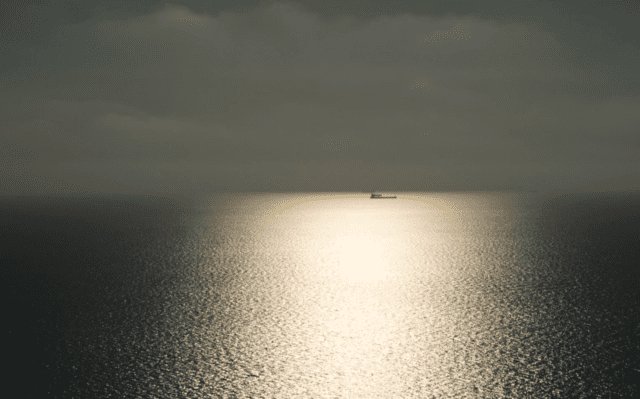
Horizon is presented as a series of dramatic visuals, opening with a stunning red sunrise and water spouts over the open water, accompanied at first by plaintive choral music before segueing into a poetic narration. “The sea and sky are continuously in an intimate state of equilibrium,” Deman’s voice-over intones. “It is a dance on a planetary scale…but recently we have become part of this dance.”
The sky today has carbon dioxide concentration at levels similar to 4 million years ago, when the planet was a hothouse, “before we even existed as a species.” The film also points out how the Mediterranean region has already reached the max 1.5 degree rise in temperature within which “normal” life can continue, as stated within the 2019 IPCC Special Report on Global Warming.
“That was one of the main drivers for making the film because the climate crisis is most visible in the Mediterranean region, as we see with all these wild fires and other things,” says Deman, who also refers to other European catastrophes such as the recent floods in Germany. “But it will just accelerate even more because it [the Mediterranean] has already warmed up to this figure, which we should never exceed…Everything above it [means] just more and more catastrophes.”
The film lays matters out in clearer terms. Mass flooding will result, especially in the southern countries, which will be followed by mass migration. Over the past 5 years, 20,000 migrants have drowned in the Mediterranean. The current refugee crisis is a fraction of what is to come, is the documentary’s stark appraisal.
Deman admits to a relief that she didn’t make her film in 2015, prior to the publication of IPCC data, as well as the recent groundswell in information on the harm of plastics. On the film’s Adriatic island base there is a small archaeological site where traces of human activity over the past 8,000 years are measured. This includes evidence of votive offerings from the time of the ancient Greeks.
These days, evidence of human influence is to be found in the tons of plastic bottles washed up every year as flotsam onto the shore. But these are a mere fraction of the plastic waste that contaminates the sea. The vast majority of discarded plastic sinks beneath the surface to congregate in vast caverns on the sea-bed. The Adriatic may be considered a pristine jewel, but it also contains the highest level of plastic waste in Northern Europe, we are told in the film.
Not surprisingly Deman intends to offer her doc to “ecologically-engaged NGOs” as well as to “spaces which give education to children or just citizens who are interested and concerned by these topics.” The artist/filmmaker also reveals that, having recently settled in Hamburg, she intends to make a feature documentary on the subject of climate change into which she will “pour my usual aesthetics.”
“This whole research process has changed my life dramatically,” she comments. “And I’m very happy for that because I think we first have to start with ourselves and then influence others. And yeah, I actually see in my closest circle of friends, acquaintances and colleagues, that there is some influence.”
“I think it would be fantastic if everybody was on board 100%,” she adds, pointing to research that indicates that real change can be effected even if only 20% of society decides to “push up from below.”
“But I think actually the biggest impact will be these catastrophes that are happening right now in Europe. For example, there’s the floods [in Germany] that have caused a broad discourse about climate change overnight in the media,” she continues. “Suddenly all the politicians are drafting plans for how to battle climate change and so on. So I think people will be very soon forced to make a difference whether they like it or not, because otherwise their cities and towns won’t be nice places to live in anymore…and they won’t like the forest fire beside the hotel in Turkey that they have booked for a week.”