Filmmaker Vlad Petri discusses his powerful and visually enthralling hybrid short doc about the trauma of war, as suffered by a young Romanian soldier serving in Afghanistan and the wounded Afghan child that he encounters. The film received a Sarajevo Documentary Competition Special Jury Mention during the award ceremony on August 19.
Some of the testimony in Vlad Petri’s The Same Dream is true, such as that of Romanian soldier Doru who stops the armoured vehicle in which he is patrolling Kandahar when he sees a badly injured child lying by the roadside. The girl has olive eyes and she watches him intensely. But he is told by central command that they can’t send rescue for a civilian, so he must leave her, and thereafter dreams every night about the girl with olive eyes who he left behind.
The second testimony is imagined, and set against monochrome images of a stream within the Romanian countryside. It is told by Leila, a girl of 12 years who leaves her house to fetch some water on a beautiful blue-skied and optimistic day. She is distracted by a red ball. But when she picks it up, the world is turned upside down and all she can feel is dust and pebbles hitting her skin. Then a soldier comes out of a car and says something she can’t understand.
Soldier Doru never knew the fate of the small girl, although director Petri likes to imagine that help eventually came for her. In his story at least, the girl lives to recount the story. But in a horrendous and tragic way, she of course lives on in the dreams of the soldier. “Because she is trauma, she has a traumatic impact on him.”
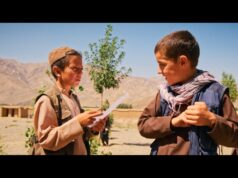
The testimonies aren’t narrated, rather embedded as text into the visuals which are sourced from public domain and the Romanian military (for the Afghanistan component), or shot back in Romania. As importantly we see no visual depiction of either protagonist.
“I wanted to let the audience imagine how they look,” Petri comments. “I didn’t want to individualize. It’s the war and through text I wanted to give these particular impressions, and to let more the viewer reflect on the war, to reflect on how it is to go from a country more than 5,000 kilometers away from Afghanistan, to go there and to explore and to fight. And then how it is for a civilian to be there, like the girl who goes to the water and sees the red ball.”
The film’s early shots from a fixed position on the back of the armoured vehicle reveal the vast, almost lunar, Afghani landscape in which the foreign military were operating, and are always imbued with a compelling sense of dread, which is enhanced by Petri’s use of sound.
“It’s something in the air, there is something through the sound,’ he says of the continual white noise that defines the soundscape of Afghanistan, and which is replicated in the film. “It’s a kind of silence, but a mechanical silence, and you always feel that something is going to happen. It’s the feeling that I experienced while in Afghanistan. I think it’s a constant feeling of fear that the people, the civilians, experience there. People don’t laugh. People tell a story and look in your eye. You have the feeling that it’s the always the last time when you talk with someone, that something will happen.”
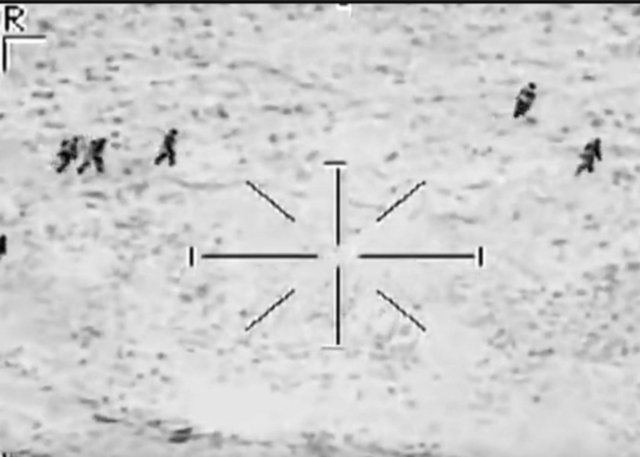
Over the course of its 28 minutes, the film progresses from personal reflections on war to its wider depiction as the frame widens and our vantage point becomes more elevated, such as when we view a battle through the machine gun viewfinder of an Apache helicopter. At this point the enemy fighters on the ground are small and indistinguishable and very expendable.
It is a structure that in some ways reflects the experience of war, Petri suggests. At first, “you have a closeness and a proximity…then maybe you don’t care too much. And then at the end we have these airstrikes and people are, you know, just like some smaller beings seen from the air. You don’t have empathy anymore.”
The film is screening in Sarajevo as seismic change is being effected in Afghanistan following the resurgence of the Taliban. “I wasn’t expecting this news so quickly, this sad news coming out from Afghanistan,” Petri comments. “This film is coming out after a long process. I was traveling to Afghanistan 12 years ago and I was very [amazed] at what I saw there. I was like the soldier in my film, a Romanian arriving there and it felt like I’m in another universe….So I was working on this film starting last year in the autumn, and I finished it this year. So it’s just a coincidence that everybody talks about Afghanistan just this moment when the film is in Sarajevo.”