

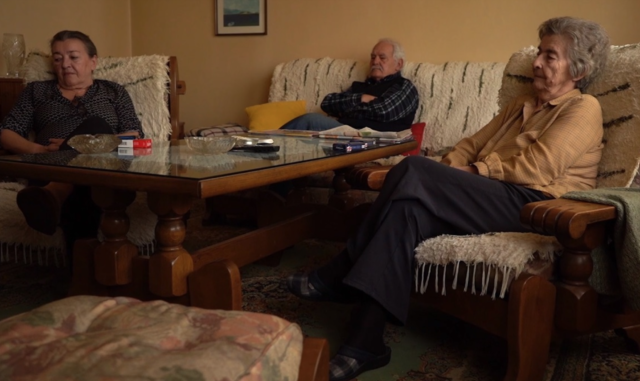
On the face of it, Wait For Me is about as straightforward as it gets. What could be simpler than filming your parents looking after your grandmother for a weekend?
Well, think again. Because grannie, a 96-year-old former 2WW partisan captain, is as sharp as a pin, and the business of caring is one that director Damir Markovina’s mother is finding increasingly stressful.
At the beginning of the AJB DOC competition film director Markovina sets off in a car from Zagreb, together with his mum Zinaida and dad Roko. They are en route to Belgrade where Markovina’s maternal grandmother Šefika lives on her own.
Šefika swears like a trooper, as does Roko, and Zinaida has a vicious line in invective herself, which she reserves much of the time for her husband, especially after he allows himself to be pickpocketed on a Belgrade bus. All the time, Markovina’s camera observes the family from inside the apartment as, little by little, the strain of cleaning, washing and (grand)parental care, performed exclusively by Zinaida, begins to take its toll.
Two scenes at the end of the film are particularly instructive, as both parents take turns in confiding in their son, first Roko about how hurt he feels after the treatment he receives, and then his mother Zinaida in a very moving, full throttle and tear-filled outburst that draws the director from behind the camera to comfort her.
“The topic of the family is, for me, always very interesting,” Markovina underlines. “It’s the environment we do not choose, but yet we are formed by it in a way. It is the stage for very big emotions, violence, power games, you know, everything. For me, the family is something very, very unique to look into as a theme. I have, of course, all kinds of relationships and problems within my family. And that is a topic I’m turning to very often.”
But did he have any reservations about recording an emotional dynamic that is so intensely personal? “Yes, I was having a lot of ethical doubts because it’s my family and my parents. And then the question where do you stop being the voyeur and where do you create an archetype out of the characters you’re editing and the film you’re making was like maybe the biggest question which I had to answer on during the process,” he replies.
Currently studying for a Masters in documentary film at the Academy of Dramatic Art in Zagreb, Markovina had originally set out to make a film mainly about his grandmother, a WW2 resistance fighter. But then he realised that the tension observable between his mother and grandmother would make for just as fascinating a film.
“I like films which are happening now, in which I can film something which is actually happening in front of the camera,” he says of the complex sense of familial discord he was observing. “I always wanted to make a film about these two generations, which is a [strong] theme for me since I’m originally from Mostar (Bosnia/Herzegovina) which was very much damaged during the war. For me, this conflict between the generation which won the Second World War and which created a new society, which was Yugoslavia, and the generation on whose watch this country fell apart, which is the generation of my mother, is a theme which I’m very much attracted to especially because my mother’s generation was created by my grandmother’s generation.”
Neither wars are referred to in the film, nor is grandmother Šefika’s career as a soldier, so the battle that is waged is very much on the intensely personal and psychological level. “My parents are constantly in this, how to put it, tilt of the pin ball, which is caught and is going only in circles, in circles and circles. So basically if you spend enough time with them, this theme, or something of this theme, will come out.”
That said, the title of the film derives from his mother’s parting words every time she leaves her grandmother, imploring her to remain healthy and alive for the next visit.
Markovic is working on two further films right now, one on the city of Mostar which was one of the epicentres of the Bosnian War, “and which formed me in many ways,” he stresses. He also working on another family-oriented doc which is guaranteed to be just as emotionally challenging as Wait For Me.
“The film we are starting shooting in a month from now is about my father’s political career,” the director points out. “During the war in the Balkans, he was a member of the parliament in Sarajevo in Bosnia. He represented the Socialist Democratic Party and was the only Croatian from Mostar who remained loyal to the Sarajevo government, to the government of Bosnia/Herzegovina.”
“So it’s a film which has a topic of his political life but also about our relationship, which is very, very heavy between me and my father. Very heavy. It’s a history of non-understanding which is very long and very deep.”





