French-based Iranian director Mehran Tamadon has been receiving effusively enthusiastic reviews in recent days for his latest feature documentary Crack in the Head, Crack in the Sky (a world premiere in IDFA’s International Competition and sold by Andana Films).
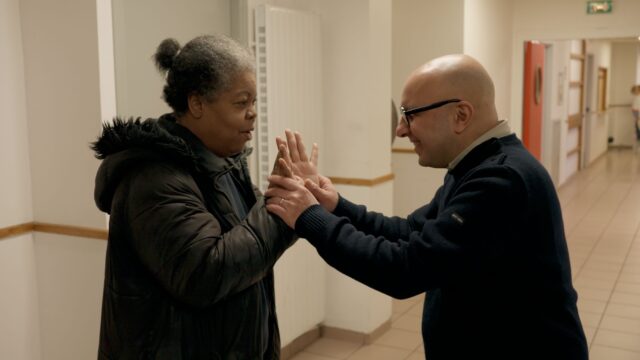
The film is set in a psychiatric ward in the suburbs of Paris. Money is running out, staff are leaving, the place is falling apart. It looks as if the unit will be closed. The director, who has been running workshops with the patients here for a decade, comes up with an unusual idea. Why not let the patients take over, or at least play at doing so?
Tamadon originally studied as an architect but eventually turned to film instead. “Maybe it’s because with architecture, we cannot question the world; we cannot question society. We can do it – but you have to be a very big architect like Le Corbusier. If you want to question, for example, the situation in the hospitals, it’s easier by cinema,” he explains his change of career.
The director has his own distinctive approach. He is not only showing reality. In subtle ways, he seeks to change it. “My question is how, with documentary, we can propose another reality than the reality we see.”
Viewers will notice immediately the trust that the patients have for the filmmaker. He has been holding workshops with them for 10 years. “They know me very well. They have my number. They call me. Of course, when I decided to do the movie in 2024, for them it was normal. I’ve known their situation for a long time.”
The patients aren’t exactly his friends but he is very close to them and realises that treating them with kindness is often far more effective than plying them with medicine. “For me, what is important is to try to have a link with them.”
When he first started visiting the unit, it had 15 nurses. By the time he started making the film, there were only five left. Many had quit, simply because pay rates hadn’t gone up while the cost of living had soared. “So the situation was catastrophic…the nurses left the unit. That’s why I told them [the patients] as a joke to manage the unit. That was the beginning of the project.”
He then saw the potential to make a film.
Circumstances may seem grim but this is a documentary with a lot of gentle humour. “I think the humour is a way to make people feel cared for. Trauma is a problem of society – and we have to take care of that problem.”
Tamadon hopes his film can encourage people to look far more kindly at those with mental illnesses. “The people we see in the movie, of course we see them in the streets. They are speaking to themselves. Each time, we see someone speaking to themself, maybe they have schizophrenia or I don’t know what else. But even in these situations, relations are possible – and we have to try [to make them].”
The patients in the unit may be disturbed but the documentary reveals that they also have abilities that often simply haven’t been acknowledged.
“Medicines flatten the emotions and creativity – but creativity means you have a lot of emotion,” he points out a paradox. In the film, he is allowing his subjects to express sides of their characters that the doctors often try to suppress. Nonetheless, medical professionals at the unit welcomed the film. They realised that Tamadon was not there to criticise them, but was instead drawing attention to the predicament of the psychiatric patients. “The situation even for the doctors is not easy either,” he adds.
Tamadon shot around 100 hours of material over roughly a one-year period. He admits that his approach to storytelling is strongly influenced, led by the work of Iranian filmmakers like Abbas Kiarostami who blended fictional and documentary elements.
“Kiarostami questions reality in his movies. I try to do that too – and see if it is possible to have another reality. Kiarostami doesn’t only show the story, he questions the art of cinema. For example, he questions what the camera is. I like that. My question is the same. I make films because I saw his films.”
The 54-year-old filmmaker has been living in France for 42 years. In many of his movies, he strives to communicate with people who may hold opinions very different to his own. For example, in his 2010 feature, Bassidji, he spends time with the most extreme supporters of the Islamic Revolution.
“I try to have consideration for everybody, even if they are my political enemies,” he states. “My question is always how relations can be possible, even if we are very different. Here [in Crack in the Head, Crack in the Sky], it is with the patients.”
Whether his subjects are hard-line supporters of the Iranian regime or inmates in a psychiatric wing, Tamadon looks for common ground – the best chances of communicating. It doesn’t always work but he keeps on trying. “It is the only way I know.”
In Tamadon’s films, there are different layers of reality. Crack in the Head, Crack in the Sky shows the psychiatric patients participating in a fiction that they are in charge. The director points out, though, that many are already living in a fiction due to their mental condition. He tried to give them roles that they were capable of performing.
Funding for the project was initially hard to find but was eventually secured through the CNC (FAIA development and enhanced development aid), and also had backing from Ciclic – Région Centre Val-de-Loire, Fonds Images de la Diversité, and Procirep-Angoa. The project, produced through TS Productions with Alter Ego Production as co-producers, won the Eurimages Co-production Development Award at Visions du Réel in 2024.
Some critics have compared Tamadon’s work to that of Nicolas Philibert who won the Golden Bear in Berlin for his 2023 feature, The Adamant, about a floating daycare centre on the Seine for patients with mental disorders. Tamadon knows and likes Philibert, and calls him a master, but cautions that their approaches are very different.
“He observes. I don’t only observe reality, I try to change it. My question isn’t just how society is, but how I want society to become.”.
Another new Tamadon project, One Step Closer, was also presented in the IDFA Forum this week. Producer by Petit a Petit Production, this documentary, which is in the pre-production phase, looks at a rural community bitterly divided by the tragic death of a young rugby player. Tamadon proposes a new village dance here – a celebration that may just manage to reunite the community, simply by giving everyone the chance to dance together.