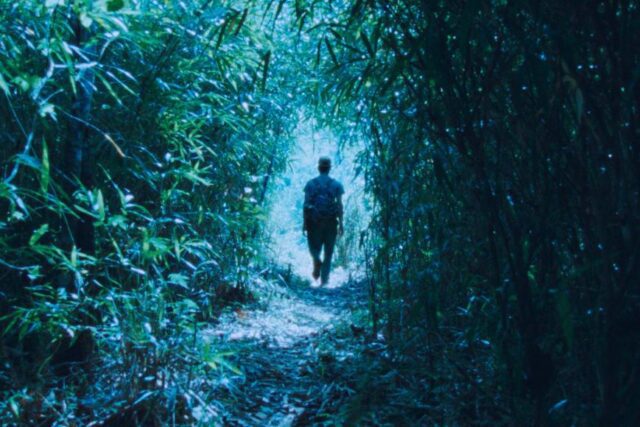
The dust of the film’s title is what is discarded when men within the Vietnamese Sedang community retreat to the jungle for their annual process of spiritual cleansing. Director Franziska von Stenglin tells Business Doc Europe about this odyssey, as undertaken by main character Liêm and his three companions, that she recorded on 16mm.
When describing Franziska von Stenglin’s documentary, which screened in DOK Leipzig German Competition, it is tempting, if maybe a little crass/obvious, to reference the likes of Conrad’s ‘Heart of Darkness’ or even John Boorman’s Deliverance, given her protagonists’ (all male) decision to journey into the deepest corners of the Vietnamese jungle.
But the story is nevertheless fascinating (and very entertaining) as Liêm, a man of Sedang ethnicity, leaves his family behind (he promises his son that next year they will go together) and determines, together with three friends, to live off their wits and whatever nature provides. In the past, when he undertook the voyage with his father, sustenance would come in the form of wild game, whether monkeys, wild cats or deer. These days, deforestation has driven away such beasts, and so Liêm is forced to catches rats and frogs, which the troupe (and the film crew) consume.
The village he leaves behind is equally fascinating, one in which the spirit of Ho Chi Minh is continually invoked and where loudspeakers report on world news, instruct on the pros and cons of internet use or call on the villagers to engage in their morning exercises. The successful outcome of the Vietnamese War is a source of pride (although Liêm and his companions are barely old enough to remember it) and many of the men wear military uniforms and sing battle hymns. The village dwellings are simple and during a festival we see the slaughter of a pig, a scene that is certainly not for the squeamish.
But most of the time it is Liêm whom we follow, a man of extreme diligence, industry and sobriety who takes the business of family and community seriously, and who we see at the beginning of the film cooking and cleaning with a baby child strapped to his back. And he is equally serious about the odyssey that he is about to undertake, an ancient tradition that goes back countless generations.
Director Franziska von Stenglin heard of the Sedang people and the ritual back in 2013 when on a study trip to Vietnam as part of her art studies in Frankfurt. “It stuck in my head because the notion of retreat or trying to escape from your daily life is something that is a totally universal desire or need that humans have,” she explains.
She adds how the country’s relatively recent history of conflict was of particular resonance. “It’s totally part of their identity and it’s more or less everywhere because you see, when you go into the houses, old photos of war heroes and there are photographs of Ho Chi Minh everywhere.” This was even more evident when Von Stenglin had all of her recordings translated in post-production when the loudspeaker pronouncements and songs became clearer. “The more I dug into it, the more I understood what a big part of their identity [the war] actually is,” she adds.
Another thing she discovered on hearing the recordings in post-production was the extent to which the men in the jungle were talking about her and her unmarried status. “It was fantastic. They were curious about what the hell we’re doing with our lives. And I’m curious about what they’re doing – and it was really nice,” she says.
The establishing scenes, which present a fascinating ethnographic study of life in the village, comprise the first third of the film, but it’s the journey into the jungle that is its heart, and is accompanied throughout by a mesmeric and escalating soundscape. One night-time sequence is particularly alluring as Liêm, with a torch strapped to his head, catches frogs in the river.
“It felt very meditative, because he was so calm doing it,” says Von Stenglin of the nocturnal expedition. “We didn’t know he was going to do it. He just said, ‘I’ll do this, film me.’ And then we did.” She likens the meditative experience with that of the film’s audience in the auditorium. “Going to the cinema is also of some form of retreat because you kind of get catapulted into another reality and sit in this sort of soundproof room and are taken out of your daily life for two hours.”
(For the record, while the frogs were delicious, the rat meat that Liêm cooked was “really disgusting.”)
Shooting on 16mm must have been, I suggest, an editor’s dream as the 80-minute film was cut from only 3 hours 50 minutes of material. Von Stenglin points out that such a limitation (if indeed that is what it is) served to clarify her decision-making processes before shooting, and that the end result remained very similar to the work described in her initial funding proposals.
“It doesn’t mean that one way is better than the other,” she says of having a lot less footage to edit than if she had shot digitally. “It’s just I prefer that way of working. We had a lot of time to edit because we didn’t have any money for a while, and so it really helped to sort of understand what this film could be…I mean, even with just 3 hours, 50 minutes, you still have a lot of opportunities.”