It may read like the plot of Local Hero, the classic 1980s British/Scottish movie in which a US oil magnate, played by a benevolent Burt Lancaster, changes his mind about developing a swathe of the beautiful Scottish coastline after flying in to see it first-hand. But back in the 1960s and 70s, the folk of Whiddy Island and Bantry, in the extreme south-west of Ireland, had an altogether different experience when the oil barons came, one that was to end in tragedy.
When, in the 1966, Gulf Oil announced it would build a new terminal on Whiddy, the locals were delighted, seeing the possibility of wealth and a greatly improved standard of living. The Irish government was delighted too. The enterprise wouldn’t cost them a penny, and was set to deliver an economic boom and massively increased employment. It was a win-win scenario.
As Adrian McCarthy, director of the feature documentary Whiddy, which world-premieres November 12 at DOC NYC, comments, “an American oil company was coming into this pretty poor part of Ireland, which most of the young people were emigrating from, and they were potentially the goose that was going to lay the golden egg.”
The promised boom may have happened as predicted, but Gulf Oil continuously called the shots, and when cost savings had to be made, the company ran roughshod over regulations concerning the maintenance of the terminal and shipping activity on the water, even persuading the Irish government not to establish a harbour authority. First there were numerous, polluting oil spills, and then came one of the most notorious disasters in European maritime history.
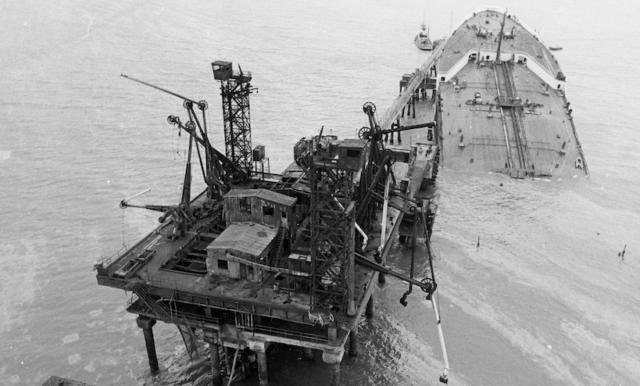
On January 8 1979, at around 1am, the French oil tanker, the M.V. Betelgeuse, owned by another oil company Total, exploded as it was off-loading oil at the terminal, killing 50 people, 41 of whom were French mariners and their families. The vessel also broke in two, discharging hundreds of thousands of gallons of oil into Bantry Bay.
During a public tribunal later that year, Total was blamed for failing to properly maintain and ballast the vessel, leading to a weakened and structurally compromised hull, while Gulf Oil was accused of providing inadequate safety equipment and a total lack of proper jetty escape craft. Gulf Oil employee John Connolly was, seemingly, set up as a token fall guy for not having raising the alarm, while the tribunal also found evidence of false entries in the log from that evening. In 1986, Gulf Oil officially surrendered its lease on the Whiddy Island terminal to the Irish government.
Director McCarthy’s father was a part-time fireman who was called to the island that night. “I was 11 years of age at the time, and we never spoke about it,” the director tells BDE. “I guess you look back and you wonder, how come we never spoke about it? But as an 11-year-old kid, I guess I was too preoccupied with [football] or New Order or whatever.”
But in 2019 he heard a programme on the radio, around the time of the 40th anniversary of the tragedy. “I phoned up my father from Dublin, where I live now, and I said, I heard there was a big anniversary gathering of the Whitty disaster in Bantry. And I asked him if he was there…And he went quiet on the phone, and my dad is never quiet on the phone. And I realised there’s really something here. He still doesn’t want to talk about this.”
Within weeks, McCarthy had driven down to Skibbereen (in County Cork) with a recorder. “I went around and sat in cars and vans with different firemen, asking them their memories of that night,” he says. “And from there, I started on a journey that’s taken seven years. And…it became a much bigger story, pretty much a story about what happens when these two worlds [big business and community] come together.”
“We’re telling a story that has never been told,” he adds.
McCarthy refers to his heavily archive-based film as a “massive edit job” and accords co-director status to his “extraordinary” editor Brenda Morrissey. “We came across this extraordinary local archive material midway through the edit that belonged to a guy down in Bantry [Denis Connolly], who was a kind of an amateur filmmaker who filmed this extraordinary footage,” adds McCarthy of a contributor who sadly died before the film’s completion.
Another great find happened by chance, after he went to the local library in Bantry, where he inquired if they had anything on the subject of Gulf Oil? “Somebody shouted, ‘Mary, where’s the Gulf Oil box?’ And a box is pulled out from the back of the library. And you kind of dust it down and you open it. And there, inside that box, were these extraordinary documents, a huge thesis and two or three books that were published by this Australian anthropologist [Chris Eipper] who had spent years of his life writing about the relationship between Gulf Oil and the Bantry community.”
“He had a huge impact on how we would tell the story,” says McCarthy of Eipper, as indeed did composer Paul Hartnell of Orbital, whose music for the film McCarthy describes as “magic.”
In the film we also meet the close relatives of those who died back in 1979, both French and Irish, prominent among whom is Michael Kingston, now a maritime lawyer, who has dedicated much of his life to investigating the tragedy and determining culpability for the 50 deaths.
McCarthy concurs with the comparison to Local Hero, and understands the allure of Gulf Oil and all its riches to the local population back in the 1960s. “When you start to see the PR machine from the oil company in action…you could start to see what’s going on, and how extraordinary they were in what they did, and how everybody bought into it. You know, everybody felt like they were, in a way, the chosen people, the chosen location.” As we discover in the film, Bantry became “the centre for capitalist activity.” A new housing estate was built for the terminal workers, and foreign ships took up “half the bay,” which they illuminated gloriously each night with their onboard lights. “You’re walking that line as a documentary maker, as somebody who steps in as an outsider,” the director tells BDE of the attitude back then. “I could see why the locals would take that position.”
McCarthy returns to the story of Denis Connolly, the local amateur filmmaker we meet in the film, to show the extent to which he and his community were determined to support the film.
“I heard that Denis was in a car crash and that he was in Dublin in the national rehab hospital, so I went up to visit him, and I couldn’t believe that he was paralysed from the neck down,” the director recalls a period early in the film’s development. “The first question he asked me was, ‘Adrian, I suppose you won’t want me in your documentary now, will you?”
A few weeks later Dennis died from a stroke, but when McCarthy later visited Denis’s family, he discovered that all of the archive footage had been bequeathed to him for use in the film. He was free to use whatever he wanted.
“I remember getting the box of that archive that had dozens of reels of Super 8 film. I knew there was some stuff in there to do with the disaster, but it was only when I brought it home and got hold of a Super 8 viewer, went up to my daughter’s bedroom and started reading through it over two nights, that I nearly fell off the chair, you know. I couldn’t believe what I was seeing.”
It was the same story with other local photographers. “I was given boxes and boxes of negs. And I just kept going through them and going through them and finding these golden bits of the story, visual little props and bits and bobs. The material kept giving right up until the very end,” McCarthy signs off.