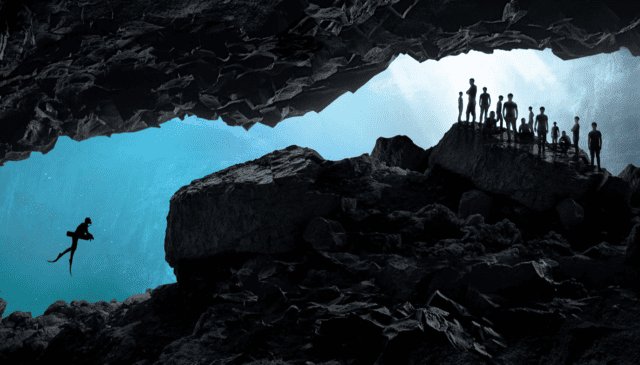
The football World Cup may have been held in Russia in the summer of 2018, but global hearts and minds were trained on events over in Thailand as a seemingly impossible campaign was launched to rescue 12 boys and their football coach from a flooded cave in Northern Thailand.
The Royal Thai Navy SEALs and U.S. Special Forces were crucial to the rescue operation, as were the thousands of volunteers who leant their support and muscle, but the oddest element within the set-up was a group of unlikely international caving enthusiasts, mainly British, who understood better than most the perils and pitfalls of the potential rescue.
In the film The Rescue by E. Chai Vasarhelyi and Jimmy Chin (Free Solo, 2018), which opened in the UK on October 29, we hear how these oddball heroes were never cut out to be team players. Some had been bullied and none ever fit in socially. Which was why a pursuit such as caving was so appealing. As John Volanthen, one of the rescuers, explains, caving was two parts ego, one part curiosity and one part desire to prove himself. “What’s more, a cave offers peace, a comfort zone,” he adds.
Director Vasarhelyi further points out how, for Rick Stanton, years of caving had prepared him for the moment when he could help save the 13 people. “What I also loved about these characters was their absolute morality, their moral courage, they have to risk everything…They were their best selves. They accepted that they would suffer in some way, and they accepted that maybe they would only save one person or no one at all, but that was still better than walking away and leaving 13 to die.”
The rescue undertaking was enormous as the kids had been stranded within a cave network that stretched ten kilometres. What’s more, two river torrents met within the subterranean system, and to round matters off monsoon rains were threatening to cut off any potential contact with the football team whom nobody knew were alive or dead, at least initially.
There was of course jubilation after first contact was made, but how could the boys subsequently be transported for hours through the raging waters? An Australian doctor (Richard Harris) suggested an answer but immediately retracted it as he deemed it not only foolhardy but far too treacherous. But as flood waters rose and oxygen levels within the cave got to life-threateningly low levels, it was the only solution left to rescuers. The boys would have to be anaesthetised and transported, unconscious, underwater in masks, each guided by one of the unlikely caving heroes…
The Rescue is a combination of first-person testimony told to camera, re-enactments and never-before-seen archive footage from inside the cave that was shot by the Thai Navy SEALs. That said, as much for operational reasons as anything else, the SEALs didn’t want to grant access to the footage. So how did Vasarhelyi persuade the Navy top brass?
“I think the fact that I showed up in Thailand really, you know, in the middle of the pandemic was quite significant for them,” responds co-director E. Chai Vasarhelyi. “Also Thanet Natisri, who’s an executive producer on the film was also in charge of water diversion [during the rescue]… he has a certain moral authority because he also was a volunteer and it made a huge difference what he did.”
But there was also a spirit of willingness on the SEALs’ part, Vasarhelyi observes, “like they were hoping to collaborate, they took a leap of faith with us… it was like an act of kindness and generosity ultimately.”
Vasarhelyi lists some of the crucial footage supplied by the SEALs, which included the discovery of the children in the underground cavern, their first meal and the moment they are anaesthetized, and the cavers John Volanthen and Rick Stanton emerging into Chamber 3 to let the SEALs know that they had found them. “And then, most moving for me, at least when you look at those shots of 200 people hand-passing a stretcher, you finally understand why you needed so many people to support this rescue,” she adds.
Yes, there were obstacles to overcome during the production, such as structural problems vis a vis the narrative timeline (the boys weren’t discovered until day ten), and there were many potential (and core) characters that had to be sidelined, despite their importance. Likewise, there were many amazing stories that could not be told, whose telling would have been too diversionary to the main narrative. Vasarhelyi therefore commends editor Bob Eisenhardt for his considerable cutting skills and expertise in both shaping and ordering the narrative.
“Thailand is just opening up now, so we’ve got plans to bring the film [there] at the end of the year…I’m really proud of the film we made within those constraints, but you can imagine it was pretty formidable, the challenges,” she says, adding her “favourite…crazy” constraint concerned the revered holy monk Kruba Boonchum who played a special role in leading prayers during the rescue.
“I wanted to interview him desperately,” she says. “But it turned out that Kruba Boonchum, when the children were successfully rescued, took an oath of silence for three years, and went into a cave in Myanmar.”
But The Rescue remains a documentary with humanity at its heart, whether in terms of the extraordinary sacrifices that are made in order to save the lives of the children, or the personal change that the rescue effected in all the characters. “I think it’s one of the primary reasons why we wanted to make the film,” stresses Vasarhelyi. “The characters are amazing and, yeah, I think that anyone who participated in the rescue emerged transformed.”
The Rescue is produced by Ventureland’s John Battsek (“One Day in September,” “Searching For Sugar Man”) and P.J. van Sandwijk (“American Dharma”) of Storyteller Productions. For National Geographic Documentary Films, Carolyn Bernstein is executive producer. Vasarhelyi and Chin also produced the film, alongside Free Solo editor Bob Eisenhardt. The Rescue is released by Dogwoof.