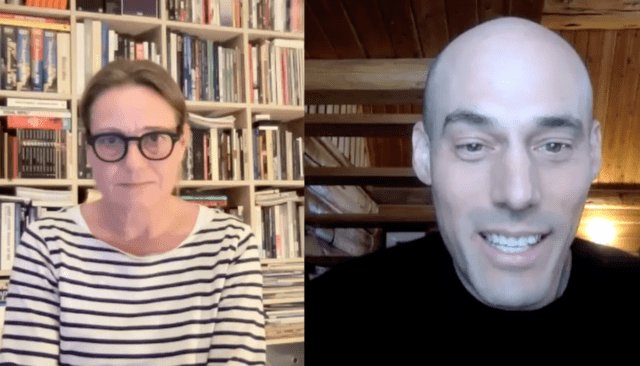
“It is horrifying; it is beautiful; it is an exercise in hope, making the film,” Bafta-winning and Oscar-nominated Joshua Oppenheimer (The Act of Killing) tells Camilla Nielsson of her Academy Award-shortlisted feature doc President. The film details the 2018 Zimbabwean presidential election as 40-year-old opposition candidate Nelson Chamisa runs against the incumbent Emmerson Mnangagwa.
Click here to see the whole conversation between Oppenheimer and Nielsson. Excerpts follow…
“President is a riveting political thriller. It is an absolute masterpiece of the form of observational documentary filmmaking,” Joshua opened up the conversation. “I venture to say it is an instant classic of the form. It reminds me of Patricio Guzman’s Battle for Chile. What I think blew me away watching it this time and also the first time, in a really hauntingly, unique way, is this – it’s spellbinding to watch the Zanu-PF officialdom from the President down to the judges and the head of ZEC (Zimbabwe Electoral Commission), just holding their corruption. How to they live with themselves?”
“The film ends with Chamisa saying “Hope! Hope! Hope!” and then you cut to the inauguration of Mnangagwa and you see his people and you think “What’s on their mind?” What cost is this? How will this cost them? To live their lives knowing that they have cheated it, and for what? For what greed? For what gluttony of power? It’s just astonishing to seize vulnerable, hopeful, totally outgunned idealists trying to create change against this kind of wall of impunity and arrogance. It is astonishing. So, thank you so much for the film. It is horrifying; it is beautiful; it is an exercise in hope, making the film.”
Nielsson responded by telling the back story to the film’s inception and production: “President is the follow-up film or sequel to my first film Democrats from 2014. The story is that Democrats was banned by former president Robert Mugabe and Zimbabwe’s censorship board for being not suitable to show to the Zimbabwean public – and that was of course a devastating blow to us as filmmakers that the film about the democratic process of creating a new constitution for the country could not be screened in the country where it mattered most.
“So, some of the lawyers who I had followed in the making of Democrats suggested that we challenge the ban in the Zimbabwean courts, because the new constitution, which the film is about, ensured freedom of speech and freedom of expression and so [the ban] was sort of an idiosyncratic and absurd act to everybody. And given that I’m not a Zimbabwean, that I’m a foreigner, it was also a sort of a risk-free exercise for me as a filmmaker to challenge the ban in the Zimbabwean court.
“So, in collaboration with a group of Zimbabwean lawyers we embarked on a two and half year challenge to the ban, and that ban was lifted in the beginning of 2018 just after Mugabe had been ousted from power in a military coup. We were called to the bench in Harare to bear witness to the case – and we won. I should say that I think that the regime at that time was trying to create the wind of a new-found democracy and show that it was a different form of government that had replaced Mugabe.
“So, they unbanned the film and it was actually at a dinner celebrating the unbanning of Democrats that some of the protagonists from the first film suggested that I come back and do the sequel and do a follow-up story about the upcoming Presidential election. It was necessary for President Mnangagwa, who had come to power during the military coup, to sanitize the military coup through a free and fair election and we thought it would be good idea to document that process…”
Click here to see the rest of the conversation between Oppenheimer and Nielsson.