Éric Baudelaire opens his new film Car La Lune (For the Moon) with a quote from Irish Nobel prize-winning author Samuel Beckett’s novel ‘Molloy’: “For the moon was moving from left to right, or the room was moving from right to left.”
“I have a lot of affinities for Beckett because I feel that he has defined what an artist does in a way nobody else has. He said that the role of the artist is to find a form that accommodates the mess. I feel that nobody has described more accurately what we try to do,” the US-born, Paris-based artist and filmmaker suggests.
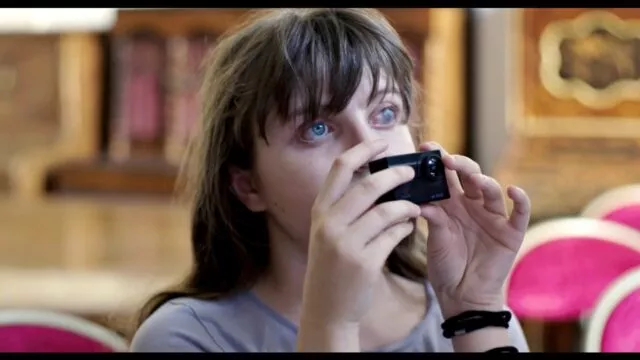
Car La Lune (a European premiere in Ji.hlava) follows five young women at the National Institute for Blind Youth in Paris. By citing Beckett at the start, Baudelaire wanted “to announce a film that is about perception. I did not want to announce a film that is about disability or handicap. What I like about the Beckett quote is that it is all about perspectives. That struck me as the right note with which to begin the journey.”
References to the moon are scattered throughout them film. We hear one of the students playing the Moonlight Sonata on the piano and another talking about light and how it resides within her.
Part of the photography on the documentary is provided by Claire Mathon, the brilliant cinematographer whose credits include Portrait of a Lady on Fire and Spencer, and who has worked with Baudelaire on several other projects. However, a large part of the film is shot by the blind students themselves.
“It’s about half and half. Half of the images are theirs and half are Claire’s. I very much enjoy Claire’s approach to observational documentary. I think she is an extremely gifted DOP in general but I think one of her greatest strengths is the tracking shots she improvises with the camera on her shoulder. I am lucky that she enjoys doing these kind of smaller films and still is willing to do with them for me despite her busy schedule.”
To film non-sighted people, Baudelaire realised he needed a DOP in whom he had complete trust. “I mean that in the ethical sense, in the political sense and in the aesthetic sense, and I have that trust in Claire. It is very difficult to film the blind when you are sighted.”
The footage shot by the five students was largely done by each them on their own, without the director around.
“Any film, particularly a documentary film, has to be built on trust,” the director reflects on his decision to hand over cameras to his subjects. “I encountered them after inviting them to watch a previous film of mine, A Dramatic Film (2019), which I had also made collaboratively with students from the Northern suburbs of Paris – the ones that are burning right now,” Baudelaire refers to the student protests currently roiling France.
He screened the film for the students, giving his own improvised audio description, and then asked if any of them were interested in making a documentary with him. Six students, all girls, volunteered. (One would later drop out),
“Quite rapidly, I began to trust them that we could make the film together – and I think they began to trust me. But it is hard to say what this trust is based on…”
At one stage, Baudelaire asked one of the students, Mèï Jendoubi, why she was willing to work so closely with him. She told him that she was “usually very distrustful” of adults in general, and that life had taught her to be wary in their presence. She also told him, though, that “when you don’t see very well, you learn to trust people and just feel it.” When he asked what exactly the trust was based on, she responded, “all kinds of things, including smell.” That both amused him and made him realise that her feelings of trust were “a sensation, not an intellectual construction. But I think that is true in all human relationships. It is a mutual gift.”
Baudelaire gave the students space to film on their own, without his instruction or interference.
Music features prominently in Car la lune. The director acknowledges that he is “not a musical person” but that his five subjects were “extraordinarily musical. Whenever they walk into a space in this boarding school of theirs., there is always a piano in the corner. It is usually out of tune but their fingers will systematically find the keyboard, they will begin playing and then they will begin singing…it became impossible not to have music present. I think their relationship to the word, is very mediated by their relationship to music.”
It helped that Baudelaire’s editor Claire Atherton is a music enthusiast and was interested in “composing this film with musical parts to it.’
Baudelaire had a simple idea at the outset. He wanted to make an observational documentary that would “show something of what I felt like when I decided to film in the realm of the blind, those difficult questions of where do I put the camera, and how do I film someone who cannot film me and who will not see the images the way I see the images.”
However, he was also determined “very gradually to shift the perspective to the images made by the students themselves. I began by filming the observational material and then I very quickly gave them cameras.”
The images shot by the students were often surprising. “I did not have any assumptions going into the project. I accepted the possibility that the film may fail because it was a very speculative idea, that blind students would create images that are beautiful to watch for a sighted audience,” Baudelaire remembers.
Two of the students were partially sighted. “Even if they only had 3% vision in their eyes, the saying that ‘in the land of the blind, the one-eyed man is king’ is true,” he says of Mèï and Iris Fontanella who “framed perfectly.”
The completely non-sighted students came up with their own solutions. One, Jade Ebara Ossebi, “just placed the camera on the piano and played. “Meanwhile, Kadiatou Diakite tried to frame images of herself and also “made that very touching shot at the end of the film through the window of her house with the snow falling.”
The director marvels at his subjects’ powers of perception. Even without sight, all had a natural fair for cinematography.
Car La Lune had its world premiere at the New York Film Festival earlier this autumn. Baudelaire doesn’t yet have a sales agent, but he sorted out a North American deal for the film himself (with distributor Cinema Guild). In France, the film will be released by JHR. Other deals will be announced in due course.