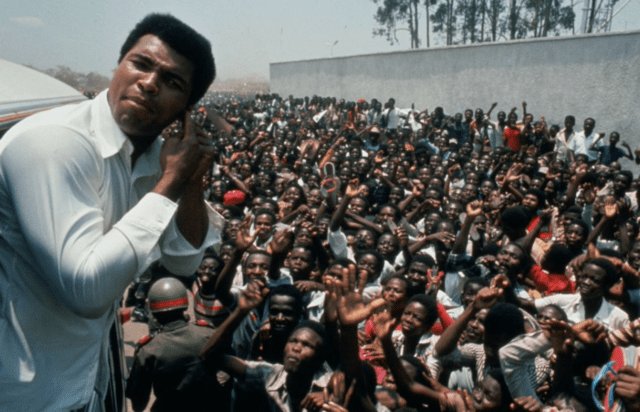
Leon Gast’s When We Were Kings (pic: courtesy of Sheffield DocFest)
Sheffield DocFest has unveiled the films that make up the ‘Documentary Journey with Asif Kapadia’ showcase during this year’s festival, running 23-28 June. The top UK doccer will additionally take part in an ‘In Conversation’ event with long-time collaborator Chris King.
Kapadia will also personally select some highlights from Sheffield DocFest’s programme of new documentaries, and is working with the team on additional talks and initiatives that will be revealed in the lead-up to the Festival.
The Academy Award® and BAFTA-winning filmmaker, whose acclaimed documentary films include Senna (2010), Amy (2015) and Diego Maradona (2019), has selected films that have had significant impact for him, inspiring his own style and creative choices as a filmmaker, writes the festival.
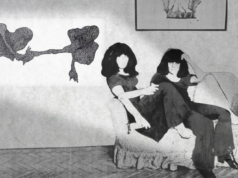
‘A Documentary Journey with Asif Kapadia’ includes works by some of the world’s most renowned filmmakers – Martin Scorsese (Italianamerican) and Claude Lelouch (C’était un rendez-vous), A Great Day in Harlem (Jean Bach) La Jetée and Patrick Keiller’s cinematic classic London.
“This selection is personal to me, as someone who grew up in Hackney in the 1970s and 1980s. I didn’t come from an art or film background. It was quite profound to know that it was possible for someone to make films like these,” reflects Kapadia.
Kapadia further reflects on the experience of seeing Leon Gast’s When We Were Kings, on the big screen, acknowledging how “without this film, there would be no Amy. There would be no Senna. There would be no Diego Maradona.”
Furthermore, the renowned doccer will participate in a conversation with frequent collaborator, editor Chris King. ‘Cutting the ‘Fame’ Trilogy’ will be the first occasion in which Kapadia and King come together to discuss their decision-making about what scenes and sequences they chose to leave out of Amy, Senna and Diego Maradona, writes the festival. During the session, they will open up the archives and revisit unused material in a frank and insightful discussion hosted by Jason Wood, BFI’s Executive Director of Public Programmes and Audiences.
‘A Documentary Journey with Asif Kapadia’ curated collection (with annotated comments by Kapadia)
C’était un rendez-vous (Claude Lelouch; France, 1976): “When I first saw it, I wondered if it was real or whether it was a fake. But it is real. And dangerous. And thrilling. Is it a movie? Is it a doc? A short film? Part of a longer film? I love the fact you cannot neatly place it in a box.” – Asif Kapadia
Dark Days (Marc Singer; US, 2000): “This made me cry. It’s a film that many people don’t know. The filmmaker was so invested in the characters and the subject, the homeless people became the crew and the filmmaker became homeless. The story and the passion that filmmaker invested in it really moved me.”
Fourteen Days in May (Paul Hamann; UK, 1987): “I was in my teens when I saw this and Clive Stafford Smith became a hero to me – the story of a UK lawyer who fights for death row inmates in the US. I eventually collaborated with him on a film about the force feeding of Muslim inmates at Guantanamo.”
A Great Day in Harlem (Jean Bach; US, 1994): “From one photo of all these jazz legends, this filmmaker created a record of their lives through the interviews she conducted with them. This film also taught me about the importance of editors in the process of making a documentary. They’re so essential in the process of creation. You can make a movie out of anything. If you have will.”
Italianamerican (Martin Scorsese; US, 1974): “As a filmmaker, Martin Scorsese is my hero. This has always been a favourite because the relationship he has with his parents is so funny and there’s no embarrassment. I’ve lost my parents and I wish I had a record like this of them. Scorsese also gave me the inspiration to make features and documentaries.”
London (Patrick Keiller; UK, 1994): “I saw this at a time when I went off to the cinema to see all different kinds of films on my own. I watched at the Everyman cinema in Hampstead on a Sunday night and was blown away by it. Shots went on forever, there was a voiceover that sounded more like poetry. It was a film made about a place that I recognised – my city – but revealed it in a completely new way to me.”
When We Were Kings (Leon Gast; US, 1996): “I saw this on a huge screen at the Empire Leicester Square. A documentary on the big screen. Muhammad Ali was one of my father’s heroes and he told me I had to see this. He became one of my heroes. I loved Ali and I knew no drama or actor or screenplay could ever do justice to him or his incredible story. Without this film, there would be no Amy. There would be no Senna. There would be no Diego Maradona.”
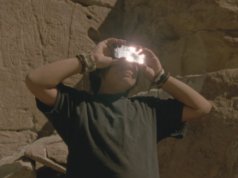
La Jetée (Chris Marker; France, 1962): “I could have included Chris Marker’s SANS SOLEIL. But La Jetée was more of an inspiration for me. It’s not strictly a documentary, but it is documenting a life – albeit a fictional one – through still images. It’s like so many documentaries, like so many films, which exist beyond easy definition and draw on so many different styles.”
Sheffield Doc Fest interim CEO Clare Stewart commented to Business Doc Europe of Kapadia in February 2022: “He is someone who has a deep love and a deep knowledge of cinema in its full breadth, and what has been fascinating about our conversation so far in terms of his curatorial input has just been to hear him talk in such meaningful ways about the films and filmmakers that have influenced his practice.”
“From a curatorial point of view, what excites me about his contribution (without revealing too much at this juncture) is that he is also very interested across all the elements of the festival,” she added. “So we are talking about components that will be in the film program section. We’re talking about components that will be in Talks and Sessions. We’re talking about other ways in which he engages with some of our youth initiatives, around the youth jury and our youth reporter scheme and so forth. And he’s also cooking up something quite exciting in the filmmaking arena as well. So what I think is really interesting about the sensibility that he’s bringing to the table is that as a lover of festivals, as well as films, he understands what it means to create in all aspects of what a festival delivers on.”
The Festival runs 23 – 28 June as a fully in-person event for the first time since Kapadia opened with Diego Maradona in 2019.